Light Is More Than Just "Light" – How Different Wavelengths Affect Plant Growth
When you walk into a plant factory or turn on an indoor LED grow light, have you ever wondered: What kind of light do plants actually need? Why are some lights pinkish-purple while others look like natural sunlight? The way plants perceive light is fundamentally different from human vision.
The human eye is most sensitive to yellow‑green light (around 555nm), so how "bright" a light appears tells you nothing about its usefulness to plants. What plants truly need are photons within the photosynthetically active radiation (PAR) range of 400–700nm. In recent years, rapid advances in LED technology have given growers the ability to "customise" light spectra – precisely tuning each wavelength for different plant species, growth stages, and cultivation goals – thereby dramatically improving photosynthetic efficiency, optimising plant morphology, and enhancing crop quality and nutrition.
This article starts from the fundamentals of plant photobiology, breaks down the real effects of different spectral bands on plants using data, and provides crop‑specific parameters and market statistics, helping you understand scientifically what light plants really need.
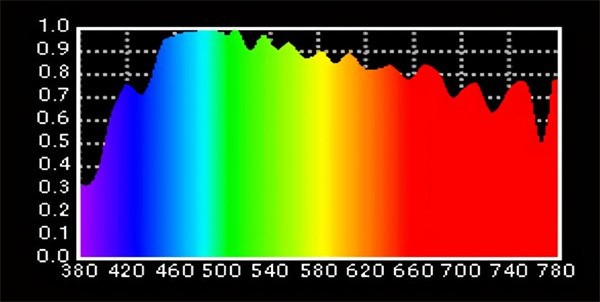
1. Spectral Breakdown: How Different Wavelengths Precisely Regulate Plant Growth
A large body of research shows that plants use light according to a core principle: blue light (400–520nm) and red light (610–720nm) are the two strongest absorption peaks for photosynthesis and contribute most to plant growth. Other wavelengths, though absorbed at lower rates, play irreplaceable roles in photomorphogenesis and quality regulation.
Blue Light (420–520nm) – The Plant "Dwarfing Agent" and "Stomatal Switch"
Blue light is one of the "engines" of photosynthesis. Chlorophyll and carotenoids have their highest absorption in the blue band, significantly promoting leaf growth, protein synthesis, and fruit formation. More importantly, blue light, acting through cryptochrome and phototropin photoreceptors, triggers a series of key physiological responses.
- Inhibits stem elongation: Blue light significantly suppresses excessive stem elongation, promoting a "short and thick" plant habit. This is a key control measure in high‑density planting to prevent lodging.
- Promotes stomatal opening: Blue light induces stomatal opening, enhancing CO₂ uptake and thus increasing the raw material supply for photosynthesis.
- Regulates anthocyanin accumulation: Blue light can promote the synthesis of secondary metabolites such as anthocyanins, resulting in more vivid flower colours and fuller fruit colouration.
💡 Commercial tip: In high‑density leafy green production, appropriately increasing the blue light proportion can effectively shorten internode length, making plants more compact and thus increasing planting density per unit area.
Red Light (610–720nm) – The "Main Engine" of Photosynthesis and Flowering Regulator
Red light drives photosynthesis with the highest efficiency, significantly promoting chlorophyll formation, carbohydrate synthesis, stem growth, and seed germination. In controlled‑environment agriculture, red light typically accounts for the majority of the spectrum (50%–70% of total light) to ensure basic biomass accumulation.
More importantly, the ratio of red to far‑red light, sensed through the phytochrome signal transduction system, controls some of the most critical developmental decisions:
- Precise control of flowering time: Phytochrome monitors the red/far‑red ratio and participates in the plant's measurement of "night length", thereby precisely regulating flowering time.
- Shade avoidance response: When a plant perceives a reduced red light proportion (indicating shading), it triggers the shade avoidance syndrome – rapid stem elongation and thinner leaves – a competitive survival strategy. This also explains why crops in dense planting often show "legginess".
- Seed germination and seedling de‑etiolation: Red light promotes the conversion of phytochrome to the active Pfr form, triggering seedling de‑etiolation and cotyledon expansion; far‑red light reverses this, maintaining the phytochrome switch balance.
Green Light (500–600nm) – The Underestimated "Canopy Penetrator"
Green light has long been overlooked by both academia and industry, even considered "useless" for plants because single leaves reflect green light relatively highly and absorb it poorly. However, recent research has completely overturned this view:
- Surprisingly high whole‑plant absorption: Single leaves actually absorb over 70% of green light, and at the canopy scale the overall absorption can exceed 90%.
- Key contribution to deep‑layer photosynthesis: Because green light penetrates more deeply, it can reach lower leaf layers and the canopy interior where red and blue light cannot go, driving photosynthesis there and thus improving the whole‑plant energy efficiency.
- Significantly increases biomass: A recent experiment using lettuce as a model crop confirmed that when part of the red and blue light was replaced with 550nm long‑wavelength green light, shoot fresh weight and dry weight increased by 29% and leaf area expanded by 18%. The mechanism was confirmed to be improved canopy light distribution, not enhanced single‑leaf photosynthetic efficiency.
💡 Application suggestion: In multi‑layer vertical farms, reasonably incorporating green light can effectively improve light availability on lower shelves, alleviating the "top‑heavy" illumination problem typical of pure red‑blue supplemental lighting.
Ultraviolet (UV‑A/UV‑B, 280–400nm) – The "Hidden Force" for Quality Improvement
Ultraviolet radiation, outside the visible range, has surprisingly strong regulatory effects on plant quality:
- Surge in secondary metabolites: Short post‑harvest treatments with UV‑B (0.5–1 hour) and UV‑A (1.5–2 hours) significantly increase the content of bioactive compounds such as phenolic acids, flavonoid glycosides, and sesquiterpene lactones in leafy vegetables like lettuce and chicory.
- Antioxidant capacity and pigment enhancement: After UV‑B and UV‑A treatment, levels of lutein and β‑carotene in plants increase significantly; anthocyanins and phenolic compounds in fruit skins also accumulate markedly, effectively improving fruit colouration and antioxidant performance.
- Signal pathway regulation: Plants perceive UV‑B through the UVR8‑COP1‑HY5 signalling pathway, which activates both the antioxidant defence system and the synthesis of secondary metabolites such as flavonoids.
Far‑Red Light (700–800nm) – The "Calibrator" of Flowering Time
Far‑red light itself has little direct contribution to photosynthesis, but through the reversible phytochrome switching mechanism, it plays a unique role in regulating plant development:
- Precise regulation of flowering time: By adjusting the red/far‑red ratio, the phytochrome molecular switch can control flowering time in both long‑day and short‑day plants.
- Trigger for shade avoidance: A low red/far‑red ratio is the most direct signal triggering the shade avoidance response, leading to rapid stem elongation.
- Transmission of photoperiodic signals: The red/far‑red signal perceived in leaves is transmitted over long distances to the shoot apical meristem, regulating seasonal flowering decisions.
Table 1: Comprehensive Effects of Different Spectral Bands on Plant Growth
| Wavelength Range | Spectral Band | Photosynthetic Contribution | Main Physiological Functions | Typical Applications |
|---|---|---|---|---|
| 280–400nm | UV | Low | Promotes secondary metabolite accumulation, enhances antioxidant capacity, inhibits certain growth hormones | Improves flavour, nutrition, colour |
| 400–500nm | Blue | High | Chlorophyll absorption peak; inhibits stem elongation; promotes stomatal opening, photomorphogenesis, gene expression | Prevents legginess; seedling propagation |
| 500–600nm | Green | Medium (deep penetration) | Penetrates canopy, contributes to lower‑leaf photosynthesis; regulates stomatal behaviour and water use efficiency | High‑density multi‑layer planting |
| 600–700nm | Red | Highest | Chlorophyll absorption peak; drives photosynthesis efficiently; promotes flowering, fruit development, carbohydrate accumulation | General supplemental lighting; fruiting stage yield enhancement |
| 700–800nm | Far‑red | Very low | Phytochrome switch; regulates shade avoidance, flowering time, seedling de‑etiolation | Flowering regulation; special photoperiod treatments |
Photosynthetic contribution ratings based on McCree curve quantum yield data and mainstream industry consensus.
2. The Unavoidable "Second Dimension": Light Intensity and Photoperiod
Spectrum is only one aspect of the problem. If light intensity is insufficient, even the most perfect spectrum is useless. The light intensity required for plant growth must lie between the light compensation point and the light saturation point.
- Light compensation point: The value at which photosynthetic products exactly equal respiration consumption. Below this, plants cannot grow, may even consume themselves, and will wither.
- Light saturation point: The light intensity at which the photosynthetic rate reaches its maximum. Beyond this, further increases in light intensity not only fail to increase yield but may cause photoinhibition, damaging the photosynthetic system.
Take tomatoes as an example: the light compensation point is 53 μmol/m²/s and the light saturation point is 1985 μmol/m²/s. For roses, the compensation point is higher (62 μmol/m²/s), but the saturation point is only 596 μmol/m²/s.
Photoperiod is equally important. A 2026 study showed significant synergistic effects between different photoperiods (4h/8h/16h) and spectral combinations on germination rate and biomass accumulation. In that study, plants treated under a 16‑hour photoperiod with a "blue‑red‑far‑red" combination were not only more compact but also had a higher dry‑to‑fresh weight ratio. The biomass reached 2.189 g in kale and 12.56 g in arugula.
3. Breaking Traditional Misconceptions About Plant Lighting
Myth 1: "Light outside the red‑blue range is useless."
Recent high‑level research has proven this to be the biggest misunderstanding. A 2025 review published in Plant Physiology and Biochemistry clearly states that green light continuously supports photosynthesis in deep leaf layers and the canopy interior and participates in multiple photomorphogenetic processes. A 2025 study on UV light confirmed that UV treatment significantly increases lutein and β‑carotene content.
Myth 2: "Efficacy depends only on the ratio of core bands."
In fact, the photosynthetic contribution of green light at the canopy scale has been re‑evaluated. Green light absorption by leaves is much higher than traditionally believed – exceeding 90% at the canopy scale – and long‑wavelength green light (e.g., 550nm) has a significant advantage in promoting lettuce growth, increasing biomass by up to 29%.
Myth 3: "Once the spectrum is set, it is best not to change it."
The ideal lighting strategy should be dynamic. A spectrum with a relatively higher blue light proportion is more suitable for seedling propagation (inhibiting legginess, promoting root development), while a spectrum with high red light proportion plus a small amount of far‑red light is more suitable for flowering and fruiting (promoting flowering and photosynthesis). The "two‑stage supplemental lighting strategy" is designed based on this principle – separate treatment for germination stimulation and growth‑stage yield enhancement – to achieve the highest light use efficiency and final yield.
4. From Lab to Greenhouse: A Decision Framework for Light Recipe Design
Based on the above scientific principles, the following spectral configuration recommendations are provided for different cultivation goals:
Table 2: Recommended Spectral Strategies for Different Cultivation Goals
| Cultivation Goal | Recommended Spectral Strategy | Core Justification |
|---|---|---|
| Seedling / tissue culture | Higher blue light proportion | Inhibits legginess, promotes root development, produces robust compact plants |
| High yield of leafy greens | Red‑blue base + 550nm long‑wavelength green | Studies confirm 550nm green light increases lettuce yield by 29% |
| Improved quality of fruiting vegetables / flowers | Red‑blue base + moderate UV supplement | UV promotes accumulation of anthocyanins, phenolics, and carotenoids; enhances colouration |
| Induce flowering in long‑day plants | Red‑dominant spectrum; adjust red/far‑red ratio | Phytochrome switch precisely controls flowering initiation |
| Multi‑layer vertical farms | Balanced mix of red, blue, green, and far‑red | Green light penetrates deeply; high photosynthetic contribution to lower leaves |
⚠️ Practical reminder: When selecting grow lights, don't just look at "wattage" or "luminous flux (lumens)". PPF, PPFD, and the spectral distribution curve are the core indicators for judging grow light performance.
5. Global Market Trend: The Commercial Value of Precision‑Spectrum Lighting Is Exploding
According to global industry reports, the global LED horticultural lighting market reached approximately US$4.8 billion in 2025 and is projected to grow to over US$15.5 billion by 2030, representing a compound annual growth rate of 26.8%. As a result, smart lighting systems and tunable LEDs are becoming mainstream in high-end plant factories, vertical farms, and research greenhouses.
Full‑spectrum plant lighting provides a more complete simulation of sunlight, effectively solving problems such as poor development and weak secondary metabolism that often occur under "red‑blue only" lighting. In the increasingly competitive controlled‑environment agriculture market, LED grow light solutions capable of precise spectral tuning are steadily establishing their irreplaceable commercial value.
Summary: Light Is Not a Single Choice – It Is a Symphony
In the long and intricate "symphony" of plant growth and development, different wavelengths of light play different instruments – blue is the conductor, guiding direction; red is the cello, pushing the main melody forward; green and UV are the brass and strings that add richness and depth, making the whole piece sound full and moving. Only their coordinated performance can produce a modern agricultural movement of high yield, high quality, and high profit.
Choosing a scientifically designed, tunable, full‑spectrum plant lighting solution is not a "nice to have" – it is an essential path to increasing yield, improving quality, reducing costs, and enhancing efficiency in controlled‑environment agriculture. The light you provide determines every cell division of your plants – have you made the right choice?