How Can Lighting Optimization Improve Livestock Health and Productivity?
 The way animals perceive their environment is fundamentally different from humans. Proper lighting is not just a matter of visibility-it's a critical factor influencing animal welfare, physiological health, and reproductive efficiency. Modern farming practices increasingly recognize that tailoring artificial lighting to the specific needs of livestock can yield significant benefits.
Understanding Animal Vision and Biological Rhythms
Most livestock species have different visual acuity and light spectrum perception compared to humans. Implementing a lighting regimen that respects their natural biorhythms is essential for maintaining healthy circadian cycles. All animals require a distinct daily dark period-typically at least 6 consecutive hours with illuminance below 5 lux-to properly reset their internal clocks and support immune function.
LED Lighting Solutions for Cattle
Daily Light Requirements
For both young stock and adult cattle, adequate lighting is crucial for normal behavior and development. A baseline illuminance of 130-150 lux at animal eye level is sufficient to encourage natural activities and feeding behavior. Research shows that extending daylight periods to approximately 16 hours-using artificial lighting during darker months-can stimulate growth in young cattle and enhance fertility in cows.
Milk Production Enhancement
One of the most significant benefits of optimized lighting comes in dairy operations. Studies consistently demonstrate that providing 16 hours of light at 200+ lux, followed by 8 hours of darkness, can increase milk production in both cows and goats by 8-9% outside summer months. This lighting strategy mimics optimal seasonal conditions, supporting higher metabolic efficiency and milk yield.
Regulatory Compliance
Following standards such as those from IKB Netherlands, modern farms must implement automated lighting controls with timers to ensure consistent daily light cycles of at least 8 consecutive hours, supporting natural day-night rhythms.
Swine Lighting Considerations
The welfare requirements for pig housing continue to evolve. Beginning January 1, 2025, the Beter Leven Keurmerk certification will require that daylight-permeable areas in walls and roofs constitute at least 2% of the total floor area. This recognizes the importance of natural light patterns for swine health and behavior.
Functional Barn Lighting for Operational Efficiency
Task-Specific Illumination Levels
Different barn activities require varying light levels:
Routine tasks: Minimum 80 lux
Detailed procedures and evening work: Up to 250 lux
Automated systems areas (such as milking robots): 200-250 lux
Installation Best Practices
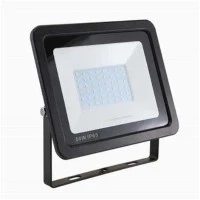
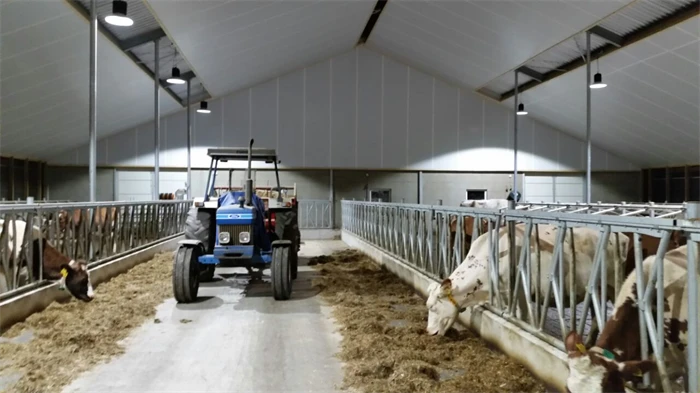
To achieve uniform light distribution throughout the barn, fixtures should be positioned to provide consistent illuminance at animal level. For facilities with ridge heights of 6 meters or more, high-bay LED fixtures with wide beam angles are recommended. In particularly dusty environments, models with specialized NANO coatings maintain performance by resisting dust accumulation on lens surfaces.
The LED Advantage in Agricultural Settings
Energy Efficiency and Heat Management
LED technology offers substantial advantages over traditional lighting such as High-Pressure Sodium (HPS) fixtures. The significantly reduced heat emission creates a more comfortable environment for both animals and workers while lowering cooling requirements. The visual comparison between outdated orange HPS lighting and modern bright white LED illumination demonstrates clear improvements in visibility and color rendering.
Customizable Solutions
The appropriate wattage and fixture placement can be determined based on specific barn dimensions and operational requirements. Professional lighting assessment ensures optimal performance while minimizing energy consumption.
Implementing a Comprehensive Lighting Strategy
Successful livestock lighting integrates multiple considerations:
Consistent photoperiods regulated by automated controls
Adequate dark periods for biological recovery
Appropriate intensity measured at animal eye level
Even distribution throughout the facility
Regular maintenance to ensure consistent performance
By adopting scientifically-grounded lighting practices, producers can simultaneously enhance animal welfare, operational efficiency, and economic returns. The transition to LED-based systems represents not just an equipment upgrade, but a fundamental improvement in how we support the biological needs of agricultural animals.
Our Case for Customer
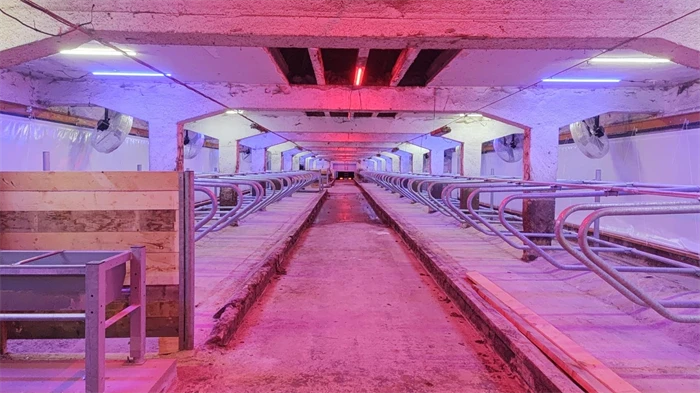
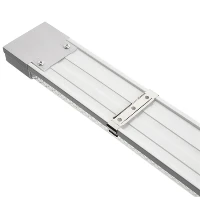
0-10V Dimmable Full spectrum White Light+620-630nm Red Light tube

0-10V Dimmable 450-460nm Blue Light Tube
Note: Specific requirements may vary by region, species, and production system. Always consult current local regulations and species-specific research when designing livestock lighting systems.
Shenzhen Benwei Lighting Technology Co., Ltd
Kevin Rao
Tel/WhatsApp: +86 199 7256 3753
Email: bwzm12@benweilighting.com
Skype: bwzm32
WeChat: 19972563753