Introduction: The Visibility Crisis in Large-Scale Arenas
The Evolution of Arena Scale and Complexity
Modern outdoor arenas have grown exponentially in size and complexity. They are no longer simple grassy fields; they are massive amphitheaters designed to host a multitude of events, from professional sports leagues to concerts and community gatherings. As the physical scale of these arenas increases, the challenge of illuminating them uniformly and safely becomes exponentially more difficult.
Defining "True Visibility"
True visibility in an arena is not just about making the ground bright. It is the ability of athletes to track high-speed projectiles without being blinded by glare. It is the ability of spectators in the highest bleachers to clearly see the action in the farthest corner. It is the ability of a 4K broadcast camera to capture high-definition, flicker-free, and perfectly color-accurate footage.
The Fallacy of the "Brute Force" Approach
Historically, facility managers attempted to solve visibility issues by simply installing higher-wattage lighting. This "brute force" approach inevitably fails. Excessive, uncontrolled light results in severe glare (disability glare), which actually reduces visibility by washing out contrast. Furthermore, high-wattage fixtures generate immense heat, leading to rapid lumen depreciation and frequent catastrophic failures. Maximizing visibility requires a precision-engineered, holistic approach.
The Optical Frontier: Defeating Glare and Directing Light
The foundation of maximizing visibility is precision optics. Light must be placed exactly where it is needed, and strictly kept away from where it is not.
Advanced Low-Glare Optical Lenses
The Destructive Nature of Glare in Large Arenas
In a large arena, lighting masts are incredibly high (often exceeding 30 to 50 meters). The sheer distance requires immense light intensity. If this intense light is emitted directly from the LED point source without adequate diffusion, it creates severe glare. For a player looking up to track a ball, or a fan looking across the pitch, this glare causes momentary blindness.
The Micro-Lens Array Solution
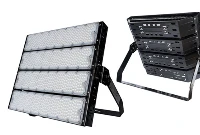
The Nexus LED Stadium Light series solves this through the implementation of advanced low-glare optical lenses. These lenses are crafted from high-grade, UV-stabilized polycarbonate and feature a precisely engineered micro-lens array. This array-composed of thousands of microscopic optical indentations-shatters the harsh LED point source, diffusing it into a soft, uniform beam. This ensures maximum visibility on the field while drastically reducing both discomfort and disability glare for athletes and spectators.
Precision Beam Control: Various Light Distribution Angles
Tailoring Optics to Arena Geometry
A large arena has highly specific geometric lighting requirements. A single, fixed beam angle cannot adequately illuminate an entire field uniformly. It will create "hot spots" (areas of over-illumination) and "dark zones" (areas of under-illumination). The Nexus series offers various light distribution angles (such as 10°, 25°, 45°, and 60°). This allows lighting designers to mix and match optics, ensuring that the light beams precisely overlap to create a uniform blanket of illumination across the entire playing surface.
Asymmetrical Optics and Obtrusive Light
In large outdoor arenas, controlling light pollution is critical. Using our proprietary asymmetrical lenses, the light is pushed strictly forward and downward onto the field. This eliminates upward light spill and prevents intense glare from bothering nearby residential areas or interfering with air traffic. It ensures that 100% of the generated light is utilized for maximizing visibility on the pitch.
Thermodynamic Visibility: Sustaining Light Output
Visibility is not static. A light that is bright on day one but dims by 30% in two years due to thermal degradation is a failed investment. Maximizing visibility means maintaining maximum lumen output for the entire lifespan of the fixture.
The Threat of Thermal Degradation
Lumen Depreciation and Chromaticity Shift
High-power LED arena lights generate immense heat concentrated in the microscopic LED junction. If this heat is not removed rapidly, the phosphor coating on the LED degrades. This results in lumen depreciation (the light physically dims) and chromaticity shift (the color of the light changes, often becoming greenish or yellowish). This degradation destroys visibility uniformity and fails broadcast standards.
The Nexus Cooling Architecture
High Thermal Conductivity Materials
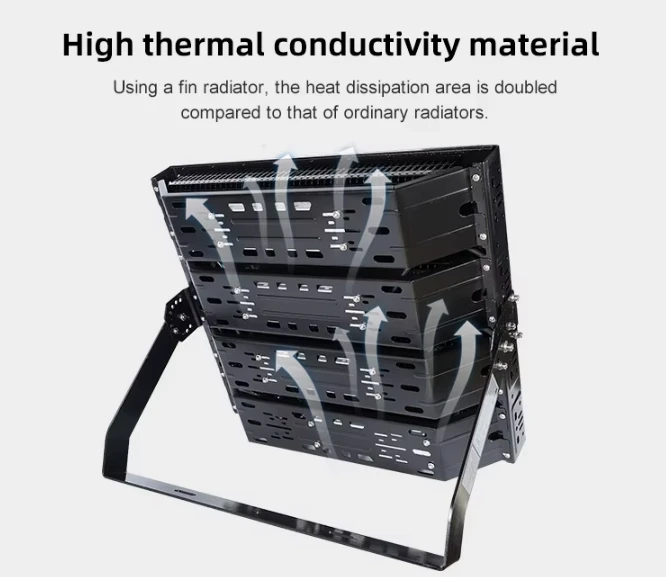
To combat this, the Nexus fixture utilizes a massive, high-pressure die-cast aluminum housing. Aluminum is selected for its excellent thermal conductivity. It acts as a giant heat sink, rapidly absorbing heat from the LED junction and spreading it evenly across the entire structure, preventing localized overheating.
Doubling the Heat Dissipation Area
To transfer the heat from the aluminum chassis into the air, surface area is critical. The Nexus series utilizes an advanced fin radiator design. By employing dozens of densely packed vertical aluminum fins, we effectively double the heat dissipation area compared to conventional flat-backed fixtures. This massive surface area allows for incredibly efficient heat exchange with the ambient air.
The Power of Strong Air Convection
The vertical alignment of our fins is intentional. It harnesses the laws of thermodynamics via the principle of strong air convection. As the LED heats the fins, the surrounding air warms and rises. This creates a continuous, passive updraft-the Chimney Effect. Cool air is constantly drawn in from the bottom of the fixture, flows over the hot fins, absorbs the thermal energy, and exits out the top. This fan-less, passive cooling ensures maximum efficiency and guarantees that the fixture maintains optimal visibility and brightness for over 50,000 hours.
Structural Precision: Anchoring the Visibility Envelope
Even the most advanced optics and thermal systems are useless if the physical structure of the fixture fails. In large arenas, structural integrity is paramount for maintaining proper aiming and protecting the internal components.
The 180-Degree Adjustable Bracket
The Importance of Exact Aiming
To maximize visibility, the light fixture must be aimed with absolute mathematical precision. A variance of just a few degrees can result in severe light spill, glare, or the creation of dark zones on the field. The Nexus fixture features a thickened 180-degree adjustment bracket. This heavy-duty, reinforced steel mounting system allows for precise, infinite adjustment across a 180-degree arc.
Preventing Structural "Droop"
In large arenas, fixtures are exposed to immense wind loads and continuous vibration. Cheaper, thin-gauge brackets will eventually yield to these forces, causing the fixture to "droop" over time. This changes the photometric layout, reducing visibility. The heavy-duty locking mechanism of our thickened bracket ensures the fixture remains locked in its precise position permanently, even in hurricane-force winds.
Environmental Defense: IP65 and Stainless Steel Clasps
The IP65 Waterproof Envelope
Outdoor arenas are exposed to torrential rain, dust storms, and high-pressure washdowns. The IP65 waterproof rating ensures the fixture is completely dust-tight and protected against water jets from any direction. This absolute barrier protects the delicate optical lenses and electronic drivers, preventing fogging, short circuits, and internal corrosion that would destroy visibility.
The Silent Guardians: Heavy-Duty Stainless Steel Clasps
To maintain the IP65 seal across thousands of thermal cycles (the expansion and contraction of the metal as the light heats and cools), the fastening system is critical. Standard screws or plastic clasps will rust, crack, or loosen over time. The Nexus series utilizes heavy-duty stainless steel clasps. These clasps apply a perfectly uniform, unyielding pressure across the optical lens, ensuring the silicone gasket remains perfectly sealed. They are immune to corrosion, guaranteeing the structural and optical integrity of the fixture for decades.
The Economic Impact: Maximizing Return on Investment (ROI)
For facility managers, maximizing visibility must translate into financial viability. A lighting upgrade is a capital investment that must yield a measurable return.
Reducing Total Cost of Ownership (TCO)
Eliminating the Maintenance Death Spiral
The most expensive aspect of arena lighting is not the purchase price, but the maintenance. Replacing a failed fixture 40 meters in the air requires heavy cranes, specialized electrical crews, and operational downtime. By investing in a fixture with advanced thermal management, IP65 waterproofing, and stainless steel hardware, operators eliminate the cycle of premature failures. The lighting system becomes a "fit-and-forget" asset, drastically reducing maintenance costs.
Energy Efficiency Through Thermal Stability
An LED operating at high temperatures loses electrical efficiency. As heat rises, resistance increases, and the fixture requires more power to maintain the same light output. Our advanced fin radiator and strong air convection design keeps the LEDs cool, ensuring maximum lumens-per-watt efficiency and lower monthly energy bills.
Unlocking Premium Revenue Streams
Broadcast Compliance
By achieving perfect uniformity and zero flicker, the Nexus LED Stadium Light meets the stringent standards of organizations like FIFA, UEFA, and major television networks. This allows the arena to host high-tier, televised professional events. The revenue generated from broadcasting rights, premium ticketing, and global sponsorships provides a massive return on the initial lighting investment.
Multi-Purpose Event Capability
Large outdoor arenas are increasingly used for concerts, community festivals, and non-traditional sports. The precise light control and low glare offered by our system make the arena highly versatile, allowing facility managers to monetize the space for a wider variety of events.
OEM/ODM Customization: Tailoring Visibility to Your Specific Arena
We recognize that every large outdoor arena has unique environmental and structural challenges. Our comprehensive OEM/ODM customization capabilities allow us to tailor our lighting solutions to your exact specifications.
Climate-Specific Engineering
Extreme Heat and Corrosive Environments
For arenas located in the Middle East or other extreme heat zones, we can optimize the fin geometry and driver specifications to ensure maximum thermal efficiency even when ambient temperatures exceed 50°C (122°F). For coastal arenas, we can upgrade the stainless steel clasps and mounting hardware to marine-grade 316 steel to resist salt spray corrosion.
Smart Arena Integration
IoT and Remote Monitoring
For modern "Smart Arenas," our ODM capabilities allow for the seamless integration of IoT sensors. Facility managers can monitor the junction temperature, power consumption, and tilt angle of every single fixture in real-time from a central dashboard. This enables predictive maintenance, ensuring maximum visibility is never compromised by an unexpected fixture failure.
Conclusion: The Ultimate Standard of Visibility
The Holistic Approach
Maximizing visibility in large outdoor arenas is not achieved through a single breakthrough, but through the meticulous integration of multiple engineering disciplines. It requires the optical precision of low-glare lenses, the thermodynamic efficiency of fin radiators and strong air convection, the structural stability of 180-degree brackets, and the unwavering durability of IP65 waterproofing and stainless steel clasps.
Partner with the Industry Leader
Do not compromise the visual experience of your athletes and spectators. Equip your arena with lighting that is scientifically engineered to conquer the darkness and the elements. The Nexus LED Stadium Light series is the ultimate solution for venues that demand absolute clarity and uncompromising performance.
How To Cooperate With Us?
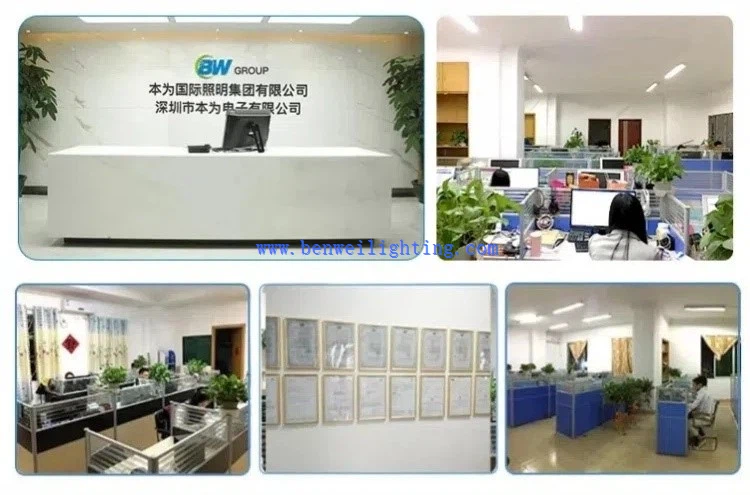
We are happy to have total control over the manufacturing process and the calibre of our products since we have our own facilities. Since we are producers rather than just brokers, we are dedicated to providing our customers with the best pricing. Since we are certain that the price and quality of our products are clear, we invite customers to see our samples first. Our commitment to quality and customer satisfaction drives us to continuously provide top-notch goods.
Our address
3rd Floor, 5th Building, Hebei Industrial Park, Hualian Community, Longhua District, Shenzhen, China