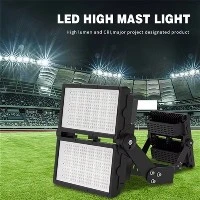
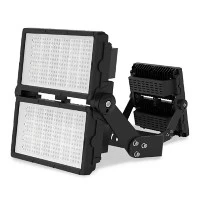
When compared to conventional lighting systems, outdoor LED building lights can reduce energy expenditures by up to 75% while converting dark properties into safe, well-lit areas.
Superior lighting is provided for residential, commercial, and warehouse facilities by these adaptable fixtures. At Benwei lighting, we assist property owners in selecting the best LED options for optimal effectiveness and security.
Why LED Lighting Reduces Expenses and Increases Security?
When compared to conventional systems, LED building lights reduce energy usage by 75%, resulting in immediate cost savings that accumulate over decades. Commercial buildings that convert to LED outdoor lighting save an average of $3,200 per year for every 1,000 square feet of illuminated space, according to the U.S. Department of Energy. The reason for these savings is that LEDs have efficiency ratings of 80–120 lumens per watt, while incandescent fixtures only have 15-20 lumens per watt.
Energy Costs Decrease Right After Installation
While producing the same amount of light as 250–400 watt metal halide or high-pressure sodium lights, commercial LED lighting use 40–60 watts. After converting to LEDs, the monthly electricity expenditures of a typical warehouse with 20 outside lighting drop from $480 to $120. Some countries give instant refunds at the point of purchase, while many utility companies offer rebates of 20–40% of the cost of installing LEDs. When smart controls activate motion sensors to cut runtime by 30–50% or automatically dim lights during periods of low traffic, these savings are amplified.
Consistently Bright Lighting Enhances Security
Warm-up delays and frequent burnouts that cause security flaws in conventional systems are eliminated by LED lighting. LEDs offer instantaneous maximum output, but metal halide lights take three to five minutes to attain peak brightness. According to research from the International Association of Chiefs of Police, houses with regular LED lighting saw 23% fewer burglaries than those with conventional systems. According to security industry study, LED color temperatures between 4000K and 5000K increase security cameras' facial recognition capabilities, increasing identification accuracy by 35%.
Costs of Maintenance Disappear With lifespans of 50,000 hours
High-quality LED fixtures last 10–15 years before needing to be replaced, while metal halide lights only last 1-2 years. Because of its endurance, there are no ongoing expenses for maintenance crew personnel, ladder rentals, or bulb purchases. After switching to LEDs, a property manager who is in charge of 100 exterior fixtures saves about $8,000 a year in maintenance costs. By withstanding temperature extremes ranging from -40°F to 140°F, weather-resistant LED housings with IP65 certifications avoid the premature failures that beset conventional outdoor systems.
For particular applications and architectural specifications, the appropriate type of LED fixture optimizes these advantages.
Which Type of LED Fixture Is Best for Your Structure?
Building perimeters are secured by wall pack lights
In order to minimize dark areas where security threats are concentrated, wall pack lights are mounted directly to exterior walls and disperse light in exact patterns. With beam angles ranging from 110 to 140 degrees, these LED lights emit 3,000 to 8,000 lumens, covering 20 to 40 feet of ground space each. In order to maintain constant 2–5 foot candle illumination levels that satisfy insurance criteria for liability coverage, commercial establishments deploy wall packs along facades at 8–12 foot intervals.
In order to avoid light trespassing infractions that result in fines (often between $500 and $2,000 in most towns), full-cutoff walls deflect light downward. These fixtures are chosen by property managers because they offer dependable perimeter security without producing glare that could annoy nearby homes.
Floodlights Effectively Cover Wide Areas
Flood lights can illuminate parking lots, loading docks, and perimeter fencing up to 150 feet away thanks to their 10,000–50,000 brightness outputs. With the use of movable brackets, these lights can be mounted on poles, structures, or ground stakes to precisely direct light where it is needed. 5000K color temperature floods are employed in security-focused installations because they improve camera performance and facial recognition accuracy by 40% when compared to warm white alternatives.
Flood lights are chosen by property owners when they need to illuminate several acres or when regular wall packs are unable to reach far-flung locations.
Canopy lights work well in enclosed areas
Gas stations, drive-throughs, and overhangs are examples of covered spaces where canopy lights work well because they offer consistent, glare-free downward illumination. These fixtures provide 4,000–12,000 lumens over 15–25 foot coverage areas and blend in with ceiling structures with low-profile designs that deter vandalism. In low-traffic canopy applications, motion sensor integration results in a 60% reduction in energy use.
When other fixture types are limited by architectural constraints or when ordinary wall packs or floods would produce undesired shadows, these specialty fixtures perform best. Performance in each of these fixture types is optimized with the appropriate brightness settings and intelligent controls.
Which Technical Details Are Most Important When Choosing LEDs
Coverage Area Is Determined by Brightness Output
The amount of ground area that each fixture can efficiently illuminate is directly controlled by its lumen output. For basic security, commercial properties require 2–5 foot candles, which means each wall pack needs 3,000–5,000 lumens to cover 400–600 square feet. Flood lights with 15,000–25,000 lumens can illuminate 1,500–2,500 square feet per fixture since parking lots require higher illumination levels of 5–10 foot candles. Because manufacturer beam angle requirements frequently turn out to be unreliable in actual operation, the Illuminating Engineering Society advises using a light meter to measure actual foot-candle levels after installation.
Raw lumen counts are not as important as patterns of light distribution. While Type V distribution produces circular coverage for pole-mounted applications, Type III distribution enhances useful illumination by spreading light forward from walls in a rectangular pattern. When compared to symmetric alternatives, property managers that select fixtures with asymmetric optics need 20–30% fewer fixtures.
Weather Ratings Avoid Expensive Mistakes
Because lesser ratings let moisture ingress, which ruins internal components within two to three years, IP65 ratings are the bare minimum of acceptable protection for outdoor LED lighting. High-quality fixtures have IP66 or IP67 certifications, which allow them to survive brief submersion and direct water jets. While less expensive fixtures malfunction when temperatures fall below 10°F or rise over 100°F, fixtures with temperature ratings between -40°F and 140°F can withstand severe weather conditions without experiencing a decrease in performance.
For coastal houses within ten miles of the ocean, resistance against salt spray becomes crucial. In salt air conditions, fixtures without marine-grade coatings deteriorate in 18 months, resulting in replacement prices ranging from $2,000 to $4,000 per unit. IK08 impact ratings guard against unintentional damage from maintenance equipment and vandalism.
Energy Savings Are Increased by Smart Controls
When occupancy sensors only turn on lights when they detect motion, they cut down on runtime in low-traffic areas by 40–60%. While astronomical timers modify on/off schedules according to dawn and sunset timings throughout the year, photocells stop energy-wasting daylight operation. During off-peak hours, controls keep the minimum security illumination at 30–50% output, then increase it to maximum brightness when sensors pick up activity.
By enabling remote management of individual fixtures, networked systems assist facility managers in detecting malfunctions before they jeopardize security. These systems, which range in price from $50 to $150 per fixture, pay for themselves through lower maintenance requests and better energy use (automatic reactions to weather or security situations are created through interaction with management systems).


http://www.benweilight.com/industrial-lighting/led-flood-light/led-powed-wall-flood-lights.html
Our address
No. 5-3 Niujiao Road, Yanchuan Community, Yanluo Street, Bao'an District, Shenzhen
Phone Number
+86 18659785153
bwzm04@ledbenweilighting.com