Requirements for LED tube manufacturers
1 Scope
This standard specifies the definition, product classification, technical requirements, test methods, inspection rules, signs, packaging, transportation and storage of indoor lighting LED tubes (hereinafter referred to as LED tubes).
This standard applies to AC frequency (50-60) Hz, voltage (86-265) V power supply, and it is used in meeting rooms, underground parking lots, office places and other indoor lighting fields with LED tubes.
2. Normative references
The following documents are indispensable for the application of this document. For dated reference documents, only the dated version applies to this document. For undated reference documents, the latest version (including all amendments) is applicable to this document.
GB/T l91-2008 Graphical signs for packaging, storage and transportation
GBrT 2828.1-2003 Attribute Sampling Inspection Procedure Part 1: Batch Inspection Sampling Plan Retrieved by Acceptance Quality Limit (AQI)
GB/T 2829-2002 Periodic Inspection Attribute Sampling Procedure and Table (Applicable to the inspection of process stability)
GBrT 2900.65 Electrotechnical terminology lighting
GB 3096-2008 Acoustic Environmental Quality Standard
GB/T 6882-2008 Acoustic sound pressure method for the determination of sound power level of noise sources. Precision method for anechoic chambers and semi-anechoic chambers
GB 7000.1 Lamps Part 1: General requirements and tests
GB/T 9468 General requirements for photometric measurement of luminaires
GB 10682 Tubular fluorescent lamps for general lighting
GB/T l4862-1993 Semiconductor integrated circuit package junction-to-case thermal resistance test method
GB 17625.1 EMC limit harmonic current emission limit (equipment input current per phase <16A)
GB 17743 Limits and measurement methods of radio disturbance characteristics of electrical lighting and similar equipment
GB/T l8595-2001-Electromagnetic compatibility immunity requirements for general lighting equipment
GB 19510.1 Lamp control device Part 1: General requirements and safety requirements
GB 19510.14-2009 Lamp control device Part 14: DC or AC electronic control device for LED module
special requirements
GB 19651.3-2008 Miscellaneous lamp holders Part 2-2 Particular requirements for connectors for LED modules
GB/T 24819-2009 Safety requirements for LED modules for general lighting
GB/T 24823-2009 LED module performance requirements for general lighting
GB/T 24824-2009 Test methods for LED modules for general lighting
GB/T 24825-2009 Performance requirements for DC or AC electronic control devices for LED modules
GB/T 24826-2009 LEDs and LED modules for general lighting, terms and definitions
SJ/T 11364 Marking requirements for pollution control of electronic information products
SJ/T 11395-2009 Semiconductor Lighting Terminology
IEC 62471 Photobiological safety of lamps and lamp systems
3 terms and definitions
The following terms and definitions apply to this standard.
3.1
LED tube fluorescent light
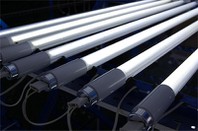
A combined straight tube type lighting fixture for indoor general lighting with LED as the light source and consistent in appearance with traditional fluorescent lamps. It consists of an LED module, an LED drive controller, a heat-dissipating aluminum profile, a cover, a thermal conductive tape, and two It consists of a plug, which can include a lamp holder and a lamp holder.
Note: According to SJ/T 11395-2009 "Semiconductor Lighting Terminology>> 3.9.5 term modification
3.2
Initial values
The photoelectric parameter value of the LED tube without aging and burning for 2 h under rated conditions.
Note: According to GB/T 24826-2009 <<LEDs and LED modules for general lighting, terms and definitions>> 2.36
Term modification
3.3
Rating (ofa lamp)
A set of working conditions of LED tubes and the values of specific parameters under specified working conditions are regulated by manufacturers and sellers.
Certainly.
Note: Modified according to the term 845-07-58 in GB/T 2900.65 "Electrical Engineering Terminology Lighting"
3.4
Luminous efficacity of luminaire (luminous efficacity of luminaire)
The ratio of the total luminous flux emitted by the lamp to the power consumed by the LED tube under the claimed use condition. It is expressed in lumens (lm)/watt (W), and it is referred to as light effect without confusion.
Note: According to GB/T24827-2009 "Performance Requirements for Road and Street Lighting Lamps" 3.8 term modification
3.5
(Initial luminous efficacity)
The initial value of LED fluorescent lighting effect.
Note: According to GB/T24827-2009 "Road and Street Lighting Performance Requirements" 3.8 terms and GB/T 24826-2009
Revised 2.36 terms in <<LEDs and LED Modules for General Lighting: Terms and Definitions>>
3.6 Initial luminous flux (rated luminous flux)
The initial value of the total luminous flux emitted by the LED tube, unit: lumens [lm].
Note: According to the term 3.6.16 in SJ/T 11395-2009 <<Semiconductor Lighting Terminology>> and GB/T 24826-2009 <<
LEDs and LED modules for general lighting Terms and definitions>> 2.36 terminology, GB/T 2900.65 "Electrical engineering terminology lighting" 845-07-59 term revision 3.7
Lumen maintenance rate (lumenmaintenance)
The ratio of the luminous flux at a specific time to the initial luminous flux during the life of the LED tube ignited under specified conditions
Expressed as a percentage. For the convenience of testing, the luminous flux can be used to calculate the luminous flux maintenance rate by replacing the luminous flux with the illuminance of the point under the lamp at a specified distance.
Note: Modified according to the term 845-07-65 in GB/T 2900.65 "Electrical Engineering Terminology Lighting"
3.8 Power factor of luminaire
The ratio of the actual power consumed to the rated power when the LED tube works under the nominal rated power supply voltage and rated frequency. Note: According to 2.46 in GB/T 24826-2009 <<LEDs and LED modules for general lighting, terms and definitions>>
Term modification
And marking method
4.1 Product Classification
According to the color, LED tubes can be divided into warm white RN (color temperature <3300K) and cool white RL (3300K<color temperature<6500K).
4.2 Marking method
4.2.1 Labeling rules
The model specifications of LED tubes are marked in the following form:
Bit code
XX LFL 30 -10W RN
Indicates the lamp category: warm white is RN, cool white is RL, 2-digit code
Indicates the 3-digit code of the rated power of the lamp
Indicates the diameter of the lamp tube, using a specific millimeter value, 3 digits code
Indicates the name of the lamp: LED tube fluorescent light (IED tube fluorescent light) is FL, 2
Indicates company abbreviation
4.2.2 Marking example
The warm white LED tube with a diameter of 30nuu and a rated power of IOW is marked as: XX LFL, 30-10W RN.
5 technical requirements
5.1 Working environment requirements
The LED tube should be able to start and ignite normally under the following conditions:
a) Indoor temperature: -25℃~+45℃;
b) Monthly average relative air humidity: not more than 90% (25℃±5℃);
c) When operating outside the above-mentioned environmental range, the manufacturer and the user shall jointly negotiate the technical requirements.
5.2 Dimensions
5.2.1 The coordination of the main external dimensions of the LED tube and the size of the lamp holder should meet the requirements of Clause 3.1 in GB 10682 "Tube Fluorescent Lamps for General Lighting". It should be consistent with the installation size of the straight tube fluorescent lamp for general lighting, and meet the installation requirements of the straight tube fluorescent lamp socket for general lighting.
5.2.2 When the above-mentioned size or matching size is exceeded, the manufacturer and the customer shall jointly negotiate. Should comply with the manufacturer's design requirements. The structure should be easy to install.
5.3 Appearance
5.3.1 The surface of the LED tube should be smooth and clean, and there should be no defects such as scratches that affect the lighting performance and use, and there should be no sharp corners and burrs that endanger the production, transportation, installation and use of the lamp inside and outside. The signs of the lights should be clear.
5.3.2 All parts should be positioned and installed firmly and reliably, and there should be no looseness: the rotating parts should be able to rotate flexibly, have good contact, and have no axial movement.
5.3.3 The welding part should be flat and firm, without welding penetration, false welding, spattering, etc.
5.3.4 The lamp cap should be fixed at both ends of the lamp in an upright position. The pins on the finished lamp holder should be able to be installed smoothly through the corresponding lamp holder without being twisted.
5.4 Security
5.4.1 The LED tube should be able to work for a long time, reliably and normally under the nominal rated power supply voltage and rated frequency, and it should not cause harm to the user and the environment.
5.4.2 The general performance, safety and corresponding test requirements of LED tubes should meet the requirements of GB 7000.1.
5.4.3 The safety and performance requirements of the LED tube control device should meet the requirements of GB 19510.14 and GB/T 24825.
5.4.4 The safety and performance requirements of the LED module of the LED tube should meet the requirements of GB 24819 and GB/T 24823.
5.4.5 The safety requirements for the socket/connector of LED tubes should meet the requirements of GB 19651.3.
5.4.6 The photobiological safety requirements of LED tubes should meet the requirements of IEC 6247 and corresponding national standards.
5.5 Electromagnetic compatibility
5.5.1 The electromagnetic compatibility requirements of LED tubes should meet the requirements of GB 17743 and GB 17625.1.
5.5.2 The input current harmonics should meet the requirements of GB 17625.1-2003;
5.5.3 The electromagnetic compatibility immunity shall meet the requirements of GB/T 18595-2001.
5.6 Electrical performance of lamps
5.6.1 The LED tube is normally turned on and keeps burning under the nominal rated power supply voltage and rated frequency.
5.6.2 When the LED tube is working under the nominal rated power supply voltage and rated frequency, the actual power consumed is equal to
The difference in rated power should not be greater than 10%, and the power factor should not be less than 0.75.
5.7 Life
The rated life of LED tubes should not be less than 30 000 h.
5.8 Main optical parameters
The main optical parameters should meet the requirements of Table 1.
Table 1 Main optical parameters
5.9 Noise
The LED tube should be able to ensure that its noise power is not more than 45dB (A) when it is working stably under rated working conditions.
5.10 Heat dissipation
The heat dissipation performance of the LED tube should be able to ensure that the junction temperature of the LED at the center of the symmetry does not exceed 60°C under the rated working conditions and during stable operation.
6. Test method
6.1 Dimensions
The dimensions of the lamp should be checked with a general measuring tool or a current gauge. When measuring the diameter of the lamp, the accuracy of the measuring tool should not be less than 0.1mm; when measuring the length of the lamp, the accuracy of the measuring tool should not be less than 0.2mm.
6.2 Appearance
The surface quality of the lamp, such as scratches and smoothness, should be inspected visually. The positioning and installation, firmness, looseness and flexibility of rotating parts, and the quality of the parts of the lamp, such as the quality of the connection parts, are checked by means of control samples and rotating connection parts. The torsion inspection of the pins on the finished lamp cap adopts visual inspection.
6.3 Security (corresponding)
When the manufacturer cannot provide a valid and qualified test report or certificate, it shall use a leakage tester or other safety test equipment to conduct safety tests such as leakage current inspection on the overall LED tube in accordance with the provisions of GB 7000.1.
The power control device is tested in accordance with GB 19510.14 and GB/T 24825.
The LED module is tested in accordance with GB 24819 and GB/T 24823.
The connectors for LED modules are tested in accordance with the provisions of GB 19651.3.
The biosafety of LED bulb lights is tested in accordance with IEC 6247.
6.4 Electromagnetic compatibility (corresponding)
When the manufacturer cannot provide a valid and qualified test report or certificate, the overall electromagnetic compatibility of the LED tube shall be tested in accordance with the following methods
Input current harmonics are tested in accordance with the regulations of GB17625.i;
Radio disturbance characteristics should be tested in accordance with GB 17743;
The electromagnetic compatibility immunity shall comply with GB/T