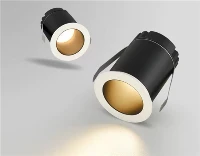
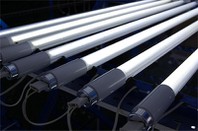
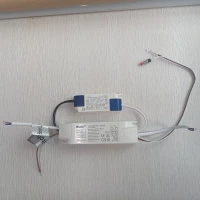
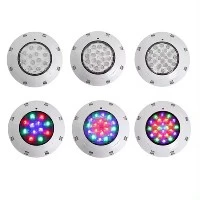
The brightness of the side-emitting SMD LED has a major relationship with the light-emitting angle of the LED. The smaller the angle of the LED, the higher the brightness. The manufacturing process is different, and the lifespan is different. The luminous intensity of white light at 180-degree angle of 5MM LED is only a few hundred MCD, and the light intensity at 15-degree angle is more than 10,000 and 20,000 MCD. When high-power LED is used outdoors, the brightness is even higher. A single power has IW, 3W, 5W, and some are combined into a high-power LED with multiple high-power, and the power can reach hundreds of W.
Color temperature and brightness don't matter, but brightness is related to lumens
Let's look at a few related concepts:
(1) Brightness (cd/m2)
Brightness is the intensity of light emitted by an object that the eye sees from a certain direction. The unit is candela/square meter [cd/m2], the symbol is L, which indicates the luminous flux of the luminous material in a unit solid angle unit area in a specific direction, which is equal to the luminous intensity of 1 candela on a 1 square meter surface.
(2) Side-emitting patch led luminous intensity (cd)
Luminous flux is the total light energy that a light source emits into the surrounding space. The spatial distribution of the luminous flux emitted by different light sources is different. The unit of luminous intensity is candela, and the symbol is cd, which represents the luminous flux emitted by the light source within a solid angle of a unit steradian (the angle formed by the surface of the object to the point light source). 1cd=1lm/lsr (steradian unit of s body angle)
(3) Luminous flux ()m)
Since the human eye has different sensitivities to electromagnetic waves of different wavelengths, we cannot directly measure the light energy by the radiant power or radiant flux of the light source. The luminous flux is represented by the symbol 0 and the unit is lumens (|m).
(4) Color rendering property of side-emitting patch led (Co|orrenderingproperty)
In principle, artificial light should be the same as natural light, so that the human eye can correctly distinguish the color of things, of course, this depends on the location and purpose of the lighting. The degree to which a light source presents the color of an object is called color rendering. Often called the "color rendering index" (Ra). Color rendering refers to the relationship between the true color of a thing (its own color) and the color displayed under a standard light source. The Ra value is determined by comparing the 8 test colors defined in the DIN6169 standard under the standard light source and the tested light source. The smaller the color difference, the better the color rendering of the tested light source color.
Benwei Lighting is an LED Tube, LED flood light, LED Panel Light, LED High Bay, LED manufacturer with 12 years of experience. If you want to purchase a high-quality LED flood light or have a more in-depth understanding of the application of LED flood lights, please contact send us inquiry, our web:  https://www.benweilight.com/.