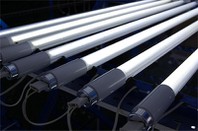
T5 vs. T6 LED Tubes: What's the Difference?
Many people run into the same question when replacing LED tubes: T5 and T6 look pretty similar, so why are the price, brightness, and installation methods different? And it gets even more confusing when one person says you can directly replace the old tube, while another says you need to rewire. So who's right?
Let's clear up the differences between T5 and T6, and what "electronic compatibility" really means.
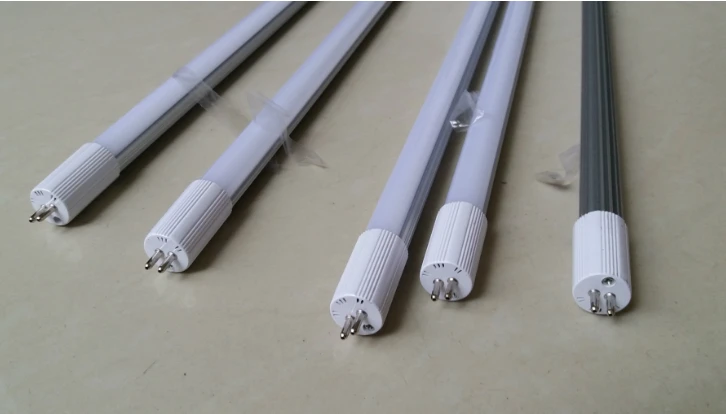
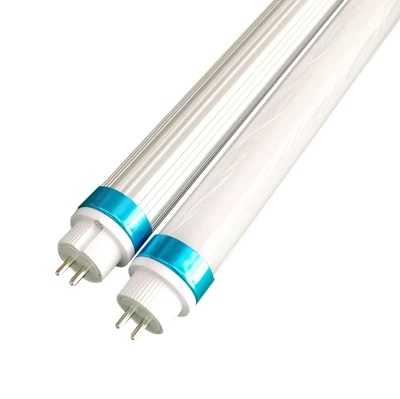
First, the most obvious difference: one is thinner, one is thicker
The biggest difference between T5 and T6 is the tube diameter. The number after "T" means the diameter is measured in eighths of an inch, and 1T is about 3.175 mm.
So:
- T5: about 16 mm, thinner.
- T6: about 19 mm, slightly thicker.
That 3 mm difference may not sound like much, but it matters. A thicker tube has more room for heat dissipation. A thinner tube makes the fixture look more compact and usually offers slightly higher efficacy.
What about power, brightness, and lifespan?
A simple way to remember:
- T5 is thinner. For a 1.2 m tube, common power ratings are around 8–20W. It has slightly higher efficacy and is great for compact spaces with even light.
- T6 is thicker. Common power ratings can reach 10–25W. At higher power, it offers more brightness, better heat dissipation, and more stable lifespan.
For example, a 1.2 m T5 at 20W can reach about 2,400 lumens. A high-power T6 at 25W can exceed 3,000 lumens. Of course, actual performance also depends on the chips, driver, and LED configuration.
Installation: can they directly replace each other?
T5 usually fits existing T5 fixtures, but it generally cannot directly replace T6. Because T6 is thicker, it may require dedicated sockets and won't fit into a T5 socket.
So before buying, check the specifications of your existing fixture. Don't just compare the length and place an order.
What does "electronic compatibility" actually mean?
This term is easy to confuse because it usually has two different meanings.
1. Electronic ballast compatibility
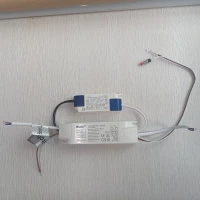
This is about whether you can keep the old electronic ballast in the fixture and simply swap the old fluorescent tube for an LED tube.
- T5 tubes: There are clearly "ballast-compatible" and "non-compatible" versions.
Ballast-compatible: Must keep the original electronic ballast. It cannot be connected directly to AC mains.
Non-compatible: Requires removing or bypassing the ballast, then wiring the tube directly to AC mains.
- T6 tubes: Standard T6 LED tubes are generally not compatible with T5 electronic ballasts. They usually need to be rewired and connected directly to AC mains. However, there are specially designed T6 ballast-compatible glass tubes that can use the high-frequency output of the original T5 electronic ballast, allowing direct replacement without rewiring. Some imported T6 LED tubes are also labeled as compatible with magnetic and electronic ballasts.
So here's the key point: ballast compatibility does not depend on whether it's T5 or T6. It depends on the specific model. Before buying, always check the datasheet or ask the supplier directly.
2. Electromagnetic compatibility (EMC)
This is about whether the tube interferes with other equipment, and whether it can resist interference from them.
This isn't optional. It's a market access requirement. For the EU, products need to meet standards such as EN 55015 and EN 61547 to obtain CE certification. China, the US, and other markets have similar requirements. Any compliant LED tube, whether T5 or T6, must meet EMC requirements. So if someone says "T6 isn't EMC compliant," that's usually not accurate.
So should you choose T5 or T6?
- Offices, retail shelves, wardrobes, display cabinets: If you want a thinner tube with higher efficacy, T5 is a better fit.
- Industrial workshops, warehouses, large meeting rooms: If you want high brightness, long life, and stable heat dissipation, T6 has more advantages.
- Existing fixtures with electronic ballasts: First confirm whether the tube is ballast-compatible. T5 has compatible options. Standard T6 is usually not compatible, but special compatible versions exist. If you're not sure, rewiring and using a non-compatible tube is often more reliable.
- Export or certification requirements: Confirm whether CE, EMC, RoHS, and other certifications are complete.
If you're choosing T5 or T6 LED tubes, or you're not sure whether your existing electronic ballast can be directly replaced, contact us. Send us your fixture parameters or photos, and we'll help confirm the right model and compatibility solution-and get a fast quote back to you.