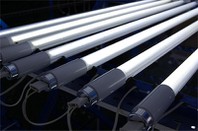
A smart industrial lighting solution uses digital control systems, universal connectivity, and a platform-based strategy to turn industrial light fixtures into intelligent, interoperable lighting systems. The use of digital insights in lighting control is becoming more popular since the switch to solid state lighting based on LED technology. The goal of the digital transformation in the industrial sector is to improve efficiency beyond what LED lighting alone can provide while also establishing safe, efficient, and productive working conditions. The possibility to develop unique capabilities and implement sophisticated features is made possible by the strong interaction that a smart lighting solution establishes between information technology (IT) and operational technology (OT), as well as between hardware and software. In order to gather, share, decide, and act, a homogeneous class of various devices and systems is combined into a comprehensive network. The administration of industrial facilities will need to undergo a significant change in the future due to Industry 4.0. This digital revolution includes smart industrial lighting.

Designing industrial lighting is a challenging task
The lighting design for industrial buildings is a unique approach because these spaces are worlds apart. Industrial facilities are any locations where production or activities related to manufacturing occur. The automobile, heavy machinery, huge machine tool, shipbuilding, aircraft, steel, chemical, petrochemical, and pharmaceutical sectors may use these heavy manufacturing facilities. They may also be light manufacturing plants that make consumer electronics, electric appliances, food, paper, textiles, leather, and wood, among other everyday items.
Unlike other types of infrastructure, industrial facilities offer a wide range of uses. These locations handle a wide range of tasks, including quality control, storage, logistics, production, machining, assembly, finishing, and packing. Industrial facilities' physical attributes and architectural layout are based on their specific systems, procedures, machinery, material and product properties, maintenance needs, and worker safety concerns. Industrial facilities have a more varied environment in addition to unique infrastructure because of the influence of primarily local elements like vibration, temperature, and atmosphere.
Industrial lighting needs to take a variety of factors into account
A modern industrial facility's lighting solution should enable the provision of a comfortable and pleasant environment while minimizing the installed lighting systems' life cycle costs. Reduced absenteeism, fewer production errors, and fewer industrial accidents can all be attributed to a visually pleasing workplace. A company may be at a competitive disadvantage if its lighting infrastructure is not operating efficiently, even if it is essential to achieve clear visibility through appropriate regulation of several parameters (glare, brightness, uniformity, illuminance, color quality, contrast, and adaptation).
Daylight harvesting is not preferred in many industrial sites, and lighting systems must run continuously. The amount of lumens that a high bay luminaire can give and the number of luminaires needed to cover the entire site are highly demanded by the expansive, high ceiling spaces that are common in industrial production halls. Over extended operation hours, the enormous number of high power lighting systems generates a very high load requirement (kW) and consumes a substantial amount of electric power (kWh).
Three main factors make up a lighting system's life cycle cost: capital expenses, energy costs, and maintenance costs. The maintenance cost is the X factor that could have the biggest influence on the life cycle cost, even if the energy cost of operating a lighting system frequently surpasses the capital cost of the lighting. LED smart high bay light can be difficult to illuminate many industrial areas. It is difficult for the lighting systems to survive in these tough conditions because of the caustic chemicals, high humidity, high temperatures, significant vibration, corrosive atmospheres, and/or unclean power. Ceilings that are difficult to reach raise personnel expenses and safety issues when it comes to routine maintenance or relamping.
Systems for industrial lighting
The design of industrial lighting must take into account a wide range of factors and employ industrial luminaires that function effectively, efficiently, and dependably in demanding settings. There are two types of industrial luminaires intended for indoor use: high bay and low bay. When the ceiling height or roof trusses exceed 6.1 meters (20 feet), high bay lights are utilized to give general illumination. Up to six meters (20 feet) is the maximum height at which low bay lights can be installed. High bay lights are direct lighting devices that disperse all of the light they emit in the direction of the surface they are intended to illuminate. In order to provide sufficient illumination across a high clear height, they are typically made to generate a light output of more than 10,000 lumens in a regulated beam. The luminaires used in low bay lighting applications usually need to have a wider dispersion for optimal coverage and emit fewer than 10,000 lumens. Because of their low mounting heights, low bay lights require tighter glare control, which can be achieved by using reflectors to block high angle light or prismatic refractors or opal diffusers to soften brightness. To illuminate shadows created by overhead impediments or to offer an illumination suitable for visually demanding jobs, localized task lighting is utilized. Flood lights, which are aimable luminaires with controlled light distributions, are typically used to illuminate outdoor production areas.
The need for luminaires that are appropriate for use in locations with unusual climatic conditions is another way that industrial luminaires are categorized. Extremely high ambient temperatures, freezing temperatures, high humidity, damp areas or hose-down settings, corrosive atmospheres, and vibration from large machinery are all challenges they must be able to endure. Industrial lighting fixtures are created, examined, and approved for usage in areas categorized according to their level of danger. Hazardous environments are defined as those that contain flammable gases or vapors, combustible and/or conductive dusts, and easily ignitable fibers and flyings. Facilities that process oil and gas, chemical and petrochemical products, drilling rigs, offshore oil platforms, marine loading and fuel transfer terminals, offshore and dockside installations, tank farms, solvent extraction plants, pipeline pumping stations, waste and sewage treatment plants, pulp and paper mills, facilities that manufacture and store ammunition and fireworks, facilities that powder and lacquer, coal preparation plants, and coal handling facilities are all examples of hazardous locations.
Technological developments in lighting
LED lighting has established its domination in the industrial lighting market and become a standard during the last ten years. Traditional lighting systems rely on high-intensity discharge (HID) or fluorescent technology, which have serious drawbacks and restrictions. LEDs offer great efficiency and dependable operation by utilizing electroluminescence generated by recombination between electrons and holes in the active region within the semiconductor p-n junctions. Although there are already significant energy savings from the widespread usage of LED luminaires, there are still plenty of chances to reduce life cycle costs.
By increasing lighting application efficiency (LAE), which takes into consideration optical delivery efficiency, intensity, and spectrum efficacy, SSL technology can result in significant extra energy savings. When compared to legacy lighting systems, LEDs' inherent longevity, spark-free operation, and solid state durability allow for the creation of robust lighting systems with a much longer lifespan. These systems are also more mechanically robust to withstand harsh environmental conditions and are significantly safer to use in hazardous locations. Due to the high maintenance costs and the reliance of industrial tasks on the lit environment, the failure-free functioning of lighting systems throughout a lengthy life cycle is crucial in industrial applications.

The field of industrial lighting continues to innovate
Although LED technology has always been at the forefront of operational efficiency, recent developments and innovations have gone above and beyond to maximize lighting systems' energy efficiency and create more productive workspaces. Utilizing LEDs' better controllability, which is what essentially distinguishes the technology from its competitors, is the foundation of these accomplishments. LEDs are electroluminescent devices that can withstand continuous on/off switching, offer full range dimming, and react quickly and accurately to control signals. With this degree of controllability, LED light output can be automatically modulated in response to sensor inputs or preprogrammed algorithms.
LED high bay lighting is compatible with all lighting control systems that have been developed to meet the energy management requirements of industrial facility owners or operators, including occupancy detection, time scheduling, daylight harvesting, institutional tuning, demand responses, and adaptive compensation. Beyond merely increasing operational efficiency, software-based control can unlock a variety of other valuable features. A color mixing system's spectrum and, consequently, the color of light it emits can be dynamically adjusted by independently dimming each LED primary. On a biological level, dynamic management of color and intensity allows for the manipulation of the production of essential hormones to elicit positive reactions in humans. The use of human-centric lighting (HCL) for improved productivity, mental wellness, and physical health in the workplace is being propelled by this technology.
The significance of customized control and interoperability
The simplest type of smart lighting is intelligent LED lighting based on embedded programmability and/or localized sensing. Deploying standalone smart lighting systems in industrial facilities with numerous fixture installations is impractical due to the cost and complexity that increase with sophistication. Depending on the visual task, the time required to complete it, the worker executing it, and the significance of the different task characteristics in completing the work, the amount of light (illuminance) and its spectral composition frequently change in these facilities. Lighting controls implemented at the circuit level in centrally controlled light fixtures are not responsive or flexible enough to meet specific needs or adapt to future layout and purpose changes.
Industrial light fixtures ought to be unified throughout the facility so that they may work together while also retaining the individuality to customize illumination for a particular space. Lighting systems should collaborate and share knowledge in order to develop a greater level of collective intelligence that makes them more capable than they would be if they operated independently.
Internet-based networking
A developing idea, smart industrial lighting centers on building a digital ecosystem to automate lights, improve spaces, and eventually maximize a company's worth. LED lighting and digital networking of intelligent control devices are key components of the digital ecosystem. Digital networking enables the communication between lighting systems and control devices using digital binary messages rather than control directives based on voltage changes, even if LEDs' digital nature enables their easy integration with electronic circuits.
Digital control systems based on soft wiring terminations replace lighting circuits based on hard analog terminations as the fundamental building blocks of control zoning. Two-way communication, computer programming, and the implementation of zoning and rezoning through software directed at individual luminaires or groups of luminaires across various lighting circuits are all made possible by the usage of digital control systems. A single luminaire can be allocated to many zones to implement various control techniques under various conditions thanks to luminaire-level digital addressability. More flexibility and, consequently, more accuracy in light delivery are made possible by the capacity to design a control zone at any scale. Additionally, software addressing makes it simple to rezon spaces to accommodate shifting needs. In order to improve facility operations and make better business decisions, two-way communication enables the collection of performance data, such as energy usage and driver status, for later processing using a variety of statistical and optimization techniques. Light fixtures can be incorporated into industrial automation systems for centralized control and facility-wide data sharing through digital networking.
Increase processing power and current regulation
An industrial luminaire becomes a digital lighting node that may be independently controlled and assisted by the collective intelligence of the digital ecosystem when LED technology and digital controls work together. The interdependent subsystems for thermal management, drive current regulation, optical control, and mechanical integration must cooperate to guarantee the best possible performance from industrial LED luminaires, which are integrated systems. The LED driver, which offers power conversion under supply voltage or load fluctuations to drive the LEDs with a constant load of DC power, is one of the constituent parts that is especially crucial. The LED driver is now an active component that is essential to the effective implementation of controls in a smart lighting system rather than just a straightforward constant current power source.
The driving current determines how luminous LEDs behave. Therefore, the deployment of various control techniques is made easier by the driver's execution of switching and dimming control orders. In situations where many LED channels or lighting layers necessitate careful balancing of luminous contrast ratios, continuous dimming is a vital capability required to provide seamless control changes and variable lighting scenarios. Using integrated pulse-width modulation (PWM) or constant current reduction (CCR) dimming circuitry, an LED driver performs this purpose.
Creating fully functional smart lighting systems is made possible by the variety of options that may be incorporated into an LED driver. The controller, which offers local data processing and decision-making, originates directives for the LED driver, and communicates with a central management system via a gateway, is essential to these systems. An integrated circuit (IC) or system-on-chip (SoC) with a microcontroller and transceiver on board is called a light controller. The microcontroller also incorporates memory, I/O, and a central processing unit (CPU). The flash memory contains embedded software, often known as firmware. A microcontroller-based LED system's programmable nature makes it possible to add intelligent lighting features like scene setup, color mixing, lumen maintenance lowering, and advanced scheduling.
The Internet of Things
Fundamentally, smart industrial lighting involves incorporating lighting systems into computer-based networks that are developing in anticipation of the Internet of Things (IoT). Interoperability is made possible at the enormous size of the IP-based network by IoT, which also expands Internet Protocol (IP) connectivity to endpoints with limited resources. The Internet of Things (IoT) architecture provides a wide range of services and applications to solve problems that are too complex to manage in a closed network.
It is not necessary for the lighting systems to physically house the processing power within the IoT ecosystem. Servers and software that enable cloud computing, big-data analytics, artificial intelligence, and machine learning may be part of the cloud infrastructure. Data processing, data visualization, data storage, and data intake can all be made more efficient with the help of these features. Facility operators may improve lighting automation and operational efficiency with the help of actionable insights from IoT data.
Everything between IoT devices and IoT apps is coordinated and managed by an IoT platform. It offers a collection of software elements for IoT device management, data management, application development, and enablement. The Industrial Internet of Things (IIoT), which is set to usher in a new era of industrial applications, may be connected to smart industrial lighting.


Our address
No. 5-3 Niujiao Road, Yanchuan Community, Yanluo Street, Bao'an District, Shenzhen
Phone Number
+86 18659785153
bwzm04@ledbenweilighting.com