Lighting is now a major factor for stadiums of all types, regardless of the sport or participant skill level. Whether it's the FIFA World Cup final or a lower-league match on a chilly Friday night, the quality of a stadium's illumination has a significant impact on the enjoyment of spectators, supporters, and athletes.
Of course, not all sports lighting is the same, and when used improperly, even identical items from the same source might result in quite different outcomes. In this article, we'll examine the topic of sports stadium lighting and provide some important advice on how to maximize the effectiveness of your own solution.
Why proper lighting is important
"Good" is the key word here. A stadium setting can be partially illuminated by almost any floodlight created in the last few decades, but it doesn't guarantee that the quality will be enough.
There are three major considerations to make when considering lighting, albeit what is "suitable" might vary significantly depending on the venue:
Will the remedy you're using be enough for your players or athletes? Will they be able to perform at the same level as they would under normal lighting conditions?
Does such system provide spectators with the visibility they require? No matter where they are seated, can they clearly see what is going on on the track or in the field?
Is your venue sufficiently lighted to ensure the protection of professional athletes? This is crucial for contact and fast-paced sports in particular.
All of these must be taken into account when determining your lighting requirements.
Sport on television provides a new dimension.
In addition to the foregoing, it's crucial to take broadcast coverage into account where appropriate. A few innovations in sports broadcasting, particularly in the last ten years, have made it necessary for some stadium lighting solutions to adhere to highly strict standards. With slow-motion and UHD video becoming more and more popular, high-power, flicker-free lighting solutions are required to supply the cameras with what they require.
Even on a more basic level, the prevalence of live streaming has given many teams and venues a brand-new option to interact with supporters, especially those who are far away. The connection may be made easier with the right illumination.
The ideal answer for sports lighting demands is provided by LEDs.
Modern stadium lighting is a subset of a larger category known as "sports lighting." However some suppliers still construct their lights using metal halide lamps, LEDs (Light Emitting Diodes) make up the bulk of stadium lighting systems produced today. These lights represent an aging technological type that has been shown to be far less energy efficient than LED.
Stadium lights often employ extremely high power LEDs since they need to illuminate big regions. For example, the horizontal illumination levels must be 1,400 lux or above at the highest grade of the soccer stadium lighting standards defined by UEFA. It is more than ten times what the FA allows for the bulk of National League games.
Quality is significantly impacted by positioning
Stadium lights are frequently installed between 40 and 60 feet above the ground, while at larger venues it's not unusual to find lights as high as 100 feet, in order to offer the finest lighting levels possible. One mast is often placed in each of the four corners, and either one or two masts run along each of the sides, for a total of six or eight masts, depending on the arrangement.
Small beam angles of between 12 and 60 degrees are employed to keep the light concentrated and bright due to the distance between the light and the pitch. The precise kind and quantity of luminaires (individual lighting units) needed will often depend on the features of the stadium and the event being held there.
The amount of light needed for different activities might vary significantly.
Although stadium lighting configurations sometimes have many similarities, there is no "one-size-fits-all" solution, especially when it comes to diverse disciplines. Most of the variation can be attributed to the nature of the sport; for example, in hockey, the speed of play and size of the ball need a level of lighting that wouldn't necessarily be appropriate on a football field.
Take a peek at our specialized sites if you'd want to learn more about some of the unique stadium lighting issues for other sports.
Although it fluctuates, power use may be estimated.
The specifications of a real venue must be taken into consideration while designing a stadium lighting solution in order to be as successful as feasible. As an illustration, consider a football stadium. There may be corner lighting, side lighting with either six or eight columns, and even grandstand lighting. In the end, the design must accommodate the demands of that stadium.
As a result, it is impossible to provide a definitive response to the question of how much electricity stadium lighting will consume. It's a variable, and depending on energy prices, it may vary from stadium to stadium and even from nation to nation. Having said that, there are two factors to think about in terms of lighting expenses.
First off, simple calculations may always be used to forecast energy expenditures. Multiply the overall number of luminaires by the amount of energy that each luminaire consumes (i.e. 1.18kW). Calculate the figure by the current kW rate per hour (i.e., £0.20), and then multiply that value by the typical annual runtime of your lights. This will enable you to predict your yearly operating expenses with some degree of reliability.
Second, and as was already noted, LED lights provide a lot of advantages over more traditional solutions like metal halide. In addition to being more energy-efficient overall, they can be rapidly turned on and off, allowing for power reduction in between games or activities. Furthermore dimmable, LEDs may operate at reduced power levels as necessary.

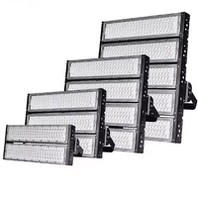
Benwei stadium flood light
【Power】500W 1000W 1500W
【Input Voltage】AC85-265V,400V
【Lighting Effect】150lm/W
【CRI】Ra≥70
【IP Rate】IP66
【Beam Angle】30°/60°/90°optional
【CCT】2700-6500K
【PF】PF≥0.95
【Surge Protection】≥4KV