Stadiums and arenas make use of powerful, energy-efficient lighting.
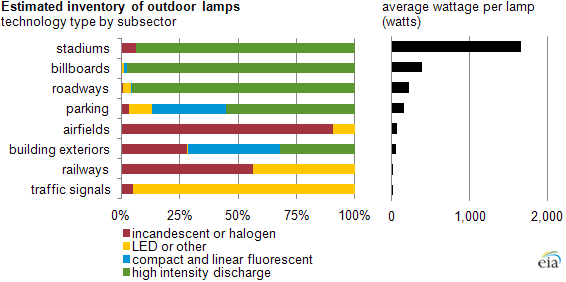
Arenas and stadiums employ effective, high High intensity discharge (HID) lamps are often used for practically all of the overhead lighting requirements in sports stadiums and indoor arenas. Stadium lighting often uses far more power than other outdoor lighting fixtures seen on billboards, streets, and parking lots. Despite their high efficiency, HID lights take a long time to warm up and reach their maximum brightness after being extinguished. Due to a power outage that affected portions of the Superdome's stadium lighting last Sunday, the Super Bowl game was delayed for a considerable amount of time as a result of this feature.
A 2012 U.S. Department of Energy (DOE) research found that 83% of the energy used for outdoor lighting in the country originates from HID lamps, accounting for 17% of all lighting usage in the country. Due to their high levels of light production, HID lamps are often only used in outdoor, warehouse, and industrial settings, in contrast to other lighting sources that may be found in a variety of applications.
For instance, a 60-watt incandescent lamp (or a comparable compact fluorescent utilizing just approximately 14 watts) will give off roughly 800 lumens of light per lamp. HID lamps can produce more than 15,000 lumens per lamp, making them appropriate for locations like sports stadiums, factories, and warehouses where large areas require a lot of light. Most residential and commercial applications only require each lamp to provide light levels in the range of about 800 to 4,000 lumens per lamp. In applications including signaling, signs, and general illumination, different lighting types like light-emitting diode (LED), incandescent, and halogen lamps are employed.
A lot of energy is needed to produce a lot of light. On a lumens-per-watt basis, HID lights are comparable to, if not more efficient than, other lighting technologies. As may be seen here, HID lights are more energy-efficient than certain other outdoor lighting kinds since they provide 75 lumens of light per watt.
The prolonged warm-up and restrike durations of high intensity discharge lights are one drawback. The 34-minute Super Bowl outage last Sunday was seen by millions of people. The primary overhead lighting in the arena of the New Orleans Superdome is provided by metal halide lamps, a kind of HID bulb. It took a while for electricity to be restored during the Super Bowl power outage, and it took even longer for the lights to restart, or become fully bright after being extinguished. Due of how the bulbs function, restrike times can take 5 to 20 minutes to reach 90% brightness, which is frequently longer than initial warm-up durations. Several types of metal halide HID lamps, according to the Lighting Research Center at Rensselaer Polytechnic Institute, employ a new starting mechanism that can reduce warm-up durations to 1-4 minutes and restrike times to 2-8 minutes. Wattage bulbs

If you want to know more about Benwei, you can click here: https://www.benweilight.com/industrial-lighting/led-stadium-light/led-flood-light-to-replace-300w-halogen.html