Lighting solutions for modern buildings must combine energy efficiency and aesthetic impact. LED exterior building lights can save up to 75% on operating expenses while transforming plain facades into architectural wonders.
We at PacLights have witnessed firsthand how well-placed outside lighting raises property values and produces enduring brand experiences. Within two to three years, energy savings from an appropriate LED system pay for themselves.
Which Type of LED Light Is Best for Your Building
Wall-Mounted LED Accent Lighting
LED lighting installed on the wall serves as the basis for architectural accent pieces. For maximum visual impact, these fixtures are mounted 8–12 feet above the ground. Most versions are 80% more efficient than conventional halogen counterparts, using 15–40 watts while producing 2,000–5,000 lumens.
Commercial buildings with wall-mounted LEDs save $2,400 a year every 1,000 square feet of facade area, according to the U.S. Department of Energy. In order to prevent hot spots and preserve consistent lighting across vertical surfaces, fixtures should be spaced 12 to 20 feet apart during proper installation.
Flood Lights to Illuminate Large Surfaces
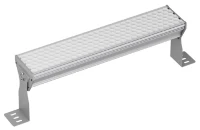
Flood lights are remarkably effective at handling big surface applications. Without sacrificing brightness, 100–300 watt LED versions can be used in place of 400–1,000 watt metal halide systems. With beam angles ranging from 15 degrees (for targeted accent work) to 120 degrees (for wide area coverage), contemporary LED flood lights provide 15,000–40,000 lumens.
When it comes to lighting an entire building, where even dispersion of light is crucial, these fixtures are excellent. When commercial properties convert from conventional flood systems to LED alternatives, they immediately experience energy savings of 60–70%.
Modern Design Lines with Linear LED Strip Lights
Continuous lines of light are produced by linear LED strip lights, which follow the edges and contours of buildings. These strips generate 600–1,200 lumens per foot while using only 8–12 watts. By extending up to 300 feet in single lines and integrating neatly into aluminum channels, the strips remove unsightly connection points that detract from the aesthetics of the design.
Through scheduling and automatic dimming, smart controls contribute an extra 20–30% in energy savings. To maximize performance all night long, these systems react to occupancy patterns and ambient light levels.
The degree to which these LED kinds complement your unique architectural characteristics will depend on the color temperature and beam angle you choose.
The Design Decisions That Make LED Facade Lighting Effective
The Color Temperature Strategy for Maximum Impact
Whether your facade accentuates modernity or provides warmth depends on the color temperature you choose. The greatest places to use warm white LEDs at 2700K–3000K are retail establishments, apartment complexes, and hospitality facilities where you want to draw people in and create welcoming environments. Cool white 4000K–5000K LEDs are ideal for tech firms, medical facilities, and office buildings that need to convey professionalism and creativity. According to research by the International Association of Lighting Designers, pedestrian engagement is 35% higher in buildings with suitable color temperatures than in generic installations.
Because mixed color temperature installations weaken architectural impact and generate visual confusion, they constantly fail. Coherent outcomes can be achieved by using a single color temperature throughout your facade. Although tunable white systems increase initial prices by 40–60%, they enable seasonal alterations that increase the appeal of properties during special occasions and holidays.
Accurate Beam Angle for Architectural Definement
Dramatic uplight effects are produced by narrow beam angles of 15 to 25 degrees, which highlight building height and vertical lines. From ground-mounted positions, these tight beams are ideal for architectural details, corners, and columns. Uniform wall washing that reveals material textures and produces consistent illumination across broad surfaces is made possible by wide beam angles of 60 to 120 degrees. According to the National Institute of Building Sciences, choosing the right beam angle enhances visual impact while lowering energy use by 25%.
Although they are 20–30% more expensive than fixed options, flood lights with adjustable beam angles remove uncertainty in the best possible light distribution. For effects that accentuate the textures of stone, brick, or concrete, place thin beam fixtures 8–12 feet away from the building base. To reduce hot spots and shadows, wide beam lights work best when positioned 15 to 25 feet away from vertical surfaces.
Combining Architecture and Materials
Fixtures on glass facades must be positioned precisely to prevent undesired reflections that cause glare and visual distraction. Use specialist anti-glare shields that prevent horizontal spills and guide light upward, or mount fixtures below the glass line. Architectural area lighting techniques, in which light strikes at shallow angles to reveal texture and depth, work incredibly well on stone and brick surfaces. Because polished surfaces reflect light differently than brushed or painted finishes (each necessitating various fixture angles), metal facades require careful consideration of finish choices.
Placement is determined more by building geometry than by aesthetics. While projecting features require downlights to preserve optical equilibrium, recessed architectural elements require uplights from below to avoid shadow pools. According to research by the American Institute of Architects, buildings with integrated design-phase installations outperform retrofit projects in terms of aesthetics by 60%.
Long-term project success and operating costs are determined by energy efficiency concerns, which are closely related to these design concepts.
The True Cost Savings of LED Exterior Lighting
Within the first year of installation, LED exterior lighting provide quantifiable cost savings that completely change your building's operational budget. Equivalent 100-watt LED flood lights cost only $44 per year, compared to $175 per fixture for 400-watt metal halide flood lights at $0.12 per kWh. When 20–50 outside fixtures are used in commercial installations, the savings of $131 per fixture soon add up.
65–80% reduction in power consumption Right away
Conventional halogen wall washers use 300–500 watts per fixture and need ballast power, which raises their overhead consumption by an additional 10%–15%. With ballast losses eliminated, LED substitutes generate the same amount of light at 75–120 watts. According to the Energy Information Administration, commercial buildings that convert to LEDs can save between $3,200 and $4,800 a year for every 10,000 square feet of facade space. After installation, these savings show up right away on your first utility bill.
For eight to twelve years, maintenance costs disappear
When used continuously, metal halide and high-pressure sodium fixtures break down every 12 to 18 months. Each lamp costs between $45 and $85 to replace, and labor expenses for high-mounted fixtures that need lift equipment range from $150 to $300. LED fixtures don't require maintenance for 8–12 years of normal use because they last 50,000–70,000 hours before needing to be replaced. Commercial buildings with 30 external fixtures minimize maintenance costs of between $6,000 and $12,000 a year.
ROI Estimates Indicate 18–24 Month Payback
For typical 5,000 square foot commercial buildings, complete LED facade systems range in price from $8,000 to $15,000. An annual cost reduction of $7,800 is achieved by combining energy savings of $4,200 with maintenance savings of $3,600. Even at premium fixture costs, this results in a full return on investment within 24 months. The quickest ROI increase available for commercial premises is LED conversion, which pays for itself in 15–18 months for buildings with higher utility bills or longer hours.
Extra Financial Gains Besides Energy Savings
Because LED outside fixtures emit 75% less heat than conventional options, they save HVAC loads. Buildings with extensive facade installations save an additional $200 to $400 a year in cooling expenses thanks to this heat reduction. Because LED security systems increase visibility and lower liability risks, insurance firms give rate discounts of 5–10% for premises equipped with them.
Concluding remarks
External LED building lights have revolutionary effects that go well beyond just saving energy. LED conversion is currently the most economic building renovation because to its 65–80% electricity reduction, 8–12 year maintenance expense elimination, and 18–24 month payback periods. Three things are necessary for success: choosing the right kinds of fixtures for your architectural elements, matching color temperature to the purpose of the structure, and positioning lighting at the right angles for the best possible dispersion of light.
Linear strips produce contemporary design lines that follow the contours of buildings, flood lights manage big surfaces, and wall-mounted lamps are excellent for accent work. As a result of lower energy and maintenance expenses, commercial establishments save $7,800 a year, which adds up over time. In addition to increased curb attractiveness and security, buildings with strategic facade systems have quantifiable increases in property value and a 35% increase in pedestrian interaction.
With the right system design and installation, Benwei lighting' comprehensive lighting solutions help you optimize these advantages. In addition to sophisticated networked systems that automatically optimize energy use, our LED fixtures come with optional daylight and motion controls. For both short-term cost reductions and long-term operational advantages, begin your LED conversion project right now.


http://www.benweilight.com/industrial-lighting/led-flood-light/led-powed-wall-flood-lights.html
Our address
No. 5-3 Niujiao Road, Yanchuan Community, Yanluo Street, Bao'an District, Shenzhen
Phone Number
+86 18659785153
bwzm04@ledbenweilighting.com