That Lightbulb Moment: A Rapid Shift Toward LEDs and Ultra-Efficient Lighting Solutions
The invention of the incandescent light bulb sparked drastic shifts in the daily lives and work of people with access to electricity. Yet, it was not until the 1970s oil shocks that questions arose about the efficiency of a bulb that wastes most energy as heat. Governments moved to promote energy efficiency, while industrial leaders like Philips and Osram invested heavily in alternative lighting, backed by laws aimed at phasing out inefficient bulbs.
The first outcome was the compact fluorescent light bulb (CFL), which offered five times the energy efficiency of traditional incandescents. However, consumers disliked its harsh blue-white glow and slow warm-up time. Halogen bulbs briefly served as a replacement but only boasted slightly better efficiency than standard incandescents. Then came LEDs, a game-changing alternative.
LEDs hold immense potential for rapid adoption and carbon emission reduction. They produce light instantly, match the colour spectrum of natural daylight, and generate very little heat – unlike incandescents, which waste up to 95% of energy as heat. American firm Fairchild Optoelectronics launched an LED lighting product as early as the 1970s, but LEDs remained expensive niche items for decades. It was not until 2000, when both industrialised and developing nations introduced minimum performance and efficiency standards (along with firm deadlines to phase out inefficient bulbs), that sales gradually shifted toward low-energy options.
Naturally, the speed and extent of LED adoption vary by country, as policies, economies, and energy access differ widely. As recently as 2015, many consumers hesitated to abandon traditional bulbs, viewing alternatives to halogens and incandescents as inadequate. But in recent years, LEDs have seen remarkable improvements in quality, design, price, and functionality-spurring a rapid surge in uptake. Today, LEDs cost \(2–\)5, use up to 90% less energy than incandescents (including halogens), and consume 60% less energy than older fluorescent lighting. By 2019, LEDs made up roughly 46% of global lighting sales, up from 37% in 2018.

Governmental Support for LED Adoption
The government-led push to phase out inefficient bulbs – critical to LED growth – began in 2005 in Brazil and Venezuela. The European Union, Australia, and Switzerland followed with their own phase-outs in 2009. Today, most governments and companies implement policies to boost LED adoption, drawn by their cost and energy-saving potential. The U.S. started phasing out inefficient bulbs in 2007 (though the Trump administration suspended the effort in 2019), while an EU directive will end sales of incandescents and halogens by late 2021.
Wider Relevance of LED Adoption
The rise of LEDs demonstrates how strong, interventionist government policies can phase out inefficient, wasteful products. Without such policies, industries would lack incentive to move beyond outdated lighting technologies. Notably, this legislation typically focuses on efficiency requirements rather than mandating specific technologies – letting industries innovate solutions. The result has been the steady decline of halogens and incandescents, yielding cost savings for both businesses and consumers.
LEDs are already reducing total energy consumption for lighting: in 2018, lighting accounted for around 13% of global energy use, and at current adoption rates, this is expected to drop to 8% by 2030. However, energy efficiency often takes a backseat to new renewable technologies and requires consistent support. According to the IEA, global energy efficiency improvements have slowed since 2015 – yet efficiency remains critical for cutting total energy use.
Lighting currently accounts for 13% of global electricity demand and 5% of annual global carbon emissions (for context, international shipping emits 1.7%). There is still huge potential to reduce lighting-related emissions: some estimates suggest that a global overnight switch to high-efficiency LEDs could cut 1.4 billion tonnes of CO₂, eliminating the need to build 1,250 power stations – a massive win for both carbon reduction and air quality.
LEDs also highlight how bold business decisions can quickly pay off. Manufacturers took risks to shift production from inefficient lighting to LEDs. In 2006, Philips Lighting (then deriving nearly two-thirds of sales from incandescents) decided to move away from incandescents and scale up LED production – a radical choice that faced strong opposition within the company and from shareholders. The move ultimately succeeded: now renamed Signify, the firm ranks among the top five global LED manufacturers, with annual revenue of around £6 billion.
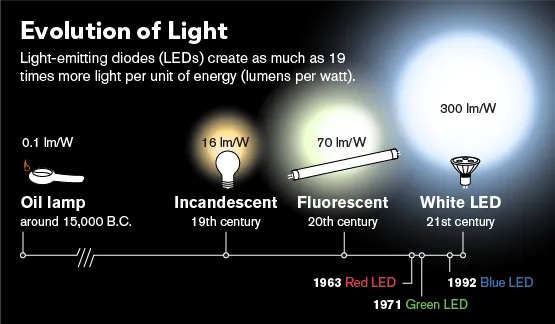
Additionally, the lighting transition underscores the importance of individual action in reducing carbon emissions. Even small personal choices, when multiplied across billions of people, yield enormous environmental and financial impacts. Passing savings to consumers helps drive change in a capitalist system. Beyond energy efficiency and environmental benefits, LEDs deliver significant cost savings: the U.S. Department of Energy estimates LEDs could cut national lighting energy use by 29% by 2025, saving households around £80 billion on electricity bills. In the UK, widespread LED adoption in homes would trim £2 billion from energy bills and prevent 8 million tonnes of carbon emissions. The initial investment to switch to LEDs in the UK is typically repaid in 3–4 months, and each household could save an average of £40 annually with full adoption.
Context and Background
The lightbulb's roots stretch back further than Volta to 1761, when Ebenezer Kinnersley demonstrated incandescence from a heated wire. But it was not until 1879 that Thomas Alva Edison patented an electric lamp that would dominate the market for nearly two centuries – having shrewdly acquired patents from other inventors to develop a functional product.
The incandescent bulb revolutionised life and work for those with electricity. Its 19th and 20th century dominance stemmed from a lack of competition and falling costs. As Edison famously predicted, "Only the rich will be able to burn candles"; by the 20th century, artificial light consumption was 100,000 times higher than in the 18th century.
However, developing efficient, long-lasting bulbs has not been smooth. In the 1920s, a manufacturers' cartel called "Phoebus" (including Osram, Philips, and General Electric subsidiaries) colluded to produce bulbs with shorter lifespans than previously available.
Fast-forward to the 21st century: once LEDs' overwhelming superiority became clear, the shift to manufacturing them was surprisingly contentious – but the promise of massive energy savings ultimately prevailed. Market penetration was slower than LED advocates hoped, requiring government intervention to accelerate adoption, scale up LED production, and phase out inefficient bulbs. Governments had extra motivation: public lighting costs consumed a large share of municipal budgets. For example, public lighting accounts for 20–40% of U.S. councils' electricity bills.
As intended, strict government legislation and efficiency standards drove down LED prices, making them affordable for billions and boosting market penetration. Over two decades, LED bulb costs have dropped more than 20-fold, while their luminous flux (lighting quality) has improved 40-fold. This has not only saved consumers money but also helped governments cut carbon emissions.
In India, for instance, the LED market grew 130-fold in five years: from 5 million annual sales in 2014 to 670 million in 2018. LEDs now deliver 30 terawatt-hours of annual energy savings – enough to power 28 million Indian homes or the entire country of Denmark for a year. Over the same period, LED bulb prices fell from around £4.50 in 2014 to £0.78 in 2019. LEDs have also made solar home lighting systems cheaper and more efficient in India, where many lack grid electricity access.
In hot climates like India, LEDs offer an added benefit: they help keep buildings cool. Incandescents waste 95% of energy as heat, making spaces uncomfortable in already stifling weather – often forcing reliance on inefficient, polluting air conditioners. LEDs, by contrast, lose minimal energy as heat, preventing unnecessary heating of people and spaces.
Enabling Factors for LED Dominance
A key driver of LED growth has been falling costs. Thanks to innovation in lighting manufacturing and large-scale production, LED prices have plummeted over decades. When LEDs first launched in the UK, consumers paid up to £9 per bulb – unthinkable today, with £1 LEDs now common. Prices dropped so quickly that a bulb could cost £1 less in just a year.
This price decline fuelled LED growth in two key ways: first, current prices make LEDs accessible to nearly all consumers, boosting sales and penetration; second, low costs shorten the return on investment (ROI), with some estimates putting it at 3–4 months. In some cases, ROI can reach 525%, though this depends on variables like usage and electricity costs.
Clear government legislation and guidance on efficiency, quality, and phase-outs also played a major role. To accelerate LED adoption, governments worldwide have introduced measures like minimum quality and efficiency standards. These policies phased out inefficient bulbs and shifted manufacturing capacity to LEDs, creating the scale needed to drive down costs rapidly. Under EU rules, 2021 could mark the end of incandescent and halogen bulb sales in the UK.
Growing consumer demand for accessible cost-saving technologies has also supported LEDs. Light bulbs let people reduce consumption (by replacing short-life bulbs) and cut emissions without specialised knowledge or large investments. Compared to halogens, LEDs excel in cost: halogens last around 2,000 hours (roughly two years of average use), while LEDs last 25,000 hours, delivering long-term savings and reducing waste. Full LED adoption saves the average household £40 annually. For consumers, businesses, and governments alike, these cost savings – paired with falling LED prices – make LEDs the default choice.
Scope and Evidence
American manufacturer Fairchild Optoelectronics launched an LED lighting product in the 1970s, but LEDs remained expensive niche items for decades.
In 2006, Philips Lighting (then deriving ~2/3 of sales from incandescents) shifted to scaled LED production; now renamed Signify, it is among the top 5 global LED manufacturers with ~£6 billion annual revenue.
LEDs last ~25,000 hours, delivering long-term consumer savings.
Brazil and Venezuela began phasing out inefficient bulbs in 2005; the EU, Australia, and Switzerland followed in 2009.
The U.S. started its phase-out in 2007 (suspended by the Trump administration in 2019).
In 2018, lighting accounted for ~13% of global electricity use and 5% of annual global carbon emissions.
Today, LEDs cost \(2–\)5 and use 90% less energy than incandescents (including halogens) and 60% less than old fluorescents.
LED sales rose from 37% of global lighting sales in 2018 to 46% in 2019.
Most governments and companies now have policies to boost LED adoption, driven by cost and energy savings.
An EU directive will end incandescent and halogen bulb sales by 2021.
A global switch to high-efficiency LEDs could cut 1.4 billion tonnes of CO₂ emissions, eliminating the need for 1,250 new power stations.
The U.S. Department of Energy estimates LEDs could cut national lighting energy use by 29% by 2025, saving households approximately £80 billion.
In the UK, widespread home LED adoption would trim £2 billion from energy bills and prevent 8 million tonnes of carbon emissions.
Full LED adoption saves the average UK household ~£40 annually.
This case study was originally published on the Nesta website here.
Together, we make it better.
Shenzhen Benwei Lighting Technology Co., Ltd.
Mobile/WhatsApp: (+86)18673599565
Email: bwzm15@benweilighting.com
Skype: benweilight88
Web: www.benweilight.com
Add: F Building, Yuanfen Industrial Zone, Longhua, Bao'an District, Shenzhen, China