Thermal Management: The no.1 Killer of LED Lifespan and How to Beat It
Ask any LED engineer: what causes 80% of premature LED failures? The answer is not cheap chips or bad drivers – it's heat. Poor thermal management silently degrades light output, shrinks driver life, and turns a "50,000-hour" lamp into a 5,000-hour disappointment.
This article focuses on the single most important variable for long-life LED lighting – thermal control. If you master this, you eliminate the root cause of most failures.
Why Heat Is the Real Enemy
An LED converts only 30–40% of its input power into light. The remaining 60–70% becomes heat. If that heat is not removed efficiently, the junction temperature (Tj) rises. Every 10°C increase above the recommended junction temperature roughly doubles the rate of lumen depreciation (light decay) and cuts driver electrolytic capacitor life by half.
High junction temperature causes:
- Accelerated lumen maintenance failure – Light output drops below 70% (L70) long before 50,000 hours.
- Wavelength shift – Critical for applications like horticulture or red light therapy.
- Driver breakdown – Electrolytic capacitors dry out faster in hot environments.
- Solder joint fatigue – Repeated thermal cycling cracks connections.
Proven Thermal Management Strategies for Long-Life LED Fixtures
1. Choose Metal Housings, Not Sealed Plastic
Plastic traps heat. Aluminum or die-cast metal housings act as heat sinks, conducting heat away from LEDs. For high-power fixtures (e.g., stadium lights, grow lights), finned aluminum extrusions are non-negotiable. Avoid fully sealed plastic bodies unless power is extremely low (<5W).
2. Maximize Surface Area and Airflow
- Add convection slots – Allow hot air to rise out and cool air to enter from below.
- Use finned heat sinks – More surface area = faster heat dissipation.
- Mount LED strips on aluminum profiles – Even for linear T8 tubes, aluminum backing helps spread heat.
3. Run LEDs at Lower Current (Derating)
Driving an LED at its absolute maximum current generates excessive heat with minimal gain in lumens. The sweet spot is usually 70–80% of rated current.
Example: A 1W LED chip rated for 350mA can be driven at 280mA. Luminous output drops by only ~10%, but junction temperature falls by 15–20°C, and lifespan doubles or triples.
Better yet: Use more LEDs at lower current instead of fewer LEDs at high current. This spreads heat over a larger area and improves uniformity.
4. Ensure Adequate Ventilation
Even the best heat sink fails if installed in a confined space or wrapped in insulation. For recessed downlights, use fixtures rated for "IC" (insulation contact) with proper thermal pathways. For floodlights, maintain at least 10–15 cm clearance from walls or ceilings.
5. Active Cooling for High-Power Applications (≥50W)
For high-bay lights, stadium floodlights, or grow lights above 100W, passive cooling may not be enough. A small, silent fan (IP-rated for dust/ moisture) can reduce junction temperature by 20–30°C, dramatically extending LED and driver life. Some premium fixtures integrate fan fail-safe circuits.
6. Monitor and Control Junction Temperature
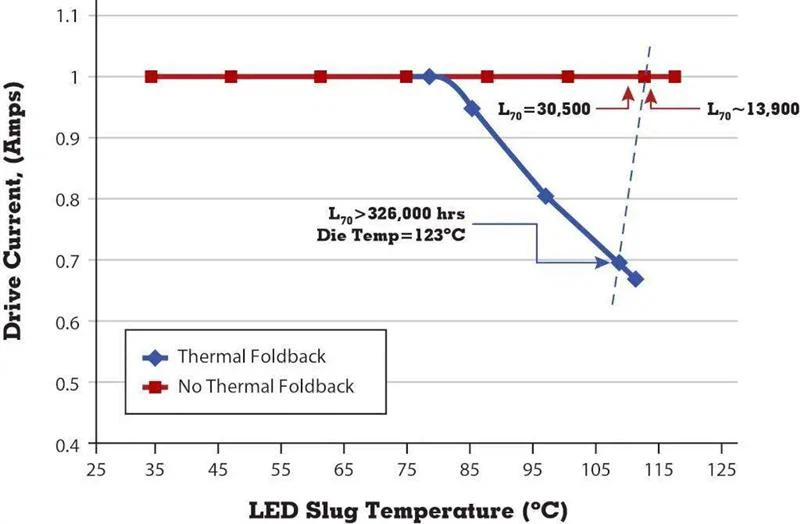
Add a temperature sensor (NTC thermistor) on the MCPCB near the LED. Use it to implement thermal foldback – a circuit that gradually reduces current when temperature exceeds a safe threshold (e.g., 85°C at the solder point). This prevents catastrophic failure and allows the fixture to keep working at reduced output instead of dying completely.
7. Target Realistic Junction Temperatures
- Acceptable for standard products: Tj ≤ 85°C (still, lifespan may drop to ~35,000h)
- Ideal for long-life (50,000–100,000h): Tj ≤ 65°C
- Exceptional for premium/medical/industrial: Tj ≤ 55°C
Achieving 65°C or lower requires a combination of good heat sink design, derating, and sometimes active cooling.
Real-World Case: T8 LED Tube vs. T8 Fluorescent Retrofit
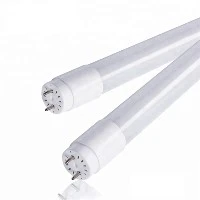
Many T8 LED tubes on the market use plastic housings with a thin aluminum back. Installed in enclosed fixtures (common in parking garages or cold storage), the trapped heat raises junction temperature to 95–105°C. Result: L70 reached in 15,000–20,000 hours – not the advertised 50,000 hours.
A properly designed T8 tube uses:
- Half-aluminum, half-polycarbonate housing (aluminum side contacts the LED strip)
- Thermal conductive adhesive (not double-sided tape)
- Derated driver (e.g., 9W LED driven at 7W)
With these measures, Tj stays below 75°C even in enclosed fixtures, achieving 50,000+ hours.

Don't Forget the Driver – Heat Kills It Too
Driver electrolytic capacitors are extremely temperature-sensitive. A rule of thumb: for every 10°C reduction in capacitor operating temperature, capacitor life doubles.
| Capacitor Rated Temp | Operating Temp | Expected Life (hours) |
|---|---|---|
| 105°C (electrolytic) | 75°C | ~30,000–50,000 |
| 105°C (electrolytic) | 55°C | ~80,000–120,000 |
| Solid capacitor / film | 75°C | >100,000 |
Best practice:
- Use electrolytic‑free drivers (only resistors, inductors, ceramic caps) for the longest life.
- Or choose drivers with solid polymer capacitors (rated 10,000+ hours at 105°C, translating to >100,000 hours at 65°C).
- Brands like Meanwell offer excellent thermal performance – we use them extensively.
Summary Checklist for Buyers & Engineers
When evaluating a long-life LED product, ask the supplier these questions:
- What is the measured junction temperature at rated power and 25°C ambient?
- Is the housing metal (aluminum) with fins or convection holes?
- Are LEDs derated (not running at max current)?
- Is there thermal foldback protection?
- What type of capacitors are in the driver (electrolytic vs. solid/film)?
- Has the fixture passed a thermal imaging test after 2 hours of operation?
Key Takeaways
Thermal management is not an add-on – it is the foundation of long-life LED lighting. A brilliant optical design or premium LED chip means nothing if heat is allowed to build up. Conversely, a modest LED system with excellent cooling will outlast premium components in a hot box.
For manufacturers, investing in thermal engineering reduces warranty costs and builds brand trust. For buyers, prioritizing thermal specifications over simple lumens-per-dollar leads to lower total cost of ownership and fewer replacements.
Remember: Cool LEDs last. Hot LEDs are a liability.