What are the advantages and challenges of 15° 0-10V dimmable LED spotlights for professional lighting?
Lighting design in museums, art galleries, and upscale commercial settings is about more than just brightness. For these demanding applications, a 15° beam angle LED spotlight and 0–10V dimming technology are combined. To assist lighting designers, contractors, and end users in making well-informed decisions, this article explores the main advantages and technical difficulties of this system.
Four Key Advantages of 15° 0-10V Dimmable Spotlights
1. Accurate Light Control to Draw Attention to Items
The center beam candlepower of a 15° beam is incredibly high due to its exceedingly narrow beam angle. As a result, the lit object and its surroundings stand out dramatically. The effect is ideal for high-end shop display lighting, museum exhibit lighting, and art gallery accent lighting, where the objective is to direct the viewer's eye and make the object the center of attention.
2. Smooth, Stable 0-10V Dimming
The analogue dimming protocol 0-10V is renowned for its dependability and advanced technology. It has a superb dimming curve and smooth, continuous dimming from 0% to 100%. Even at extremely low brightness levels, 0-10V exhibits no discernible flicker or stepping, in contrast to TRIAC or low-frequency PWM dimming, making it comfortable for the human eye.
3. Systems that work well together for business projects
0-10V is a standard protocol for business and industrial lighting, and it's easy for building management systems (BMS), lighting control consoles, and scene panels to work together. For places like showrooms, conference rooms, and hotel ballrooms that need to handle a lot of spotlights from one place, the wiring is easy and the commissioning goes quickly, which makes the system simpler overall.
4. Better quality light
This type of professional spotlight usually has COB LEDs with a high CRI (>90) and precise optical lenses or mirrors. When used with 0-10V lighting, they still show true colours even at low dimming levels. This is very important for lighting things like art, fabrics, and skin tones that need to look their true colours.
Five Challenges to Consider During Selection and Installation
1. Needs very accurate optical design
To reduce the beam angle to 15° while keeping a clean, uniform spot free of artefacts, the lens or reflector design and mould making must be very precise. A lot of low-quality goods have secondary spots, stray light, or colour fringing at the beam edge, all of which can really ruin the quality of the image.
2. Installation and adjustment with little room for error
A narrow beam means that the flashlight is very picky about where it is placed. It's not possible to make mistakes with the aiming position or where the fixtures are placed. If the fixing hole or fixture position is off, the beam might not hit the thing it's supposed to. Also, when adding a lot of fixtures, the low-voltage 0-10V signal wiring needs to be carefully routed and kept away from the mains power lines to avoid electromagnetic interference that can mess up the dimming.
3.How to Make Dimming Work with "Off-State" Devices
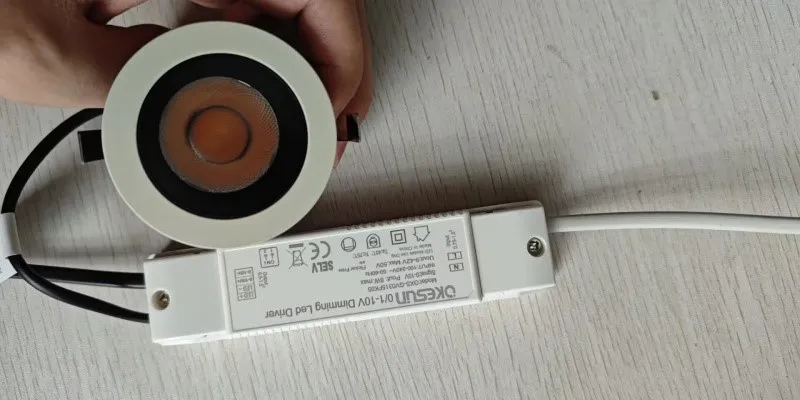
Even though 0-10V is a standard system, drivers and dimmers from different brands may still have trouble dimming together. This is especially true below 5% brightness, where flickering or uneven output may show up. Even worse, most 0-10V systems can't physically cut off power from the wall at 0V. The driver is still in sleep mode, and the LED may still give off a dim light. Use a dimmer with a built-in relay or add a different switch circuit to turn the light off completely.

4. Changes in colour temperature and chromaticity when the brightness is low
This is a problem that LED lighting often has. Some LED chips have small changes in colour temperature and tint when the dimming level is very low. This small change might be obvious in a 15° spotlight used for high-quality accent lighting, and it could change how the scene is lit.
5. Costs more overall
It costs more for a precise 15° optic and a high-quality 0-10V dimmable driver to work together than for regular flood downlights or household spotlights. This investment, on the other hand, provides a controlled, repeatable, and high-quality lighting environment for projects with strict lighting quality standards.
In conclusion
A standard way to light a business is with a 15° LED spotlight that can be dimmed from 0 to 10V. The best thing about it is that it can make lighting effects that are very controlled and powerful. The hardest thing about it is getting the optics right and setting it up on-site. If you can install and adjust the lights professionally and your job needs the best lighting possible, this is the best combination for you.
To view specific product specifications or receive project selection advice, visit our product center or contact our technical team.
Contact
Kevin
bwzm12@benweilighting.com
+8619972563753
FAQ
Q: What kinds of tasks do you think a 15° beam angle would work best for?
A: A 15° beam angle is best for tasks that need precise control of the light, like lighting museum exhibits, art galleries, high-end shopfront displays, and hotel rooms that need to stand out.
Q: What's the difference between TRIAC dimming and 0-10V dimming?
A: 0-10V is a low-voltage analogue signal dimming method that works well with central control systems and gives you smooth, flicker-free control. TRIAC dimming is a high-voltage phase-cut method that is easier to set up but more likely to flicker at low levels and doesn't work with as many devices.
Q: How can I solve the problem of a 0-10V dimmed light not turning off completely?
A: You can add a relay circuit to cut the mains power or choose a 0-10V dimmer with a built-in switch that turns off the power automatically when the dimming signal is at its weakest.
Q: What is the most important thing to think about when putting in a 15° spotlight?
A: To make sure each beam hits its goal, the most important step is to carefully plan where the fixtures will go and how they will point ahead of time. To avoid signal confusion, keep the wiring for the 0-10V signal away from the wiring for the mains power.