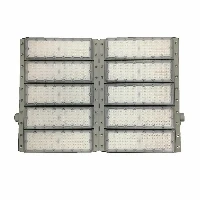
LED flood lights are a game-changer in the ever-evolving field of contemporary lighting, with uses in anything from elaborate architectural marvels to large outdoor stadiums. An excellent LED flood light is more than just a light source; it is a complex fusion of state-of-the-art technology, exceptional energy efficiency, robust durability, and outstanding performance. Examining the distinguishing features of these flood lights offers useful information to help consumers and business professionals make wise decisions. High-Efficiency LED Chips: The Foundation of Lighting A collection of high-efficiency LED chips, the unsung heroes in charge of transforming electrical energy into bright light, are at the core of a premium LED flood light. Prominent producers such as Cree and Osram have established the benchmark in this field by producing chips with incredible lumen-per-watt ratios. Modern LED chips, for example, may produce up to 150 lumens per watt, which is far more than what their inferior predecessors can produce. In practical applications, this results in a notable benefit. These cutting-edge chips enable a 100-watt high-quality LED flood light to deliver a luminous output that is on par with or even higher than that of a conventional 500-watt halogen flood light. The outcome? more light while using a fraction of the energy.
Better Heat Dissipation Design: Maintaining Efficiency and Durability
Heat is an inevitable byproduct of LED operation, and if it is not properly managed, it may quickly impair performance and drastically reduce lifespan. High-quality LED floodlights use creative heat-dissipation designs to overcome this issue. These flood lights, which are usually housed in housings made of premium aluminium alloys, quickly dissipate heat from the LED chips by taking use of the material's exceptional heat-conductive qualities. The dissipation process is further improved by the installation of large-surface-area heat sinks with delicately sculpted fins. Some sophisticated versions use heat-pipe technology, which produces an extremely effective thermal route that guarantees the LED chips run at ideal temperatures. In addition to stabilising the flood light's performance, this careful heat management increases its longevity, lowering maintenance costs and the need for frequent replacements.
Optimal Beam Angle and Light Distribution: Customising Lighting to Meet Requirements
An LED flood light's applicability for various applications is largely determined by its beam angle and light dispersion. To meet a variety of lighting needs, high-quality flood lights come in a broad range of beam angles. For concentrated illumination, such as illuminating distant objects or emphasising certain architectural aspects, narrow beam angles-between 10 and 30 degrees-are perfect. Conversely, broad-area coverage is best achieved with wide beam angles of 120 degrees or more, which provide consistent lighting in expansive areas like parking lots or sports fields. The use of well designed reflectors and lenses results in a uniform dispersion of light without dark areas or uneven brightness, which is a hallmark of excellence. A steady and comfortable lighting environment is produced by precisely directing light with parabolic reflectors and evenly dispersing it with diffusing lenses.
Bringing Colours to Life with a High Colour Rendering Index (CRI)
A crucial indicator of light source quality, the Colour Rendering Index compares artificial light to natural light to determine how well light sources can replicate object colours. Colours seem vivid and true to life when illuminated by a high-quality LED flood light, which usually has a CRI of 80 or better. Flood lights with a CRI of 90 or more are recommended for situations where colour accuracy is crucial, including art galleries, museums, or retail displays. By making colours more vibrant and distinct, these high-CRI flood lights improve an object's visual attractiveness. They are also essential for increasing the precision of color-differentiation activities in industrial contexts, such quality control inspections and assembly procedures.
Sturdy and Weather-Resistant Building:Withstanding the Conditions
Because they are often used outside, high-quality LED flood lights are designed to withstand a variety of weather conditions. Their housings are made of sturdy materials that are very resistant to corrosion, such as powder-coated aluminium or stainless steel. High-level ingress protection (IP) ratings are attained by tightly sealing joints and seams to keep out dust and water. For instance, an IP65 certification guarantees defence against dust and low-pressure water jets coming from any angle, but IP67 and IP68 ratings permit immersion in water at different depths. From sweltering deserts to frigid arctic areas, this sturdy design ensures dependable performance under even the most extreme conditions.
Long Life and Energy Savings: An Eco-Friendly Lighting Option
The exceptional energy efficiency of LED technology, and consequently, high-quality LED flood lights, is one of its biggest benefits. LED flood lights may save up to 80% on energy usage when compared to conventional incandescent or halogen flood lights, which results in significant power bill savings. When combined with their 50,000-hour or longer lifespan, these flood lights provide an economical and environmentally friendly lighting option. The combined energy savings and lower maintenance needs over the course of the flood lights' lifespan can yield substantial cost benefits in large-scale outdoor projects, such as lighting parks, roads, or business complexes.
Unleashing Lighting Creativity with Dimming and Control Features
Modern high-quality LED flood lights provide unmatched lighting design freedom thanks to their sophisticated dimming and control features. They may be easily included into smart lighting systems, giving users the ability to customise the lighting patterns, colour temperature, and brightness to suit their own requirements. The light output may be smoothly and precisely controlled by dimming using a variety of techniques, such as analogue dimming and pulse-width modulation (PWM). These flood lights' simplicity and adaptability are further increased by remote control features made possible by smartphone applications or central control systems. Lighting specialists may employ these characteristics to create dynamic and immersive lighting experiences in event settings, and outdoor security applications can increase safety and energy efficiency by adjusting illumination levels according to activity or time of day. In conclusion, a high-quality LED flood light is the epitome of lighting technology because it combines energy-saving features, long lifespan, high CRI, optimal beam angle and light distribution, superior heat dissipation, high-efficiency LED chips, and sophisticated control capabilities. These elements must be taken into account when choosing an LED flood light for any application in order to guarantee that the final product will provide dependable, high-performance illumination that satisfies the project's particular needs. A high-quality LED flood light is essential for attaining outstanding lighting outcomes, whether the goal is to illuminate a sizable industrial complex, improve the visual appeal of a historic site, or create a secure and welcoming outdoor area.

https://www.benweilight.com/industrial-lighting/led-flood-light/led-powed-wall-flood-lights.html