Going Back to the Fundamentals: Light and Wavelength
Understanding the fundamentals of wavelength and light is crucial before we can respond to the issue of whether 365 nm or 395 nm is better for your application.
We see distinct visible light wavelengths as different hues, as you may remember. For instance, light at 450 nm is royal blue, whereas light at 630 nm is sharp and red. Visible light has a wavelength between 400 and 800 nm, but ultraviolet light, which is invisible, has a wavelength below 400 nm.
The wavelength value is crucial even if photons with wavelengths shorter than 400 nm are invisible to the human eye. For instance, UV with a wavelength of 365 nm is classified as "UV-A," whereas UV with a wavelength of 290 nm is classified as "UV-B." The kind of UV is determined by its wavelength, which is a crucial differential between UV categories in terms of use and even required safety measures.
Fundamentally, you should be aware that 395 nm is roughly 30 nm closer to visible light, or violet, than 365 nm. Stated differently, 365 nm is "deeper" into the UV spectrum than 395 nm.
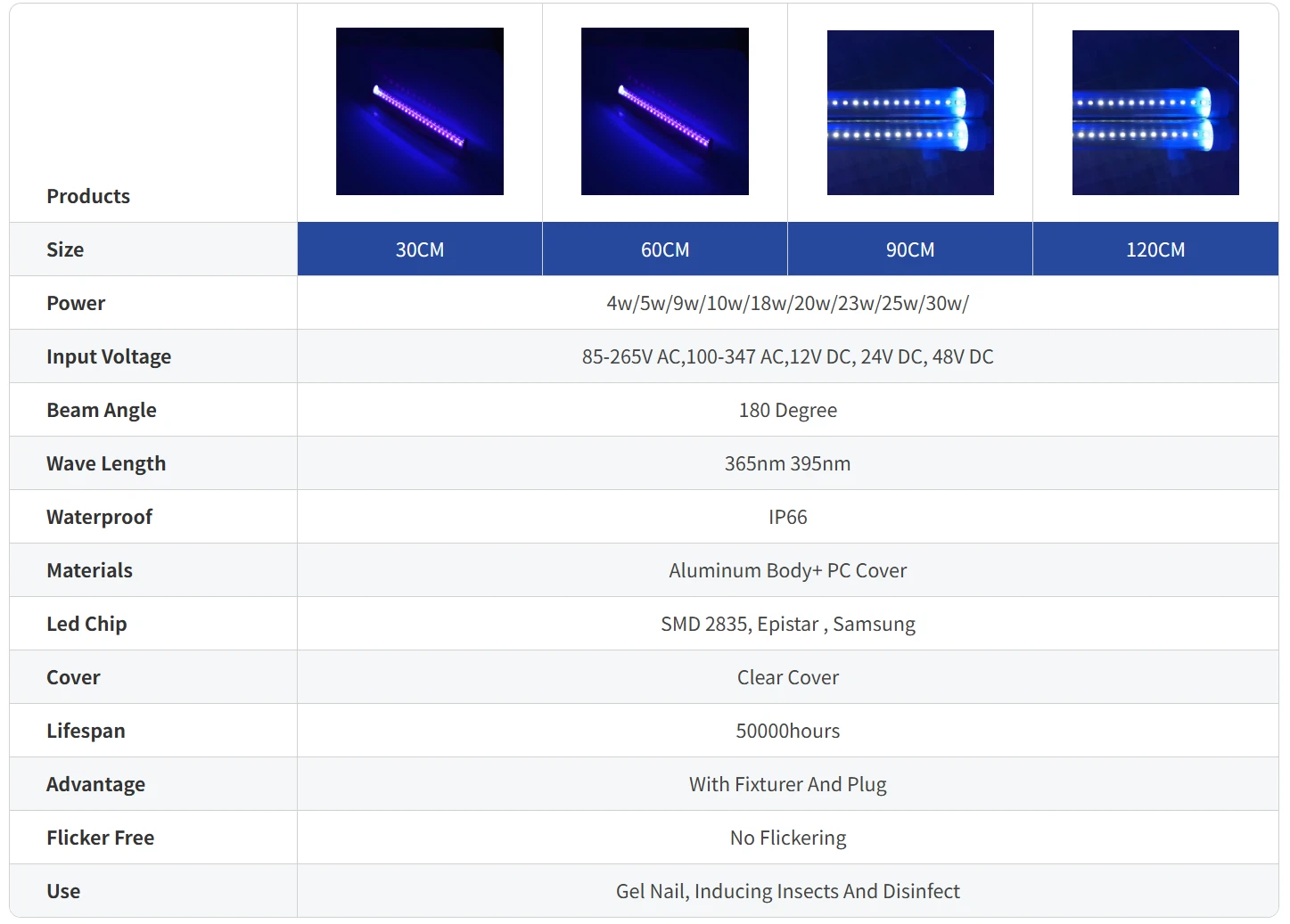
Applications of UV-A at 365 and 395 nm
UV-A wavelengths include both 365 nm and 395 nm choices. In general, UV-A lamps are helpful for curing paint and polymers, as well as for producing and viewing fluorescence effects. Compared to the more potent UV-B and UV-C rays, UV-A wavelengths are safer.
So what will a 30 nm difference mean?
The primary distinction is that compared to the 365 nm LED, the 395 nm LED emits significantly more visible light. Whereas the 365 nm LED produces a drab, bluish-white light (due to leftover light energy that "tails" off into the visible spectrum), the 395 nm LED produces a noticeable violet hue. Both kinds can typically produce "blacklight" or curative effects and emit in the UV-A wavelength range.
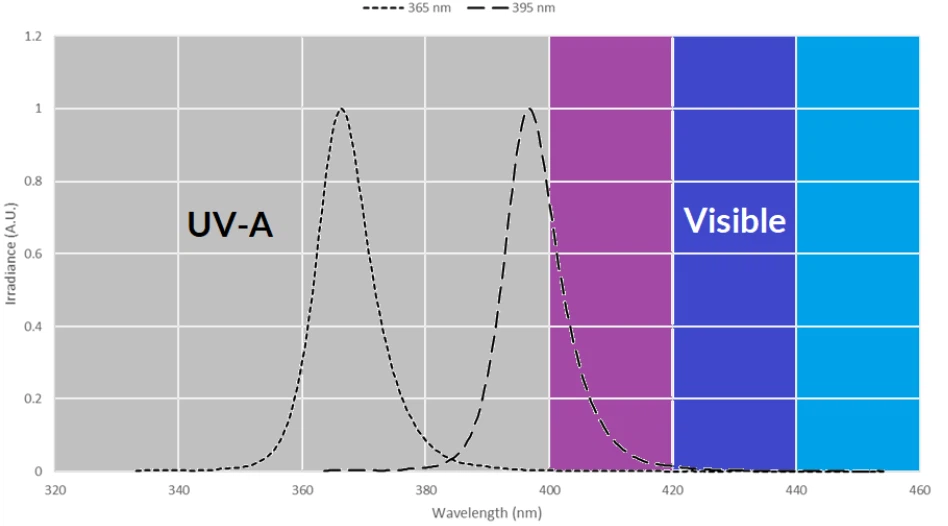
What causes the variation in the amount of light that is visible? The spectrum output diagrams of the 395 nm (wide dotted line) and 365 nm (narrow dotted line) LEDs are displayed in the above chart. Both 365 nm and 395 nm LEDs emit over a range of wavelengths, both above and below their designated wavelengths, as you will notice. Put differently, 395 nm LEDs don't just emit light at that wavelength.
According to the definition of peak wavelength, the 395 nm LED emits most at 395 nm, but it also emits a significant amount of light at 400 nm and even 410 nm. The visible, violet region of the spectrum is where these wavelengths are firmly located.
Of course, the 395 nm LED also generates light at wavelengths shorter than 395 nm, and the light energy at these wavelengths is highly efficient in causing UV-A reactions or fluorescence effects. However, it is crucial to observe that a sizable amount of the light energy is being released in the visible, violet region, as the figure illustrates.
On the other hand, you will observe that almost all of the light energy in the 365 nm spectrum output falls into the invisible UV-A band, with emission energy tumbling off before it reaches 400 nm. This is ideal for the majority of UV-A applications since it will optimize the amount of UV-A energy relative to visible light energy.
However, you will probably observe a poor, bluish-white color emitted when a 365 nm LED is illuminated. This is brought on by "leakage" of visible light, which is the emission of tiny but noticeable amounts of visible wavelength energy, or white light. Although the visible light energy is so tiny that it appears as "0" in spectral charts, it can be detected in certain applications, including UV photography, and can be an annoyance. Other visible light filtering methods might be required in these situations.
The Strongest Fluorescence at 365 nm
Absorption spectrum data show that many items fluoresce most strongly at 365 nm, in addition to the fact that 365 nm UV lights have the advantage of not generating violet light.
As a result, applications requiring higher fluorescence effects might benefit more from 365 nm light. 365 nm light might be regarded as the best option when performance is crucial, especially when combined with the benefit of emitting less visible, violet light.
Cost and Efficiency Differences
Chips with a 365 nm wavelength are often more expensive and less efficient due to the manufacturing process used to make LED diodes. Although the precise price difference will vary depending on the type of product, 395 nm LED products are more affordable than 365 nm LEDs, which generally have a higher price tag.
Waveform Lighting provides a range of UV LED strip lights and UV flood lights at both 365 and 395 nm. Purchase links are provided below.


Our address
No. 5-3 Niujiao Road, Yanchuan Community, Yanluo Street, Bao'an District, Shenzhen
Phone Number
+86 18659785153
bwzm04@ledbenweilighting.com