The Hidden Costs of Traditional Outdoor Lighting
To understand the necessity of the Thermal Respirator, one must first diagnose the inherent vulnerabilities of standard outdoor flood lights. Facility managers are not just buying light bulbs; they are buying reliability. When that reliability fails, the hidden costs emerge.
The "Breathing Effect" and Moisture Ingress
Outdoor fixtures are subjected to severe diurnal temperature fluctuations. During the day, the fixture heats up, causing the internal air to expand. As night falls or a sudden rainstorm hits, the housing cools rapidly, and the internal air contracts.
This creates a vacuum, a phenomenon known as the "breathing effect." This negative pressure inevitably draws in ambient air-and with it, moisture-through microscopic gaps in the silicone seals and cable glands. Once inside, the moisture condenses on the coldest surfaces, typically the internal lens and the LED board. The result is catastrophic: corrosion of the printed circuit board (PCB), short circuits in the driver, and a permanent reduction in optical clarity due to water spots.
Thermal Stress and Accelerated Lumen Depreciation
LEDs are semiconductor devices; they are highly sensitive to heat. When the heat generated by the LED junction cannot be efficiently dissipated, the temperature rises rapidly. This thermal stress accelerates the degradation of the phosphor coating and the semiconductor die, leading to Lumen Depreciation (L70 or L80).
Traditional low-cost housings, often made of thin aluminum or stamped steel, lack the thermal mass and surface area to effectively dissipate this heat. Consequently, the fixture dims significantly within the first two years of operation, failing to meet mandated lighting levels for safety and security.
The Financial Black Hole of Maintenance
When a high-mast flood light fails at 30 or 40 feet in the air, the cost of the replacement unit is the least of the facility manager's worries. The true expense lies in:
Labor and Equipment: Renting boom lifts or cherry pickers and paying specialized technicians.
Downtime: Unlit areas causing safety hazards, parking lot accidents, or security vulnerabilities.
Inconsistent Inventory: Managing multiple replacement part numbers and dealing with urgent shipping fees.
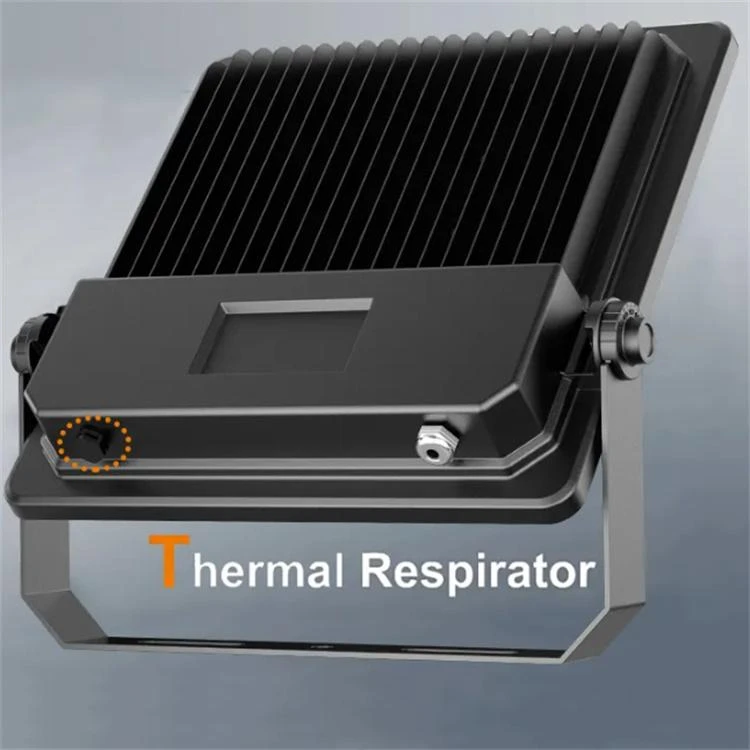
The Core Technology: How the Thermal Respirator Works
The Thermal Respirator (often referred to as a pressure equalization valve or breathable waterproof vent) is the critical component that revolutionizes the longevity of outdoor flood lights.
The Anatomy of the Respirator Valve
The respirator is a small but sophisticated mechanical device embedded into the die-cast aluminum housing. It features a highly engineered micro-porous membrane (often made of expanded PTFE).
This membrane is hydrophobic (water-repellent) but highly breathable. It allows air molecules, which are extremely small, to pass freely in and out of the housing. However, liquid water molecules, which have a much higher surface tension, cannot penetrate the membrane.
Pressure Equalization in Action
By allowing air to flow freely, the respirator ensures that the internal pressure of the flood light remains identical to the external atmospheric pressure.
Eliminating the Vacuum: When the fixture cools, the respirator allows air to enter without creating a vacuum, meaning the silicone seals are no longer stressed.
Stopping the Suction: Because there is no pressure differential, ambient moisture is not sucked into the housing.
Eradicating Internal Condensation
By keeping the internal pressure stable and allowing microscopic amounts of trapped moisture to escape as vapor, the Thermal Respirator completely eliminates internal condensation. The UV-Proof Optical PC Lens, the Nano-Plastic Reflector, and the Aluminum PCB remain perfectly dry. This single feature can effectively double the lifespan of the LED driver and the light source itself.
The Synergistic Defense: Thermal Respirator Meets Die-Cast Aluminum
A Thermal Respirator is highly effective on its own, but it is most powerful when paired with a robust thermal management system. This professional-grade flood light features an elite synergy between its respirator and its Die-Casting Aluminum Housing.
Advanced Heat Dissipation Architecture
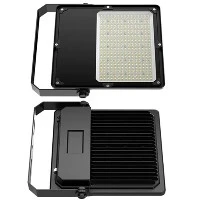
The heavy-duty die-cast aluminum housing is engineered with a dense, optimized fin structure. This design maximizes the surface area exposed to ambient air.
High Thermal Conductivity: Aluminum rapidly transfers heat away from the 3030 SMD LEDs and the driver.
Convection Efficiency: The dense fins create a chimney effect, allowing cooler air to flow upward and displace the heated air, ensuring continuous, passive cooling.
Lower Junction Temperature: By consistently keeping the LED junction temperature low, the fixture prevents thermal degradation, ensuring maximum luminous efficacy (125-140 lm/W) is maintained over its 50,000-hour lifespan.
Structural Integrity and Impact Resistance
The die-cast aluminum housing is not just a heat sink; it is an armored shell. Finished with a robust powder coating, it offers exceptional resistance to corrosion, UV degradation, and salt spray-making it ideal for coastal ports and harsh industrial environments.
Combined with the high-strength Tempered Glass Cover and Waterproof Silicon Gel seals, the fixture achieves an IK08 impact rating, protecting the internal components from heavy impacts and vandalism.
The IP66 Fortress
The combination of the pressure-equalizing respirator and the heavy-duty die-cast housing results in an IP66 ingress protection rating.
Dust-Tight: Total protection against dust ingress, which can otherwise accumulate and cause thermal insulation or electrical shorts.
Water Jet Protection: Protected against powerful water jets from any direction. This makes the fixture completely immune to heavy storms, typhoons, and high-pressure wash-downs commonly used in industrial facilities.
The Operational and Financial Benefits for Facility Managers
Switching to Thermal Respirator Flood Lights is not just a technical upgrade; it is a strategic financial decision.
Slashing Total Cost of Ownership (TCO)
The most immediate and tangible benefit for facility managers is the drastic reduction in maintenance costs.
Zero-Maintenance Operation: With a rated life of 50,000 hours (over 10 years of typical nightly use) and the elimination of moisture-induced failures, the need for routine maintenance is virtually eliminated.
Reduced Equipment Rentals: No more scheduling expensive boom lifts or cherry pickers every few months to replace failed fixtures.
Labor Savings: Maintenance crews can be redeployed to other critical facility tasks, optimizing workforce efficiency.
Uncompromising Safety and Security
Facility managers are responsible for the safety of employees, visitors, and assets. Thermal Respirator Flood Lights deliver unwavering, flicker-free illumination with a high Color Rendering Index (CRI>80).
Sports and Public Areas: The precise optics (available in multiple beam angles like 60° or 90°) ensure uniform light distribution, eliminating dark spots and glare that could cause accidents.
Security Integration: Consistent, high-output lighting acts as a powerful deterrent against trespassing and vandalism, while ensuring CCTV cameras capture clear, high-definition footage day or night.
Energy Efficiency and ESG Compliance
Sustainability is no longer just a buzzword; it is a measurable KPI for facility managers.
High Efficacy: The advanced 3030 SMD LEDs deliver up to 140 lm/W, meaning a 150W fixture can easily replace a 400W traditional HID system, cutting energy consumption by up to 65%.
Carbon Footprint Reduction: By reducing energy usage and eliminating the manufacturing, transportation, and disposal of replacement fixtures, facility managers can significantly lower their facility's carbon footprint, directly contributing to corporate ESG (Environmental, Social, and Governance) goals.
Ease of Installation and Precision Aiming
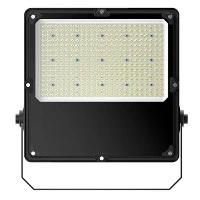
The transition to these advanced fixtures is seamless, thanks to thoughtful engineering. The flood light features a Thickened Iron Rotating Bracket with a robust locking mechanism.
Tool-Free Adjustment: Installers can easily adjust the angle of the light precisely where it is needed during installation, ensuring optimal light distribution.
Wind Resistance: The heavy-duty bracket provides a secure, rigid mount, ensuring the fixture does not shift over time due to high winds or vibrations, maintaining the exact optical performance specified by the lighting designer.
Real-World Application Scenarios
The versatility of the 20W-200W range makes this fixture indispensable across diverse facility types:
Industrial Parks & Logistics Centers: Withstanding high dust levels and wash-downs, these lights illuminate vast loading docks and storage yards.
High-Mast & Stadium Lighting: The robust thermal design and rotating brackets allow for safe, high-altitude mounting, delivering broadcast-quality lighting for sports facilities.
Municipal Infrastructure: From parks to parking lots, the IP66 and IK08 ratings ensure the lights can withstand vandalism and extreme weather, reducing municipal maintenance burdens.
Ports and Coastal Areas: The die-cast aluminum and powder coating provide the necessary salt-spray resistance, while the respirator prevents the heavy condensation typical in coastal environments.
Conclusion: The Future-Proof Investment
Facility management is evolving from reactive maintenance to predictive, reliability-centered asset management. In this new era, traditional flood lights, with their inherent vulnerabilities to thermal stress and moisture ingress, are an obsolete liability.
By adopting Thermal Respirator Flood Lights, facility managers are choosing a future-proof solution. The combination of a die-casting aluminum heat sink, a revolutionary pressure-equalization valve, and premium components (3030 SMDs, branded drivers, UV-proof lenses) guarantees a 50,000-hour, zero-maintenance lifespan.
This is not just an upgrade in illumination; it is a decisive investment in operational stability, financial efficiency, and environmental sustainability.
Take control of your facility's lighting infrastructure today. Contact our specialists to request a specification sheet or schedule a consultation to see how our Thermal Respirator Flood Lights can reduce your maintenance OPEX and elevate your safety standards.
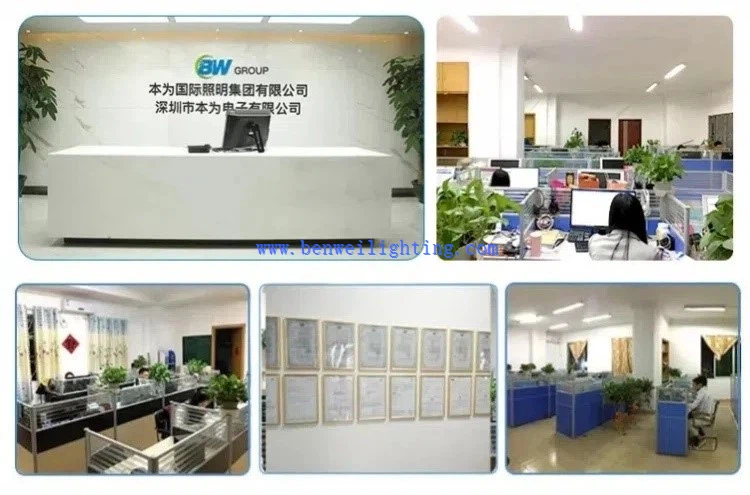
How To Cooperate With Us?
We are happy to have total control over the manufacturing process and the calibre of our products since we have our own facilities. Since we are producers rather than just brokers, we are dedicated to providing our customers with the best pricing. Since we are certain that the price and quality of our products are clear, we invite customers to see our samples first. Our commitment to quality and customer satisfaction drives us to continuously provide top-notch goods.
Our address
3rd Floor, 5th Building, Hebei Industrial Park, Hualian Community, Longhua District, Shenzhen, China