What Light Should You Use in a Mushroom House or Plant Shelf?
In mushroom cultivation, indoor plant factories, or home plant shelves, lighting is often one of the key factors determining yield and quality. Many people think "as long as it's bright enough," but mushrooms and plants have very different light requirements – especially mushrooms, which do not perform photosynthesis but are highly sensitive to specific spectra for photomorphogenesis. Choosing the wrong light can result in deformed mushrooms or even no fruiting at all.
1. What Mushrooms Need Is Not "Light" but "Signal"
Mushrooms are fungi, containing no chlorophyll, and cannot produce nutrients through photosynthesis. However, light is still an essential part of mushroom cultivation – it mainly regulates primordium formation, cap color, stipe length, and morphological uniformity.
Research shows:
- Blue light (450-470nm) promotes fruiting body formation, deepens cap color (e.g., shiitake, oyster mushrooms), and inhibits excessive stipe elongation.
- Red light (620-660nm) can promote mycelial growth and increase yield for some species, but too much red light leads to thin, elongated stipes.
- Green/yellow light has little effect on mushrooms and is generally not used as a primary light source.
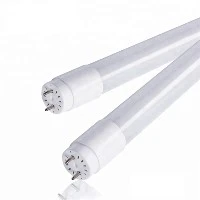
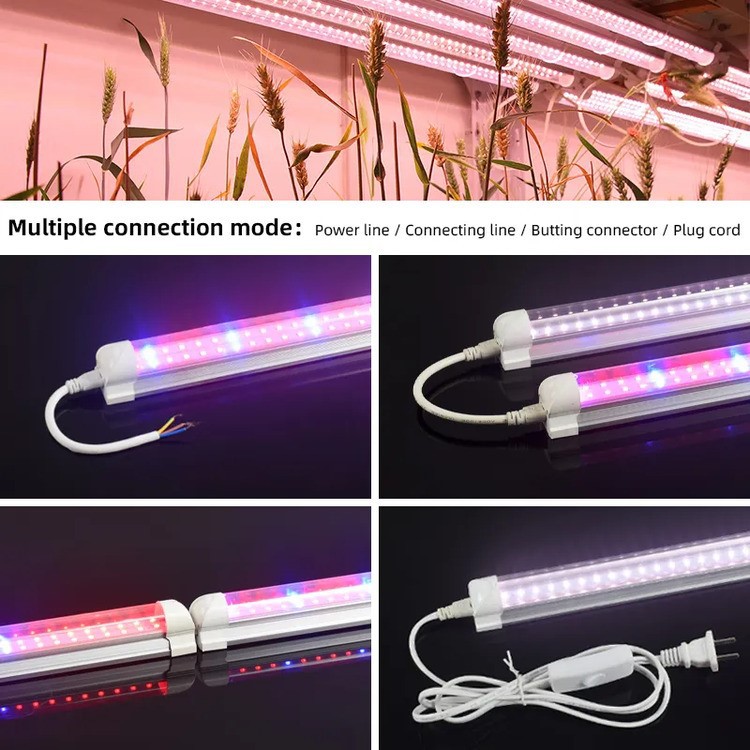
Therefore, a mushroom‑dedicated LED tube is not "full spectrum" but a narrow‑band spectrum dominated by blue light with a small amount of red light as a supplement. The Benwei T8 LED mushroom light tube is designed based on this scientific principle: blue peak at 460nm, red peak at 640nm, with a blue:red ratio of approximately 3:1 – perfectly matching the needs of common species such as white button mushrooms, oyster mushrooms, and shiitake.
2. What Plants Need Is "Photosynthetically Active Radiation", Not "Brightness"
For leafy greens, flowers, or seedlings on plant shelves, the key lighting indicator is Photosynthetically Active Radiation (PAR, 400-700nm), not lumens (lm) perceived by the human eye. Although traditional fluorescent lamps have decent lumen output, their PAR ratio is low and they generate a lot of heat.
The advantages of LED plant light tubes are:
- High efficacy – more PAR per watt.
- Customizable spectrum – red:blue ratio can be adjusted according to plant type.
- Cool light source – can be placed close to plants without burning leaves.
Benwei T8 LED plant light tubes are available in two versions:
- Mushroom‑dedicated version – blue:red ratio 3:1, promoting uniform primordium formation and cap coloration.
- General plant version – red:blue ratio 4:1 (for leafy greens) or 5:1 (for flowering/fruiting), with a small amount of far‑red light.
3. Data Comparison: How Can LED Tubes Save Energy and Increase Yield?
Many growers still use fluorescent tubes or ordinary white LED tubes, but the differences in actual performance and cost are huge. The table below compares three light source solutions for a 20 m² mushroom house (continuous lighting 24 hours/day, 8,760 hours/year):
| Comparison Item | Traditional Fluorescent Tube (T8 36W) | Ordinary White LED Tube (18W) | Benwei T8 LED Plant Tube (18W) |
|---|---|---|---|
| Actual power per tube | 40W (including ballast loss) | 18W | 18W |
| Spectral matching efficiency | Low (contains much green/yellow light, useless for mushrooms) | Very low (unstable blue light ratio) | High (customized for mushrooms/plants) |
| Fruiting uniformity (relative value) | 100% baseline | 90-110% fluctuation | 130-150% |
| Cap color score (1-5) | 3.0 (pale or yellowish) | 3.5 | 4.5 (deep brown and shiny) |
| Annual power consumption (20m², 60 tubes) | 60 × 40W × 8,760h = 21,024 kWh | 60 × 18W × 8,760h = 9,460 kWh | 60 × 18W × 8,760h = 9,460 kWh |
| Annual electricity cost (@ $0.12/kWh) | $2,523 | $1,135 | $1,135 |
| Lifespan to 70% lumen maintenance | 8,000 hours (replace yearly) | 15,000 hours (replace ~1.7 years) | 50,000 hours (nearly 6 years without replacement) |
| Contains mercury | Yes | No | No |
The table clearly shows: the Benwei T8 LED plant tube consumes the same electricity as an ordinary white LED tube, but due to its customized spectrum, yield and quality are significantly improved. Compared to fluorescent tubes, electricity costs are reduced by more than 50%, and the maintenance cost of yearly lamp replacement is eliminated.
4. More Than Spectrum: Uniformity, Waterproofing, and Heat Dissipation Matter Too
Mushroom houses and plant factories often have high humidity (80%-95%). Ordinary tubes are easily damaged by moisture. The Benwei T8 LED plant tube features the following practical designs:
- IP65 waterproof rating – moisture and dust resistant, suitable for spray environments.
- Silicone sealed end caps – prevent water vapor from entering the tube.
- Aluminum alloy heat sink housing – ensures LED chip operating temperature stays below 65°C, slowing lumen depreciation.
- Clear/frosted cover options – clear cover for higher light transmission (plant shelves), frosted cover for more uniform light (multi‑layer mushroom rooms).
In addition, light uniformity directly affects fruiting consistency. Benwei tubes use high‑density LED bead layout (144 beads per meter) together with an optical diffuser plate, achieving uniformity above 90% on the illuminated surface, avoiding bare spots in corners that lead to no fruiting.

5. How to Choose the Right LED Tube for Your Mushroom House or Plant Shelf?
Follow these three steps:
- Identify your needs – Pure mushroom cultivation → choose blue‑dominant (mushroom‑dedicated version); mushroom + seedling → choose adjustable red:blue version; pure leafy greens → choose red:blue ratio 4:1.
- Calculate the quantity – Typical mushroom house requires light intensity of 50-150 lux (mushrooms) or 200-300 µmol/m²/s (plants). A Benwei T8 tube at 1.5m height covers approximately 2-3 m² per tube.
- Confirm installation method – Benwei tubes can directly replace traditional T8 holders (no ballast modification needed; compatible with inductive/electronic ballast bypass or direct connection to mains).
Conclusion
Lighting for mushroom houses and plant shelves is not about brighter or more expensive – it's about correct spectrum, long lifespan, and low energy consumption. With its precise blue:red ratio, IP65 waterproof rating, 50,000‑hour L90 lifespan, and over 50% energy savings, the Benwei T8 LED plant tube has become the top choice for many professional growers. Replace once, benefit for nearly six years – a calculation well worth your consideration.