What's So Special About High-CRI T8 LED Tubes?
If You Pick the Wrong Tube, Even the Most Expensive Interior Design Won't Save You.
Why are museums and high‑end stores rushing to replace their lights with this LED tube?

1. CRI: What is it and why is it more important than brightness?
Walk into a nice clothing store. That red coat looks like a deep rich burgundy under the shop lights. You take it home – and it turns a dull, muddy brown. Just your eyes playing tricks on you, right? Wrong. The lighting is playing tricks.
CRI ( Colour Rendering Index ) is a measure of how accurately a light source reproduces the true colours of an object . Scores are out of 100, with 100 being perfect (natural sunlight) Most regular LED tubes only have a CRI of about 80.
So why do so many LED tubes that claim a CRI of 80 make red look dull? The answer is the R9 value.
R9 is a special index that evaluates the reproduction of red colors. It is not included in the average Ra score. A tube can have a decent average CRI, but if its spectrum lacks sufficient red content, the R9 value will be very low - sometimes even negative. That's why red clothes, lipsticks, fresh meat, etc., look grey and lifeless under such lights.
Short version: Ra tells you the average score; R9 tells you how good the red looks.

2. Why should you pay attention to the Benwei High‑CRI T8 LED Tube?
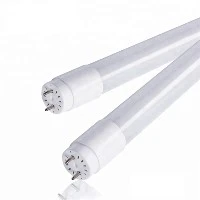
The key specifications of this Benwei T8 LED tube are solid:
| Parameter | Benwei High‑CRI T8 | Ordinary LED Tube |
|---|---|---|
| CRI | Ra >95 (97‑98 optional) | Ra ~80 |
| R9 (red rendering) | >80 | often low or negative |
| Efficacy | 100‑130 lm/W | ~80 lm/W |
| Lifespan | 50,000 hours | 30,000 hours |
| Warranty | 5 years | 1‑2 years |
2.1 Full‑spectrum design – light that mimics nature
The core technology behind a high CRI is full‑spectrum design. Ordinary LED tubes use a blue chip + yellow phosphor, resulting in a spectrum with a sharp blue peak and very little red. Benwei tubes use an optimised phosphor blend to produce a continuous spectrum much closer to natural sunlight. This not only reproduces all colours accurately, but also reduces blue‑light hazards and improves visual comfort for long working hours.
2.2 Good heat dissipation = long life
The biggest enemy of an LED tube is lumen depreciation - it starts bright, but after a few months it becomes dim. Heat dissipation directly determines the actual lifespan.
Benwei uses a 1.2mm thick 6063 aluminium alloy housing + 19mm wide PCB dual‑heat‑sink structure. 6063 aluminium has a thermal conductivity of about 200 W/m·K, rapidly moving heat away from the LEDs to keep junction temperatures under control. Cheap plastic or thin‑aluminium tubes trap heat, causing the LEDs to run hot and degrade much faster.
2.3 Flicker‑free driver – eye protection
Flicker may not be visible to the naked eye, but it can be seen under a high‑speed camera. Prolonged exposure to flickering light causes eye fatigue, dryness and strain.
Benwei tubes use a Rubycon capacitor driver to achieve true flicker‑free output. Rubycon is a top‑tier Japanese capacitor brand - more heat‑resistant, longer life and better voltage stability than ordinary capacitors. It is the standard choice for high‑quality LED drivers.
2.4 Dimmable – flexible for many applications
The tube supports both 0‑10V and TRIAC dimming. 0‑10V is the mainstream standard for commercial lighting, while TRIAC allows direct replacement of legacy phase‑cut dimmers. Whether you need precise light control for a photography studio or an atmospheric dimming effect for a boutique or restaurant, this tube has you covered.
3. Choosing a T8 tube – what else matters besides CRI?
3.1 Efficacy and power
A standard 4‑foot (1.2m) T8 LED tube typically uses 14‑18W, but the luminous flux (lumens) can vary greatly. A good tube delivers 1300 lm or more; a poor one may give only 800‑900 lm. Don't just look at wattage - check efficacy (lm/W). Higher efficacy means more light for less energy.
3.2 Colour temperature
Colour temperature (CCT) determines whether the light feels "warm" or "cool".
3000K warm white – good for restaurants, hotels, creating a cosy atmosphere.
4000K neutral white – suitable for offices, retail stores.
6500K cool white – for factories, warehouses, areas requiring high concentration.
Match the CCT to the application - don't blindly pick cool white for everything.
3.3 Certifications and warranty
Reputable brands typically offer 50,000‑hour lifespan + 5‑year warranty – a basic guarantee of quality. A short warranty often means the product has poor heat dissipation or a low‑grade driver.

4. Which applications "must have" high CRI?
Museums & galleries – Museum lighting standards clearly state that for colour‑critical exhibits, the minimum CRI should be Ra 90 or higher. High‑CRI tubes accurately reproduce paintings, textiles and artefacts, avoiding misleading visitors.
High‑end retail & clothing stores – Under a CRI 98 LED tube, clothing colours appear almost as they would in natural light. Customers see exactly what they buy – fewer returns, higher conversion.
Photography & live‑streaming studios – A light source with Ra≥95 can serve as fill light, ensuring excellent colour accuracy in photos and videos.
Hospitals & dental clinics – High‑CRI lighting helps medical professionals accurately distinguish tissue colours, which is crucial for diagnosis and treatment.
5. Summary
Choosing a tube is not just about "how bright". CRI (especially R9), efficacy, thermal design, driver quality – these five indicators are all essential.
The Benwei High‑CRI T8 tube delivers: Ra>95, R9>80, full‑spectrum design, 1.2mm aluminium heat sink, Rubycon capacitor driver, and a 5‑year warranty. At its price point, it is highly competitive. For anyone who values true colour rendition, visual comfort and long‑term reliability, this tube deserves serious consideration.
For a complete guide to T8 tube selection, installation tips and energy‑saving retrofits, see our LED Tube Buying Guide.
For samples or custom solutions, please contact us through the official website.