To decide what to do if your LED light strings become wet, it's helpful to first grasp the distinction between dry, damp, and wet-rated LED lights. Then, depending on the relative need of the circumstance, you may proceed with the best course of action.
Ratings for LED Light Strings
Dry-rated LED lights should only be used indoors, under cover, and away from water sources.
Only indirect water can be used to expose LED lights that are damp-rated. Think of these as being in the bathroom, the laundry room, or the awning over the patio. There can be a very little amount of moisture buildup at the end.
LED lights that are water-resistant may be near running or dripping water. They are completely watertight. These might be close to a swimming pool or in a place where it rains or snows.
When an LED light is completely immersed in water, it becomes hazardous. Since water is a conductor and electricity travels through the lightbulb, electrocution might happen. It is safe to assume that if water is added to a live electric current, the current may very well travel in the opposite direction from where it was intended to go.
Care Instructions for Wet LED Light Strings
Here is a brief and condensed procedure for handling a wet LED light string.
If you can, find out how moist it is. If the LED light string is wet-rated, the situation might not even be a problem. Next, ensure that you can access the power source without touching a live wire while in a wet environment. If the fixture cannot or should not be exposed to moisture, disconnect it from the power source next.
If at all feasible and necessary, you should clean up the water. Although it should go without saying, this merits attention.
The LED light string should then be dried. After giving it a thorough wipe, leave it in the sun for a few days, and only when you're certain that it has dried out, give it a test. Reconnect it to a power source and clear the area before using your LEDs to ensure safety.
The light might turn out to be alright in the end. However, there's also a chance that it has been harmed and needs to be replaced.
The way that LED lights are sealed against water will determine how long they may be exposed to it.
Referencing an ingress protection rating chart, also known as the international standard IEC 60529 by the International Electrotechnical Commission (IEC), which designated it for use internationally, is one typical way to measure this. However, it's doubtful that you will come across somebody casually referencing IEC 60529 unless you travel in a herd of engineers.
The IP rating refers to two groups of digits that classify a product's resistance to moisture and infiltration. IP65 is the two-digit code for it.
The first number describes how well it can defend against various-sized things, such as a hand vs dust particles. Here, there are six levels. For instance, an IP64 is totally dust-tight. Dust protection is IP54-rated. A finger, which has a width of 12.5 mm, is protected by an IP25.
The second number is a measure of its resistance to moisture. Dripping water, splashing water, spraying water, jets of water, and complete submersion beneath water are only a few examples of the many types of moisture. Despite total submersion, the measurement also takes into consideration the angle at which the water reaches the target item.
A light can withstand water splashes coming from any angle if its IP64 rating is known. If a lamp is IP67 certified, it can withstand being submerged for 30 minutes in water up to 1 meter deep. These are numbers 0 through 8.
Therefore, if a lamp has an IP measurement, you can determine how water-resistant it is and if you even need to bother about drying the LED light string off at all.
Does every producer offer this? No, it isn't always required. But some people do. Even though it's helpful to stay knowledgeable and educated about the entire industry, it's generally a good idea to understand that an electric current shouldn't be exposed to water.
You may proceed after all water has been dried and eliminated from the situation.
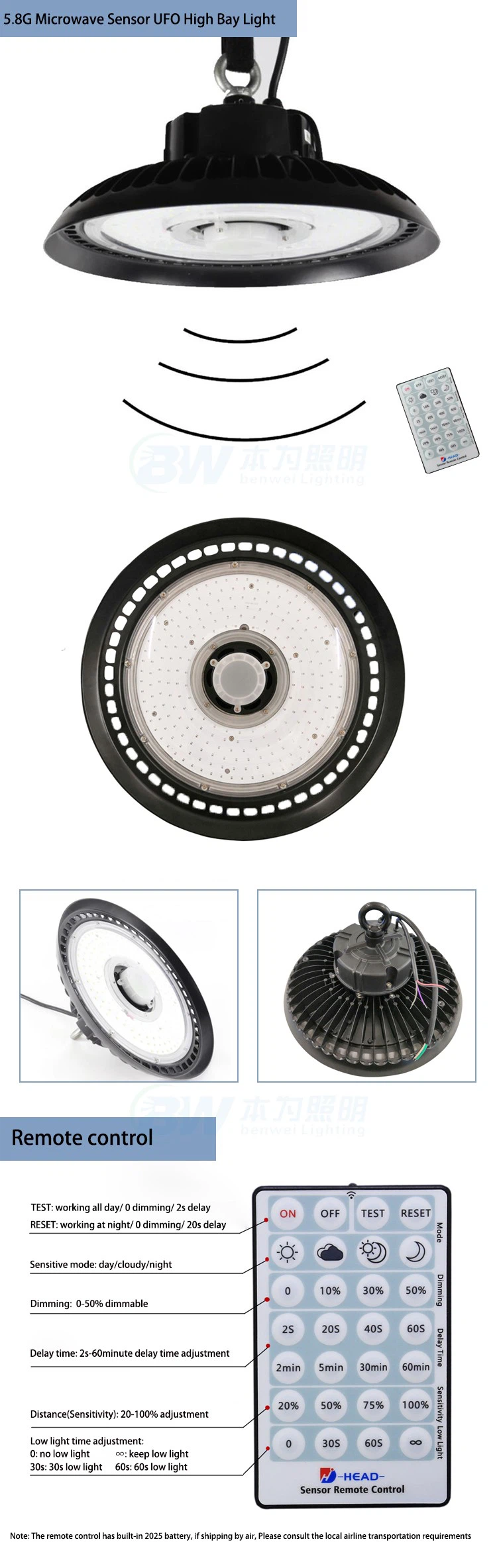
Benwei warehouse led lights:
|
Model |
BW-002-S100W |
BW-002-S150W |
BW-002-S200W |
|
Power(W) |
100W |
150W |
200W |
|
Light Source |
SMD |
||
|
Input Voltage |
AC220-240V/ AC100-305V / 480v 50/60Hz |
||
|
Material |
Aluminum+PC |
||
|
Beam Angle |
60°/90°/120° |
||
|
IP Rating |
IP65 |
||
|
CCT |
3000K / 4000K / 6000K |
||
|
CRI |
Ra>80 |
||