When Pests Chase Light: How LED Technology is Revolutionizing Grain Storage
By Kevin Rao November 14, 2025
Have you ever imagined that tiny pests lurking in warehouses have distinct "preferences" for light? Recent research reveals fascinating insights into the light-chasing behaviors of six common stored grain pests – knowledge that could help us protect our food supplies in an eco-friendly way.
A "Feast of Light" for Pests
It turns out these troublesome creatures have their own favorite colors when it comes to LED lighting:
Rice weevils are drawn to warm yellow light (590nm), much like our appreciation for sunset glow. Red flour beetles prefer fresh green light (520nm), while cigarette beetles and confused flour beetles both favor cool blue light (460nm). Most intriguingly, the rusty grain beetle and maize weevil share a preference for "dark" ultraviolet light (365nm).
Brightness Matters, But Not How You'd Think
The research shows these pests are quite particular about light intensity – stronger isn't necessarily better. For instance, red flour beetles reached a remarkable 92.22% attraction rate at 120 lx, but this effectiveness decreased when intensity rose to 220 lx. It's similar to how we humans prefer not to stay in harsh, bright light for too long.
Time is the Ultimate Test
The study also revealed that these light-chasing behaviors need time to develop. Throughout the 90-minute observation period, attraction rates consistently increased over time. This tells us that pest traps need to give these creatures sufficient "decision-making time" to be effective.

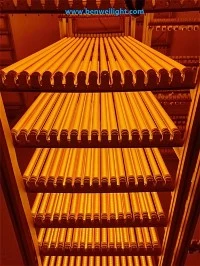
590nm Yellow-orange light
Why Do These Details Matter?
In grain storage, traditional chemical control methods face serious challenges: growing pesticide resistance, chemical residues, and environmental pollution. Understanding pests' phototactic behavior allows us to create customized "light traps" – both environmentally friendly and highly effective.
The Future of Smart Pest Control
What's even more exciting is that scientists are exploring ways to combine specific LED wavelengths with other attractants. By pairing carefully selected lights with sex pheromones or food scents, we can create irresistible "packages" that lure pests into traps.
This approach represents a harmonious way of working with nature. Instead of relying solely on chemicals to fight pests, we're learning to use their own biological characteristics against them – a smarter, more sustainable solution.
The next time you see an LED emitting specific colored light, imagine that in some grain warehouse, such carefully designed beams are silently guarding our food supplies. In our pursuit of sustainable development, this research points toward a promising future where we work with nature rather than against it.
What other biological traits in nature could we harness to create more environmentally friendly solutions?
FAQ
Do LED lights attract spiders?
LED lights do not directly attract spiders, but they do so indirectly.
Spiders prefer to spin webs near food sources, and areas around lights are ideal locations. Since LED lights attract insects, spiders will also come along.
What color of light attracts insects?
First, ultraviolet light is the most attractive to insects. Second, blue and green light also attract insects. Other colors attract fewer insects.
Tel/Whatsapp:+8619972563753
Email:bwzm12@benweilighting.com
Skype:bwzm32
Web:https://www.benweilight.com/