Why are modern poultry farms switching to LED chicken lamps?
– Deep dive into spectral biology and economic benefits
1. Phenomenon: From "lighting" to "photo‑biological regulation"
In the past, poultry lighting only solved the problem of "being able to see". Today, modern poultry farms are replacing traditional fluorescent and incandescent lamps with LED chicken lamps – not just for energy savings, but because LEDs can precisely control spectrum, intensity, and photoperiod, fundamentally affecting the birds' circadian rhythms, feeding behavior, and hormone secretion.
Poultry vision is far more complex than human vision. A chicken's eye contains four types of cone cells, sensitive to violet (415 nm), blue (460 nm), green (540 nm) and red (610 nm) wavelengths. The hypothalamus also contains photoreceptors that regulate circadian rhythms and reproductive function. Blue wavelengths (400–480 nm) influence the secretion of melatonin and gonadotropin‑releasing hormone, thereby affecting reproductive development and egg production. Red wavelengths (600–700 nm) have been shown to promote broiler growth rate and feed conversion efficiency. This means – different wavelengths of light have distinctly different effects on chickens.
2. Key data: Real benefits of LED chicken lamps
2.1 Laying performance improvement
A free‑range layer farm in Powys, UK, with 16,000 hens, replaced 54 two‑foot fluorescent strips with 105 units of 48V/9.6W warm‑white LED chicken lamps. The results:
Egg production rate increased by 6.1% – generating an additional £27,192 (approx. RMB 250,000) over a 78‑week laying cycle
Earlier onset of lay, and higher cumulative egg numbers compared to the previous flock
Energy cost reduction of £2,724, and annual carbon reduction of 1,218 kg CO₂e
Power density comparison:
| Lighting solution | Number of fixtures | Total power | Power per fixture |
|---|---|---|---|
| Original fluorescent | 54 | - | 2‑ft strip |
| Upgraded LED | 105 | - | 9.6W each |
2.2 Broiler weight gain and feed conversion efficiency
For broiler production, LED lighting also shows outstanding results:
Body weight in the LED group significantly better than conventional light sources – ~18% higher at 5 weeks (1,781.9 g → 2,098.8 g per bird)
Red wavelengths (620–780 nm) can stimulate growth hormone release by approximately 8%
Intermittent lighting (1 hour light + 3 hours dark) improves feed conversion efficiency by 5%–8%
2.3 Energy consumption and lifespan comparison
The core economic advantage of LED chicken lamps comes from their electro‑optical conversion efficiency:
| Light source type | Efficacy (lumens/watt) | Typical lifespan | Energy profile |
|---|---|---|---|
| Incandescent | ~15 lm/W | 1,000 hours | 5% light + 95% heat |
| Fluorescent | ~60 lm/W | 6,000 hours | Requires annual replacement |
| LED chicken lamp | 120–150 lm/W | >50,000 hours (~8 years) | 60%–80% energy saving |
ROI calculation: Although a single LED lamp costs about twice as much as a fluorescent lamp, the electricity savings will recover the difference in 18 months. For example, replacing 1,000 units of 40W incandescent lamps with 10W LEDs, running 16 hours/day, saves approximately RMB 38,000 per year in electricity. LED chicken lamps reduce maintenance frequency by >90%, significantly lowering labor and downtime costs.
3. Scientific application strategies for different spectra
The core value of modern LED chicken lamps is – matching spectrum to growth stage for precise, multi‑phase farming:
| Growth stage | Recommended spectrum / CCT | Mechanism |
|---|---|---|
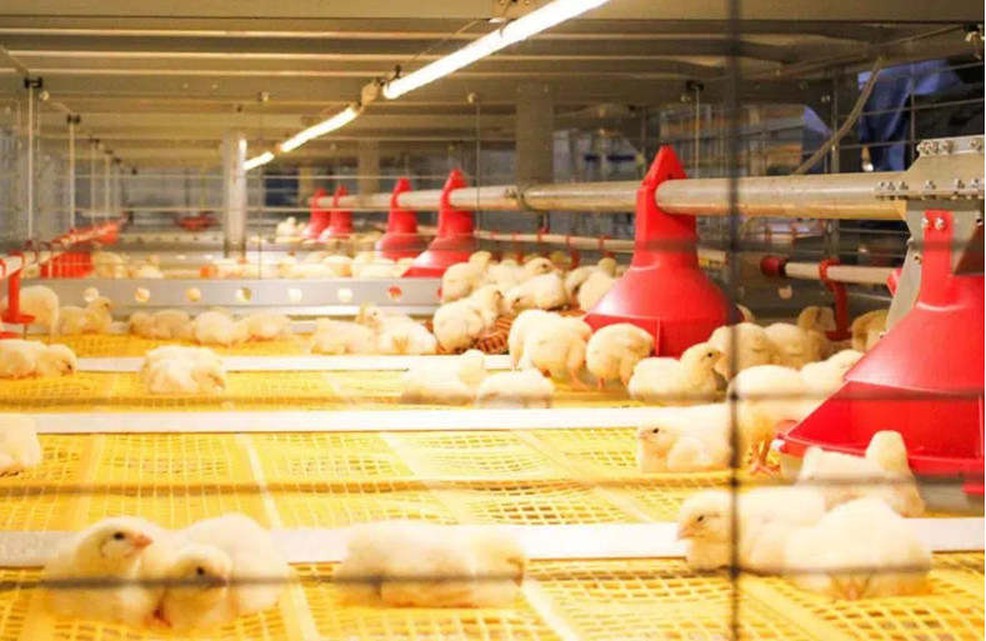
| Chick stage (0–3 days) | High‑intensity white light, 30–50 lux | Guide drinking and feeding; establish early behavioral habits |
| Growing stage (broilers) | Blue (455–495 nm) + Green (510–540 nm) | Promote growth, enhance immunity, reduce stress |
| Finishing stage (broilers) | Red (620–780 nm) | Stimulate growth hormone release, improve weight gain |
| Laying stage (layers) | Warm white (2800–3000 K), 16‑hour photoperiod | Stimulate laying hormones, maintain egg production rate |
Blue and green light also reduce fear responses and stress levels in broilers, improving animal welfare.
4. Industry standards and purchasing tips
When selecting chicken lamps, pay attention to the following technical parameters:
Ingress protection ≥ IP65 – Poultry houses are high‑humidity, high‑dust, and ammonia‑corrosive environments; IP65 ensures long‑term reliable operation.
Flicker‑free driver – Flicker causes stress and feather pecking; always choose flicker‑free power supplies.
EU standard reference – According to EU Council Directive 2007/43/EC, the light period must provide at least 20 lux (measured at bird eye level), at least 4 hours of darkness per 24 hours, and use gradual on/off transitions to simulate dawn/dusk.
Installation guidelines – Install one 40W LED chicken lamp per 200–300 m², mounting height 1.8–2.2 m, with uniformity >0.7.

5. Expanded conclusion
An LED chicken lamp is not just a "lighting device" – it is a production management tool that uses photobiology to regulate poultry physiological rhythms. Choose the right spectrum, and each layer can produce 38 more eggs per year, each broiler can gain 300 g more meat. For a 10,000‑bird farm, the increase in egg production alone can generate tens of thousands of RMB in additional annual revenue. Combined with 80% electricity savings, the payback period is typically less than 18 months. We recommend that farmers prioritize dedicated LED chicken lamps with tunable spectrum, flicker‑free operation, high IP rating (≥IP65), and request third‑party LM‑80 lumen maintenance reports to ensure stable operation for more than five years.
Should you have any requirements for bulk purchasing or customized lighting solutions, please do not hesitate to contact us for a detailed quotation.