Why Are Professional LED Cold Cabinet Lights a Must for Commercial Cold Chains?
In the daily operation of supermarkets, fresh food stores, and cold storage warehouses, cold cabinet lights may seem like small components that only "illuminate the cabinet", but they actually directly affect product display effects, operating costs, and safety compliance. Many customers wonder: Can ordinary LED lights replace cold cabinet lights? What are the core advantages of professional LED cold cabinet lights? Today, we will use professional LED knowledge + real data to fully explain, help you understand the key points of cold cabinet light selection, and avoid procurement mistakes.
1. First, Clarify: Cold Cabinet Lights ≠ Ordinary LED Lights, Core Difference Lies in "Low-Temperature Adaptation"
Ordinary LED lights are designed for normal temperature and dry environments, while cold cabinets, freezers, air curtain cabinets and other scenarios are generally in low-temperature, high-humidity, and high-condensation environments of -40℃~10℃. This requires LED cold cabinet lights to break through three major technical bottlenecks - low-temperature startup, anti-condensation, and low-temperature corrosion resistance, which is also the core difference between them and ordinary LED lights. The specific parameter comparison is shown in the table below, and the data intuitively reflects the advantages:
|
Core Technical Parameters |
Professional LED Cold Cabinet Lights |
Ordinary LED Lights |
Customer-Perceivable Value |
|
Operating Temperature Range |
-40℃~10℃ (Instant Startup) |
-10℃~40℃ (Difficult to Start at Low Temperature) |
Suitable for -25℃ freezers, no flicker, no black screen, avoiding interruptions in product display |
|
Protection Level (IP) |
IP65~IP68 (Fully Sealed) |
IP20~IP44 (Non-Waterproof) |
Anti-condensation, anti-frost, waterproof, eliminating short circuits and electric leakage, reducing maintenance costs |
|
Color Rendering Index (CRI) |
Ra≥90, Ra≥95 for high-end models |
Ra≥70~80 |
Restore the true color of fresh food, meat and beverages, driving sales up by 20%+ |
|
Luminous Efficacy & Energy Saving Rate |
110~130lm/W, 70%~80% energy saving |
80~100lm/W, 50% energy saving |
Each cold cabinet saves about 600 degrees of electricity per year, significantly reducing long-term operating costs |
|
Service Life |
≥50,000 hours (Service life extended in low-temperature environment) |
20,000~30,000 hours (Easy to decay at low temperature) |
Maintenance-free for 3 years, reducing 50% of replacement costs and labor costs |
|
Packaging Technology |
COB Integrated Packaging (for some high-end models) |
Ordinary SMD Packaging |
Luminous efficacy increased by 22%, condensation suppression capacity enhanced by 37%, more durable |
2. Core Technologies of LED Cold Cabinet Lights: Why Can They Adapt to Cold Chain Environments?
The "durability" of professional LED cold cabinet lights comes from the precise adaptation of three core LED technologies, which are also the key points that customers should pay most attention to when purchasing. Each technology corresponds to solving pain points in actual use scenarios:
- Low-Temperature Startup Technology: Adopting a wide-temperature constant current driver chip and optimized circuit design to ensure instant lighting at -40℃ extreme cold environment without delay or flicker - solving the problem of startup failure and sudden brightness drop of ordinary LED lights at low temperatures, suitable for cold storage, low-temperature freezers and other scenarios.
- Anti-Condensation Sealing Technology: Adopting a fully sealed structure + built-in breathing valve, combined with an anti-fog PC mask, which can effectively isolate water vapor and condensation in the cold cabinet, avoid short circuits caused by fog and water accumulation inside the lamp, and at the same time meet the anti-corrosion and moisture-proof requirements of IEC 60598-2-24:2013 international standard for refrigerated lamps.
- High CRI Optical Optimization Technology: Selecting high-quality LED beads and optimizing spectral design, the color rendering index of Ra≥90 can maximize the restoration of the true color of products. Some high-end models enhance the 450nm blue light band for fresh food scenarios, making meat more bright red and fruits and vegetables more vivid, directly improving product attractiveness.
3. Market Data Speaks: The Necessity and Industry Trend of Cold Cabinet Lights
With the upgrading of the cold chain industry and the expansion of fresh food retail, the market demand for LED cold cabinet lights continues to rise. The data witnesses its rigid demand attribute and also provides reference for customers' choices:
|
Data Category |
Specific Data |
Core Interpretation |
|
China Market Scale |
Reached 1.847 billion yuan in 2025, expected to increase to 2.021 billion yuan in 2026, with a year-on-year growth of 9.4% |
The market is steadily expanding, driven by the upgrading of cold chain facilities and the demand for stock replacement |
|
LED Penetration Rate |
The LED penetration rate in the commercial cold chain lighting field is over 92%, and the LED lighting ratio of newly produced cold cabinets is 98.6% |
LED cold cabinet lights have become the mainstream, and traditional lamps are gradually being eliminated |
|
Downstream Demand Distribution |
Supermarket system procurement accounts for 53%, fresh food chains + central kitchens account for 29%, convenience stores and others account for 18% |
Diversified application scenarios and prominent commercial rigid demand attributes |
|
Policy-Driven Requirements |
"14th Five-Year Plan for Cold Chain Logistics Development" requires that the LED transformation coverage rate of cold chain cabinets in top 100 supermarkets should be ≥85% by 2026 (currently 61% completed) |
Huge demand for stock replacement and continuous release of procurement demand |
4. Must-See for Customers: 4 Major Losses of Choosing the Wrong Cold Cabinet Lights, Avoid Pitfalls in Professional Selection
Many customers choose ordinary LED lights instead of professional cold cabinet lights to save costs, but ultimately incur additional expenses. Combining industry cases, we summarize 4 core losses:
- Increased Maintenance Costs: Ordinary LED lights are easily damaged at low temperatures, requiring replacement every 3-6 months on average, and the annual replacement cost is more than 3 times that of professional cold cabinet lights;
- Increased Commodity Losses: Poor color rendering leads to dull product color and reduced customer purchase willingness. It is estimated that the sales volume of the fresh food area can be reduced by 15%-20%;
- Increased Safety Risks: Insufficient waterproof level is prone to short circuits caused by condensation, leading to electric leakage and fire. At the same time, it does not meet international safety standards such as IEC 60598-2-24:2013, affecting compliant operation;
- Increased Energy Consumption Costs: Ordinary LED lights have low luminous efficacy, and each cold cabinet consumes about 300 degrees more electricity per year, resulting in significant energy loss when used on a large scale.
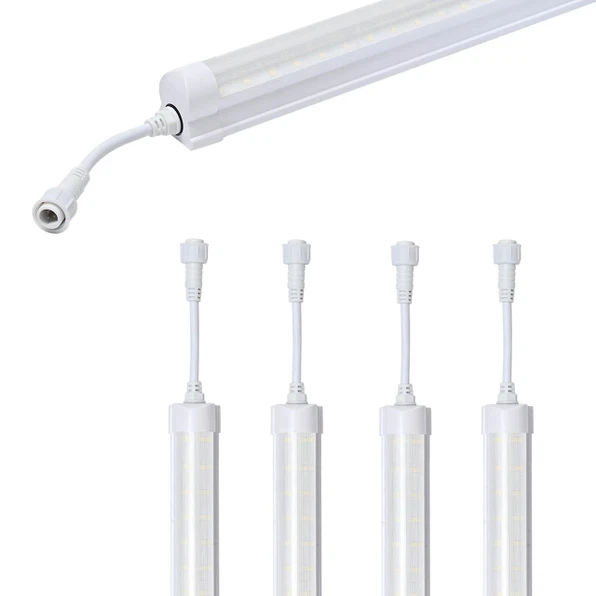

5. Summary: Are Professional LED Cold Cabinet Lights Cost-Saving or Cost-Increasing?
The answer is clear: Choosing the right professional LED cold cabinet lights is a long-term cost-saving choice. Calculated per cold cabinet, although the initial purchase cost of professional cold cabinet lights is 20%-30% higher than that of ordinary LED lights, with an energy saving rate of more than 70%, a service life of more than 5 times, and a 20% increase in sales volume, the cost can be recovered within 3 years, and it will continue to help customers reduce operating costs and improve returns in the future. Whether it is a supermarket, a fresh food store or a cold storage warehouse, professional LED cold cabinet lights are not "optional products", but "must-have products" to enhance competitiveness.