Why Do Basketball Courts Show "Zebra Striping"? Eliminating Uneven Light and Dark Areas: Which Professional LED Court Lights Should You Choose?
In lighting renovations for professional basketball arenas, outdoor basketball courts, and school sports venues, many operators encounter a typical problem: after the lights are turned on, the court is not evenly and brightly illuminated, but instead shows alternating bands of light and dark, commonly known in the industry as "zebra striping." This kind of illuminance discontinuity makes it difficult for players to judge the trajectory of high passes, and it can also cause frequent brightness shifts in 4K broadcast footage. To completely solve this problem, simply increasing fixture wattage is not enough. Instead, selection must focus on core indicators such as light distribution, uniformity, glare control, and flicker, and choose professional LED luminaires truly suitable for basketball courts.
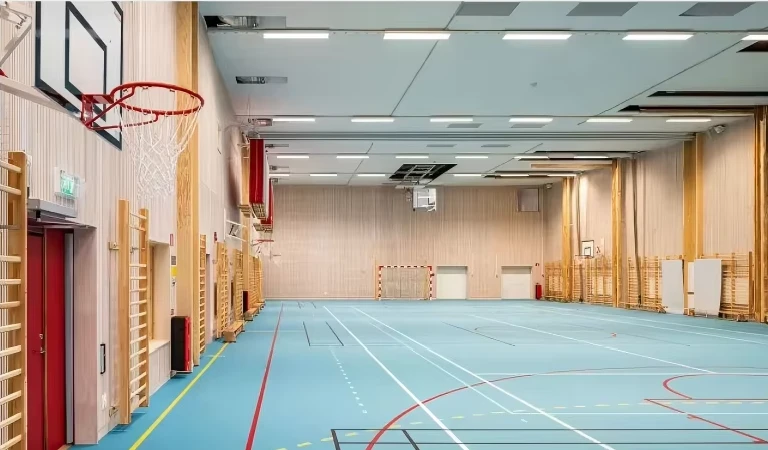
I. The Essence of Zebra Striping: Not Insufficient Brightness, but Unbalanced Uniformity
The essence of zebra striping is severely insufficient horizontal illuminance uniformity. According to basketball venue lighting standards, the horizontal illuminance uniformity U0-the ratio of minimum illuminance to average illuminance-for professional competition courts should generally be no lower than 0.7. For amateur training courts, it should also preferably reach 0.5 or above. When U0 falls below 0.5, obvious alternating bright and dark areas are likely to appear on the court, which is zebra striping.
Common causes of zebra striping include: use of ordinary symmetric floodlights, which scatter light in all directions; mismatch between fixture beam angle and pole layout; insufficient blending of light spots from multiple LEDs; unreasonable mounting height, spacing, and projection angle; and flicker from drivers or horizontal bands caused by camera capture. Among these, optical light distribution design is the most critical factor.
II. Judging with Data: Which Lighting Indicators Are Directly Related to Zebra Striping?
Table 1 intuitively proves that zebra striping is not merely a subjective impression, but is directly related to illuminance uniformity, glare value, and flicker depth.
| Degree of Zebra Striping | Horizontal Illuminance Uniformity U0 | Glare Value UGR | Flicker Depth | Typical Scenario |
|---|---|---|---|---|
| Severe | <0.5 | >28 | >10% | Ordinary symmetric floodlights, single-side layout, four-corner spotlighting |
| Mild | 0.5–0.7 | 22–28 | 3%–10% | Amateur training courts, low-standard renovation projects |
| Basically eliminated | ≥0.7 | ≤22 | <3% | Professional competition, HD broadcasting, professional training |
From Table 1, it can be seen that if a fixture's U0 is below 0.5, zebra striping will still appear even if the average illuminance of the court is very high. Therefore, when purchasing LED lights for basketball courts, one should not only look at wattage and luminous flux, but also at light distribution method and uniformity indicators.
III. To Eliminate Zebra Striping, You Must Choose LED Court Lights with the Following Optical Qualities
1. Asymmetric Light-Distribution Lens Design
Professional basketball court LED luminaires should use asymmetric light-distribution lenses, not ordinary symmetric floodlighting. Asymmetric optics can precisely direct light onto the court area, reduce outward scattering, and at the same time fully blend the light spots of multiple LEDs through internal total reflection surfaces and mixing structures in the lens, reducing zebra striping at the source.
2. Multiple Optional Beam Angles
Different venues have different pole heights and installation spacings, so luminaires should support multiple beam angles such as 60°, 90°, and 120°. Based on a standard basketball court size of 28 m × 15 m and actual mounting heights of 6–10 m, professional lighting simulation is used to calculate the number of luminaires, installation positions, and projection angles, so as to achieve a uniformity of U0 ≥ 0.7.
3. Deeply Recessed Anti-Glare Lens and Honeycomb Anti-Glare Mesh
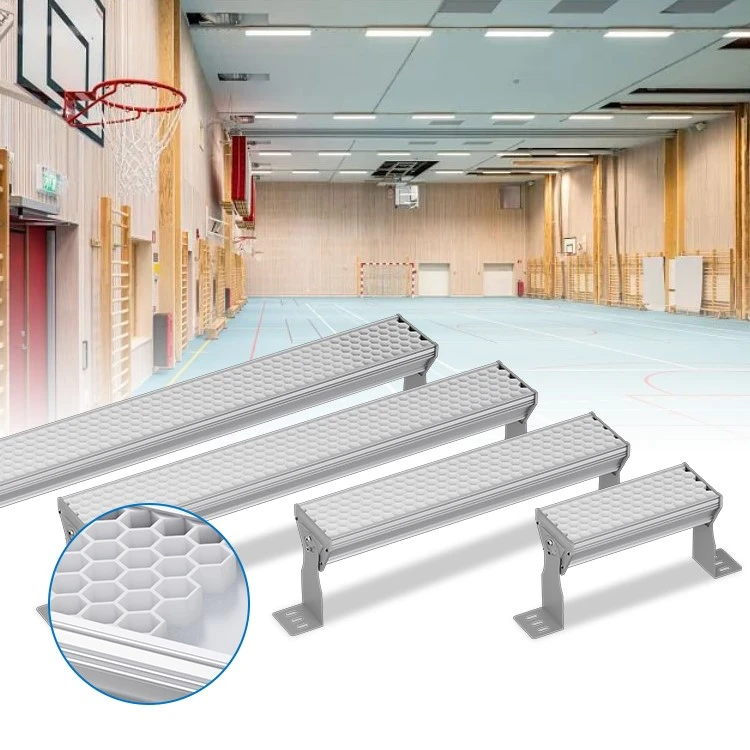
Zebra striping is often accompanied by glare problems. Professional court lights should use deeply recessed anti-glare lenses and can be equipped with honeycomb anti-glare mesh, limiting the beam angle to between 60° and 90° and controlling UGR within 22. This not only reduces glare but also makes ground illuminance more uniform.
4. High Color Rendering Index and Flicker-Free Driver
The color rendering index Ra should reach 90 or above. For professional competitions, R9 > 50 is recommended to ensure true restoration of jersey colors and floor textures. The driver power supply should be flicker-free, with flicker depth <3%, avoiding black horizontal bands in HD broadcasting and slow-motion replay.
IV. Comparison Between Ordinary Floodlights and Professional LED Court Lights: Why the Latter Can Solve Zebra Striping
Table 2 further proves that ordinary symmetric floodlights and professional asymmetric light-distribution LED court lights differ fundamentally in optical design, which is also the key to whether zebra striping can be eliminated.
| Comparison Item | Ordinary Symmetric Floodlight | Professional Asymmetric Light-Distribution LED Court Light |
|---|---|---|
| Light distribution | Symmetric distribution, scattering in all directions | Asymmetric light distribution, precisely directed onto the court |
| Beam angle | Fixed at around 120° | 60°/90°/120° optional |
| Layout method | Four-corner or single-side, prone to concentrated light spots | Two-side 45° cross-projection, more uniform light mixing |
| Horizontal illuminance uniformity U0 | 0.35–0.50 | 0.70–0.85 |
| Glare value UGR | 28–32 | ≤22 |
| Light utilization rate | 60%–70% | 85%–92% |
| Zebra striping performance | Obvious | Basically eliminated |
| Broadcast flicker | May exist | Flicker-free, flicker depth <3% |
| Applicable scenarios | Amateur, temporary lighting | Training, professional competition, HD broadcasting |
Note: The data in the table are conventional simulation experience values for similar projects. Actual values need to be calculated according to court dimensions, pole height, and lighting layout scheme.
V. Taking Benwei Professional LED Basketball Court High Bay Lights as an Example
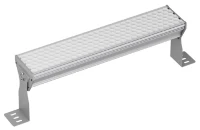
Taking the Benwei professional LED basketball court high bay light series as an example, its design concept is centered on "anti-glare, high uniformity, and flicker-free." Such products typically use deeply recessed anti-glare lenses, combined with honeycomb louvers or anti-glare mesh. Beam angles can be selected as 60°, 90°, or 120°, and UGR can be controlled at ≤22. Through professional optical simulation and precise lighting layout calculation, full-court uniformity of U0 ≥ 0.7 can be achieved at mounting heights of 6–10 m.
The product power range covers 60 W–400 W, luminous efficacy can reach above 150 lm/W, color temperature covers 3000 K–6000 K, and color rendering index is Ra ≥ 80, with high-configuration versions reaching Ra ≥ 90. The driver supports flicker-free design to meet HD broadcasting requirements. For venues that already have zebra striping, improvements can be made by replacing professional asymmetric light-distribution lens modules, adjusting fixture projection angles, and adopting two-side 45° cross-lighting layouts.
If you are planning or renovating a basketball venue and hope to completely eliminate zebra striping and achieve professional-grade uniform lighting, please contact us. Our lighting engineer team can provide a free DIALux illuminance simulation report, covering key indicators such as horizontal illuminance, uniformity U0/U1, glare value UGR, and flicker. We will also recommend the most suitable Benwei LED court light models and lighting layout scheme according to your court dimensions, pole height, and usage scenario.
Please provide the following information so that we can create a customized solution for you:
- Venue type: indoor/outdoor
- Court dimensions: such as 28 m × 15 m or other sizes
- Pole height and existing lighting layout method
- Target illuminance level: training/amateur competition/professional competition/HD broadcasting
- Whether dimming control or intelligent lighting system integration is required
Contact us: bwzm88@benweilighting.com
We promise to respond within 24 hours and provide professional lighting simulation and selection advice.