
When entering a modern classroom, the lighting fixtures one sees upon looking up often shape a student's initial impression: is it a harsh, eye-straining glare, or a natural, comfortable brightness? Over the past few years, we have received numerous inquiries from schools, educational facility contractors, and engineering firms. A frequently asked question is: for classroom lighting, should one choose pendant lights or panel lights?
Panel lights, with their simple installation and affordable price, have long been the "standard" for classrooms. However, an increasing number of projects are shifting toward linear pendant lights. This is not merely a trend; there are several practical reasons behind this shift. Let's explore them one by one, considering both lighting design and real-world usage scenarios.
Softer Light and Better Glare Control
With panel lights, the light-emitting surface faces directly downward; when students look up or turn their heads, they may encounter the light source head-on. Prolonged exposure to this can significantly increase eye fatigue.
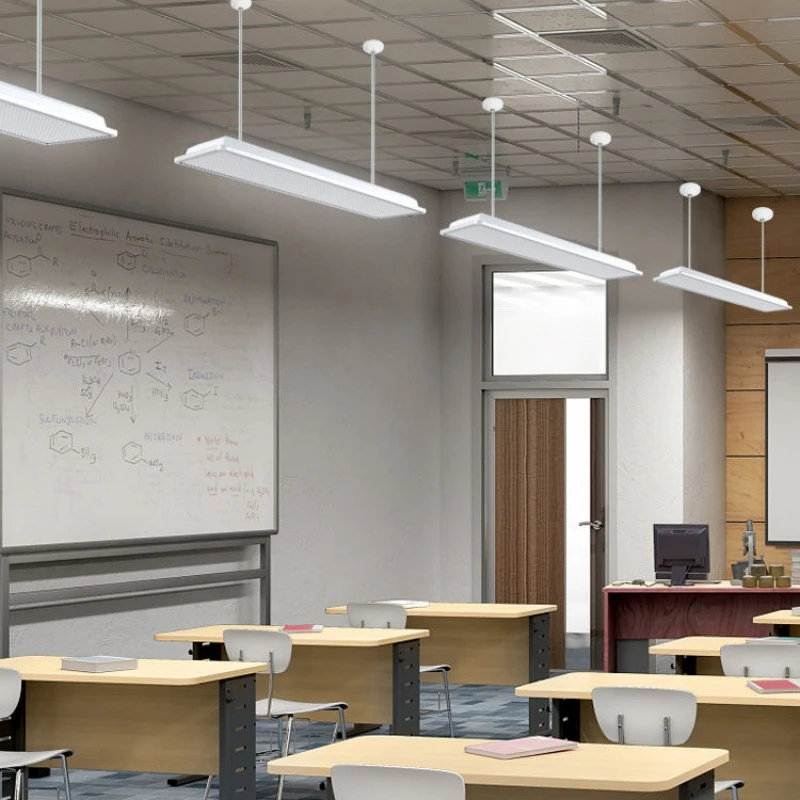
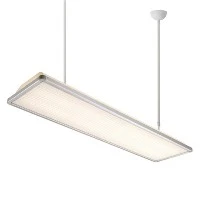
Pendant lights designed for classrooms are typically equipped with micro-prismatic lenses, opal diffusers, or anti-glare louvers. The light is diffused or processed before being emitted, resulting in a softer, more comfortable level of brightness. For students who spend six to eight hours a day in the classroom, this difference is truly noticeable. When selecting fixtures, pay attention to the UGR (Unified Glare Rating) value-for classroom environments, a value below 19 is generally recommended.
More Uniform Illuminance and Better Coverage for the Blackboard
Because panel lights are recessed into the ceiling, their light is directed straight down, which can easily create "bright spots" directly beneath the fixtures while leaving the spaces between them dimmer. Pendant lights, suspended from above, allow light to spread over a wider area; with proper layout, this makes it easier to achieve uniform illuminance across student desks.
Furthermore, many pendant light series designed for classrooms include specialized blackboard lighting options. These utilize asymmetrical light distribution to minimize reflections on the blackboard, ensuring that even students in the back rows can clearly see what is written. This is a capability that standard panel lights struggle to provide.
Adjustable Suspension Height to Accommodate Different Ceiling Heights
Classroom ceiling heights vary significantly: older school buildings may have ceilings just over 3 meters high, while new educational facilities might exceed 3.6 meters. Flat-panel lights are fixed to the ceiling; if the ceiling height changes, the lighting effect changes accordingly.
Pendant lights, by contrast, allow for height adjustment via suspension cables or rods. This enables the fixtures to be positioned at an optimal distance from classroom desks, striking the right balance between illuminance and glare. This flexibility is particularly valuable for renovation projects or large-scale orders involving spaces with varying ceiling heights.
Upward and downward light emission: Reducing the "gloomy ceiling" effect
Many classroom pendant lights feature a design that emits light both downward and upward: the downward component illuminates the desks, while the upward component directs light toward the ceiling, which then reflects it back into the room.
This approach prevents the ceiling from appearing dark, creating a more balanced visual brightness throughout the space and making the classroom feel more open and airy. In contrast, standard flat-panel lights only emit light downward, often leaving the ceiling dim and diminishing the overall sense of space.
Superior heat dissipation and easier maintenance
Because pendant lights are suspended, air can circulate freely around the fixture. This provides better heat dissipation than recessed flat-panel lights, which helps extend the lifespan of the LED driver and the LED chips themselves.
In terms of maintenance, most pendant lights are surface-mounted, meaning there is no need to dismantle the ceiling to replace the power supply or the fixture itself-making both initial installation and future repairs much more convenient. For schools, which operate over the long term, this translates into significant, albeit indirect, cost savings.
Enhanced aesthetic appeal and elevated classroom quality
Modern educational institutions-especially international schools and private training centers-are increasingly focused on their spatial image. Linear pendant lights offer a clean, minimalist aesthetic; they can be installed as individual units or connected into continuous strips, resulting in a visually organized and layered look.
While flat-panel lights are functional, their design is often uniform, making it difficult to achieve a distinct visual identity. If your client prioritizes a "premium" look for their classrooms, pendant lights offer a much more compelling solution.
Conclusion
Flat-panel lights are not inherently poor; they remain a valuable choice for spaces with low ceilings or limited budgets. However, when evaluated across criteria such as glare control, illuminance uniformity, installation flexibility, heat management, maintenance, and overall spatial quality, pendant lights offer a more comprehensive set of advantages for classroom environments-which is precisely why an increasing number of school projects are opting for them. In brief:
Eye-friendly and comfortable: Secondary light distribution for reduced glare.
Uniform illumination: Covers both desks and the blackboard.
Highly adaptable: Adjustable height, suitable for various ceiling heights.
Durable and low-maintenance: Excellent heat dissipation and easy to service.
Enhanced aesthetic: Elevates the overall look and feel of the space.
Looking for the right lighting fixtures for your classroom project?
If you are working on a project for a school, training center, or other educational facility, please leave a message or send us an email. Our team will provide tailored product recommendations and a free quote based on your specific requirements. Contact us today to receive a customized lighting solution.