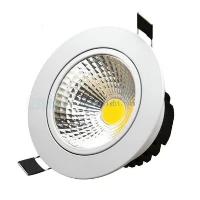
Picture a homeowner finishing a kitchen renovation. Six new downlights go into the ceiling, the room looks wonderfully bright when it's empty, and then she starts chopping vegetables. Her own shadow falls across the board, the sink corner looks gloomy, and the carrots look a little gray. One reviewer of this very downlight describes a similar disappointment: the first set, in 4000K, felt like a conference room, so the 3000K version had to be ordered for a second try.
The lamps weren't faulty. The problem was planning. A kitchen is judged by how much light lands on the work surface, what color it is, and where it comes from, not by how many fittings are in the ceiling. Let's put numbers on it.
How Bright Should a Kitchen Be?
Guidelines vary by source, and they also vary by zone, because walking through a kitchen and slicing food on a counter are different visual tasks. Here is how published guidance compares:
| Zone | Guideline | Illuminance on the surface |
|---|---|---|
| Circulation / ambient | Kitchen lighting guide | about 150–200 lux |
| General kitchen | Residential code reference | 200–300 lux |
| General kitchen | IES-based summary | 300–500 lux |
| Countertop and hob | Residential code reference | 300–500 lux |
| Worktop, sink and cooking | IES-based summary | 500–750 lux |
The same residential reference calls kitchen under-lighting the most common failure it sees: a cook working in 100 lux of ambient light has about one-fifth of the recommended task illumination. Note too that official lux requirements apply mainly to commercial buildings, so for homes these are design targets rather than legal rules (source).
From Lux to Lumens: The Calculation Behind a Good Layout
Lux describes light on a surface; lumens describe light from a fitting. The bridge between them is a simple rule of thumb:
Lumens needed = Target lux × Floor area (m²) ÷ Utilisation factor
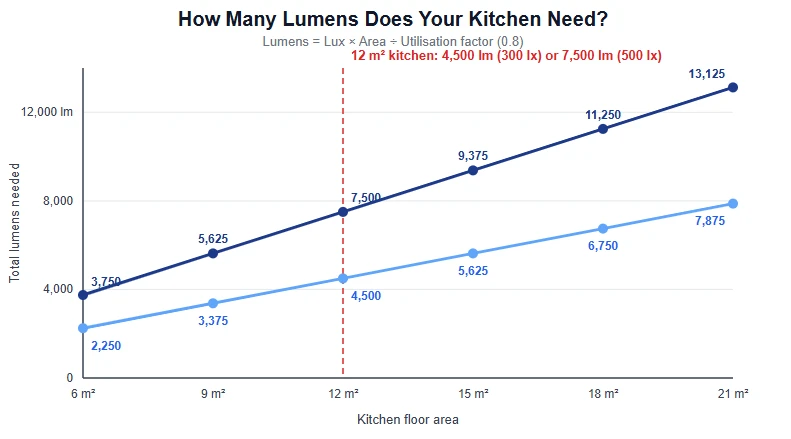
A kitchen lighting guide works one example: 300 lux over 12 m² is 3,600 lumens, and with a utilisation factor around 0.8 (some light is absorbed by walls and cabinets), you need about 4,500 lumens installed. Applying the same method to a range of kitchen sizes:
| Kitchen area | Lumens for 300 lux (general) | Lumens for 500 lux (worktop) |
|---|---|---|
| 6 m² | 2,250 lm | 3,750 lm |
| 9 m² | 3,375 lm | 5,625 lm |
| 12 m² | 4,500 lm | 7,500 lm |
| 15 m² | 5,625 lm | 9,375 lm |
| 18 m² | 6,750 lm | 11,250 lm |
| 21 m² | 7,875 lm | 13,125 lm |
So How Many Downlights Is That?
It depends on each fitting's wattage and efficacy. Our kitchen downlight range runs from 7 W to 50 W, so here is a 12 m² kitchen worked through for two common sizes at three efficacy levels. The efficacy figures are assumptions for illustration; use your chosen model's datasheet value.
| Fitting efficacy | 8 W, 300 lux (4,500 lm) | 8 W, 500 lux (7,500 lm) | 12 W, 300 lux (4,500 lm) | 12 W, 500 lux (7,500 lm) |
|---|---|---|---|---|
| 90 lm/W | 7 fittings | 11 fittings | 5 fittings | 7 fittings |
| 110 lm/W | 6 fittings | 9 fittings | 4 fittings | 6 fittings |
| 130 lm/W | 5 fittings | 8 fittings | 3 fittings | 5 fittings |
Efficacy matters more than people expect: the same kitchen needs 11 fittings or 8 depending on it. As a spacing guide, residential references suggest ambient downlights at roughly 1.5 to 2 m centres.
The Shadow Problem: Why Downlights Alone Aren't Enough
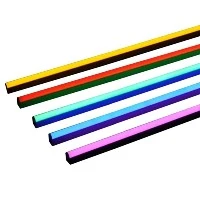
Back to our cook. Ceiling light falls from behind her head onto the counter, so she works in her own shadow. That is why kitchen designers layer light: downlights for ambient, a second layer for the worktop. One guide suggests mounting under-cabinet strips 350 to 450 mm above the worktop to deliver task light directly onto the surface. Our LED kitchen cupboard downlights are made for exactly this layer.
Color: Why 3000K Felt Right and 4000K Felt Like an Office
Two numbers decide whether a kitchen feels pleasant and shows food honestly: color temperature (CCT) and color rendering (CRI). Published guidance on CCT does not agree:
| Source | Suggested CCT |
|---|---|
| Domestic kitchen guide | 2,700–3,000K for most homes; 3,000–4,000K for modern or industrial looks |
| Kitchen lighting guide | 3,500–4,000K for worktops, sink and ambient; 3,000–3,500K at an island or breakfast counter |
In practice, 3000K suits a warm, social home, while 4000K suits a task-driven kitchen, which is exactly what that reviewer found. A useful rule from Downlights.co.uk: the ceiling lights and under-cabinet lights should match in color temperature.
Color rendering is the quiet one. Guides recommend CRI 80 as a minimum and CRI 90 or higher for any surface you cook on, because low-CRI ambient light makes meat, vegetables and skin read the wrong color, and good rendering also helps you judge how fresh food is. Our kitchen downlights are specified at 95 Ra, available in 2700K, 3000K, 4000K and 6000K.
Dimming: One Kitchen, Three Moods
A kitchen is a workspace in the morning, a dining room in the evening and a night-time snack stop after that. One guide suggests programmable scenes such as a "Cooking" scene (task lights at 100%, ambient at 50%) and a "Dining" scene (task at 20%, ambient at 30%). One buyer of this downlight describes the result: full output during the day and half-dimmed at night through smart dimmers. The range supports on-off, TRIAC, DALI and 1–10V control, so be sure to match the dimmer to the driver type.
Before You Order: A Short Installation Checklist
| Check | Why it matters |
|---|---|
| Cut-out size | Available from 75 mm to 240 mm; measure the hole you already have or plan to drill |
| Ceiling depth | One reviewer noted that the slim body fit within drywall depth, including spots along ceiling joists |
| Location near the sink and hob | Water and heat zones may need a higher IP or fire rating, which this page does not state, so ask for it. See our IP65 recessed downlight as an option |
| Dimmer compatibility | Choose the driver type (TRIAC, DALI or 1–10V) that matches your control system |
| Color batch | Order all fittings in a single batch so color temperature stays consistent |
| Electrical work | Have a licensed electrician handle wiring near water, as local codes require |
Quick FAQ
- Is 300 lux enough for a kitchen?
It is a good target for general light. Worktops, sinks and hobs usually want 500 lux or more, which is why a second layer helps.
- Which color temperature should I choose?
3000K for a warm home kitchen, 4000K for a bright, task-focused one. Whatever you pick, match it across all layers.
- Does a higher wattage always mean a brighter kitchen?
No. Brightness is lumens, which depend on wattage multiplied by efficacy. Compare lumens, not watts.
- Can I get a sample first?
Yes, free samples are available from our factory, and we recommend testing color and dimming in your own kitchen.
Planning a Kitchen Lighting Project?
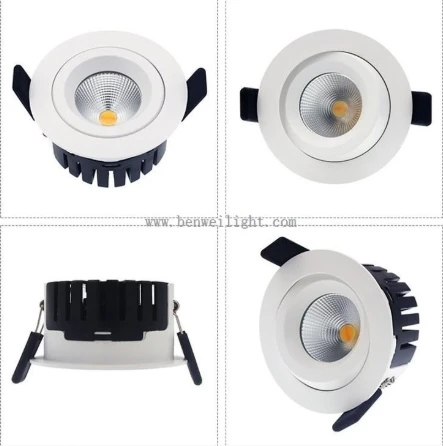
At Benwei Lighting, we make the kitchen downlights described above in 7 W to 50 W, with cut-outs from 75 mm to 240 mm, black or white finishes and 2700K to 6000K color temperatures. Tell us your kitchen size, ceiling type, target color temperature and dimming control, and we will recommend the number of fittings and send a quotation. You can also see our 150lm/W LED downlight range for higher-efficacy options.