Why Must Cleanrooms and Semiconductor Fabs Use Yellow LED Tubes? Ordinary Tubes Can Ruin an Entire Batch!
You think it's just a different colour? No – this protects products worth millions.
1. Why Do We Need "Yellow Tubes"? – The Invisible Killer of Photosensitive Materials
In semiconductor wafer fabs, PCB exposure lines, printing plate‑making rooms, photosensitive emulsion coating lines… there is one common taboo: blue light and UV radiation.
Ordinary LED tubes, fluorescent tubes, and even natural light contain significant amounts of blue light (400‑500nm) and UVA (315‑400nm) . These short‑wavelength high‑energy photons directly cause:
- Accidental photoresist exposure – the photoresist on a wafer undergoes unwanted chemical reactions under blue/UV light, leading to short circuits or open circuits on the circuitry.
- Degradation of photosensitive materials – film, diazo paper, screen‑printing emulsions can fail within minutes under normal light.
- Catastrophic yield loss – a tiny accidental exposure may scrap an entire batch worth millions of dollars.
The solution is simple: use tubes that emit only a specific yellow spectrum and completely block blue light and UV. That is why yellow LED tubes (also called "yellow light tubes" or "anti‑UV tubes") exist.

2. Ordinary White LED Tube vs. Yellow Anti‑UV LED Tube – Spectral Comparison
The spectrum of a standard white LED has a strong blue peak (around 450nm) plus a broad yellow emission from the phosphor excited by that blue light. That blue peak is exactly where photosensitive materials are most sensitive.
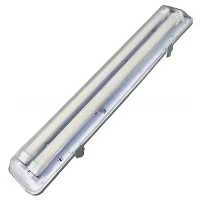
The core technology of our T8 yellow LED tube is:
- Dedicated yellow LED chip + special phosphor blend – the dominant wavelength is concentrated in 590‑595nm (pure yellow region).
- Complete cut‑off of blue and UV light from 400‑500nm – practically zero leakage of UVA/blue light (as measured).
- Clean spectrum – no stray light generation.
This means: under yellow tubes, workers can operate and inspect normally, while the photosensitive materials "see" no harmful light – it is like putting a giant pair of blue‑blocking goggles over the entire cleanroom.
3. Beyond UV Blocking – What Else to Look For in a Yellow LED Tube?
3.1 Illuminance and Uniformity
Many low-end yellow fluorescent tubes sacrifice brightness for the sake of being "yellow." Our T8 fluorescent tube uses high-efficiency yellow LED chips, and a single 1.2-meter tube can reach over 1200lm, ensuring that the illuminance meets the standard in yellow light environments (usually requiring 300-500Lux), and preventing workers from making mistakes due to fatigue caused by dim lighting.
3.2 Colour Rendering? – A Necessary Trade‑off for Special Applications
Ordinary white LEDs pursue a high CRI (Ra>80). But a yellow tube is essentially monochromatic – it cannot reproduce true colours. Under yellow light, everything looks yellowish‑brown. That is unavoidable. In a photosensitive workshop, "seeing outlines and detecting defects" is far more important than "true colour rendition". If colour discrimination is needed, amber or orange tubes with specific wavelengths can be used as supplements, but standard yellow tubes are not evaluated by CRI.

3.3 Lifetime and Reliability
Semiconductor cleanrooms operate 24/7. Replacing tubes is difficult and expensive. The Benwei yellow T8 uses an aluminium‑plus‑plastic structure + constant‑current driver, achieving 50,000 hours of life with a 5‑year warranty – eliminating frequent maintenance headaches.
3.4 Compatibility – Direct Replacement of Old Yellow Fluorescent Tubes
Traditional yellow light areas use fluorescent tubes with a yellow coating (such as yellow fluorescent tubes). Fluorescent tubes contain mercury, are fragile, have rapid light decay, and require a ballast. Our T8 LED yellow tubes are designed for direct replacement (remove the ballast and connect to AC power, or use a compatible electronic ballast), making upgrades very convenient.
4. Which Industries Absolutely Need Yellow LED Tubes?
| Industry | Specific Application |
|---|---|
| Semiconductor manufacturing | Wafer lithography, photoresist coating, developing, etching processes |
| PCB manufacturing | Exposure machine alignment, dry‑film / wet‑film coating lines |
| Printing plate‑making | Laser imagesetting, CTP plate‑making, screen‑printing emulsion coating |
| Optical films / polarisers | Photosensitive adhesive coating lines |
| Microelectronics assembly | UV‑curable adhesive dispensing areas (to prevent premature curing) |
| Museums / archives | Display cases for artworks and textiles that are extremely sensitive to UV and blue light (yellow or amber lighting can be used) |
In these places, using the wrong tube can mean rework at best, or a full batch scrap at worst. A yellow LED tube is not a "decorative light" – it is a process‑safety device.

5. Summary – Choose the Right Tube to Protect Your Yield
For general lighting, we pursue high CRI, high brightness, and a comfortable colour temperature. But in a photosensitive material production environment, spectral purity trumps everything else.
The Benwei T8 yellow anti‑UV LED tube delivers:
✅ Dominant wavelength 590‑595nm – pure yellow light
✅ Complete cut‑off of blue light (400‑500nm) and UV
✅ High efficacy, long life, direct retrofit for traditional yellow fluorescent tubes
✅ Suitable for Class 100+ cleanrooms
If your production line is sensitive to blue light / UV, or if you are still using old yellow fluorescent tubes, it is time to upgrade to a safer, more energy‑efficient, and more durable LED yellow tube.