Introduction: The Hidden Cost of High Luminous Decay Industrial Lighting
Current Status of Warehouse and Workshop Lighting Pain Points
Industrial workshops and warehouses are examples of high-frequency, long-cycle lighting environments. The majority of industrial facilities need 10 to 16 hours of continuous illumination each day, and some warehouses that are left unattended around-the-clock even run full-time lighting all year round. Ordinary LED three-proof batten lights on the market often have significant luminous degradation issues under such high-load operating settings. After 20,000 hours of usage, over 70% of common, inexpensive three-proof lights would have a luminous attenuation rate of more than 40%, according to data from industrial lighting tests. A number of production and management issues will arise when the initially intended high-brightness industrial lighting eventually becomes dim and uneven.
Inadequate lighting brightness and uneven light distribution in production workshops will lower worker accuracy, raise the possibility of processing mistakes and safety incidents, and lead to visual fatigue for long-term operators, all of which will indirectly lower production efficiency. Dim illumination has an impact on shelf management, inventory sorting, and products inspection in storage warehouses, which may result in incorrect goods entrance and departure as well as poor warehousing efficiency. High luminous decay also necessitates frequent lamp replacement and routine maintenance, which raises labour and procurement costs for businesses and results in needless production shutdown losses during maintenance and replacement.
The Core Value of Low Luminous Decay Three-Proof Batten Lights
Industrial-grade lighting fixtures designed for long-term high-load industrial situations are low luminous decay three-proof batten lights. They use anti-attenuation, long-life stability, and adaptation to severe environments as key design indications, which sets them apart from standard civil and commercial three-proof lights. Long-term constant luminous flux output, a slower rate of light brightness attenuation, and an extended effective service life for the whole bulb are the key benefits of low luminous decay lighting products.
Low luminous decay three-proof batten lights can provide industrial businesses with three main economic advantages: first, they can save long-term procurement costs by reducing the frequency of lamp replacement; second, they can save labour and time costs associated with manual maintenance; and third, they can maintain stable high-brightness lighting, guarantee production and warehousing efficiency, and prevent safety risks due to lighting attenuation. In order to achieve genuine long-term zero-maintenance lighting, high-quality heat dissipation, sealing, and electrical safety design that can adapt to dusty, humid, high-temperature, and low-temperature severe industrial conditions are often combined with good low decay performance.

Professional Analysis of Luminous Decay Mechanism of Industrial Three-Proof Lights
Definition and Industrial Evaluation Standard of Luminous Decay
One of the most crucial metrics for assessing the longevity of industrial lighting fixtures is luminous decay, which is the irreversible decrease of the luminous flux of LED light sources and completed lamps during extended powered operation. The L-value assessment standard, of which L70, L80, and L90 are the fundamental measurement dimensions, is widely used in the industry. The mainstream certified standard for high-quality industrial lighting is L80, which indicates that the lamp can sustain more than 80% of the original luminous flux after a certain number of working hours.
With a luminous decline rate of 30%–40%, ordinary industrial three-proof lights can only retain L60–L70 standards after 20,000 hours, which is far from satisfying the long-term operating requirements of workshops and warehouses. With L80 as the primary design standard, professional low luminous decay three-proof batten lights achieve a luminous attenuation rate of less than 18% after 30,000 hours of continuous operation and less than 3% initial decay within the first 1,000 hours, which is significantly higher than the industry average level.
Main Causes of Severe Luminous Decay in Ordinary Three-Proof Lights
Inadequate three-proof batten lights have significant luminous fading due to a variety of flaws in the material selection, structural design, heat dissipation system, and driving power configuration.
First of all, subpar items use inexpensive regular PC lampshades and untrained LED light beads that are devoid of anti-aging and anti-UV coatings. Reduced light transmittance and apparent luminous attenuation come from the lampshade's vulnerability to yellowing and brittle breaking during prolonged high-temperature operation and light exposure. Second, there is significant heat buildup within the lamp body as a result of the irrational heat dissipation arrangement. LED lamp beads age more quickly and have a much shorter effective luminous life because the high temperature produced by the long-term operation of the light source cannot be dispersed over time.
Furthermore, the majority of inexpensive three-proof lamps perform poorly in terms of sealing. Dust and damp water vapour may easily enter the workshop and warehouse due to the absence of an integrated silicone sealing structure. Humid gas will oxidise and age internal circuits and lamp beads, exacerbating brightness loss; dust builds up on the surface of the lamp tube and internal components, obstructing light output and producing luminous attenuation. Lastly, unstable voltage output from subpar constant-current driving power sources is prone to stroboscopic and current fluctuation, which causes quick luminous degradation and hastened light source fatigue.
Core Selection Criteria for Low Luminous Decay Three-Proof Batten Lights
Low Decay Light Source and Professional Luminous Performance Parameters
Industrial-grade high-stability T8 light sources are required for high-quality low luminous decay three-proof batten lights as the light source is the primary carrier of luminous decay performance. High-quality T8 LED tubes with a notional service life of up to 50,000 hours-two to three times longer than regular lamp beads-are supported by professionally approved goods. This industrial-grade light source features consistent luminous flux production, little heat generation, and potent anti-aging capabilities, in contrast to standard light sources with uneven light emission and poor stability.
Excellent low decay three-proof lights have a colour rendering index CRI≥85, meaning they can fulfil the high-precision lighting requirements of workshop processing and warehouse inspection while also effectively restoring the colour of commodities and workpieces. Simultaneously, it offers three distinct colour temperature options: 3000K warm white, 4000K neutral white, and 6000K cool white. This allows it to adjust to the various scene requirements of workshop high-brightness operation lighting and warehouse storage environment lighting. More significantly, the expert light source management system ensures long-term steady brightness of the lamp body by achieving ultra-low initial decay and long-term stable attenuation, with just 3% luminous loss in 1,000 hours and 18% loss in 30,000 hours.
High-Quality Anti-Aging Material Structure to Suppress Luminous Decay
High-quality low luminous decay three-proof batten lights employ an industrial-grade ABS+PC composite material structure, which fully resolves the issue of light attenuation brought on by material ageing and yellowing. This is because material ageing is a significant external source of luminous decay. High-strength anti-aging ABS engineering plastic, which has superior anti-corrosion, anti-oxidation, and anti-yellowing properties, is used to make the lamp body shell. Long-term hot and low temperature alternating conditions won't cause it to age, distort, or fracture, and structural stability guarantees that there won't be any light deviation brought on by shell deformation.
With a light transmittance rating of up to 92%, the lampshade is made of striped high-transmittance, flame-retardant PC polycarbonate. It has a professional anti-UV and anti-aging coating that can successfully withstand UV radiation and environmental degradation, prevent yellowing and light transmittance attenuation after extended usage, and sustain steady light output for at least eight years. This thicker industrial-grade lampshade essentially reduces the luminous deterioration produced by material ageing, in contrast to regular thin PC lampshades that are prone to brittleness and yellowing.
Independent Heat Dissipation System to Reduce Light Source Fatigue
The primary cause of LED light source ageing and luminous decline is heat buildup. Regular three-proof lights use an integrated closed construction without separate heat dissipation channels, which causes quick attenuation of luminous flux, continual high-temperature baking of lamp beads, and long-term heat buildup within the lamp body. Superior low luminous decay three-proof batten lights use an independent heat dissipation cavity design that creates a scientific heat circulation channel, separates the light source heating area from the internal electrical cavity, and can swiftly export the heat produced by the light source's prolonged operation to the outside of the lamp body.
This structured heat dissipation design successfully lowers the lamp's internal operating temperature, prevents light source fatigue and ageing brought on by high temperatures, significantly slows down the rate of luminous decay, and guarantees that the lamp can continue to provide stable luminous performance even after eight years of continuous operation. In addition to increasing heat dissipation efficiency, it prolongs the lamp's total service life, safeguards the internal driving power supply and circuit components, and achieves the twin benefits of low decay and long life.
IP65 Full Protection Design to Avoid Environmental Attenuation Loss
The majority of warehouses and workshops are located in corrosive, humid, and dusty conditions. Serious luminous deterioration will result from internal component ageing and a decrease in light transmittance caused by dust buildup and water vapour erosion. As a result, high-level protection performance is required for exceptional low luminous decay three-proof lights. The IP65 complete ingress protection certification, which is the primary assurance for long-term low decay operating in challenging situations, is a feature of professional industrial-grade three-proof batten lights.
In terms of dust protection, the Level 6 dust-proof standard achieves total dust tightness, preventing light blocking and attenuation brought on by dust buildup on lamp tubes and internal components. No fine industrial dust may enter the inside of the lamp. Regarding water prevention, the Level 5 water-proof standard can withstand low-pressure water jet splashing from all angles, adjust to humid settings such subterranean warehouses, car wash workshops, and cold storage, and stop water vapour penetration and circuit oxidation ageing.
In order to provide complete closed protection, the whole light uses integrated silicone seamless compression sealing technology, stainless steel quick-release buckles, and waterproof cable glands at both ends. It can withstand the erosion of weak acid, alkali, and chemical volatile gas in chemical workshops and food processing facilities, preventing luminous deterioration brought on by environmental corrosion, and has passed 500 hours of salt spray testing.
Scene-Based Selection Strategy for Warehouse & Workshop
Low-Temperature Cold Storage & Humid Warehouse Lighting Selection
Low temperatures, high humidity, and extended periods of closed operation are features of cold storage and humid storage facilities. In this climate, common three-proof lights are vulnerable to circuit condensation, component ageing, and fast luminous degradation. Low luminous decay three-proof batten lights with broad temperature adaptability and high-level sealing performance should be prioritised when choosing lights for such situations.
In situations with very low temperatures, high-quality goods can function steadily between -30°C and +55°C without seeing an abrupt spike in luminous degradation. In addition to guaranteeing that the light source and circuit components are always in a dry and stable operating state and maintaining ultra-low attenuation performance for an extended period of time, the full-sealed waterproof and moisture-proof structure completely isolates condensed water and humid air, preventing frequent lamp failure and brightness attenuation in cold storage environments.
Dust-Proof and Anti-Corrosion Lighting Selection for Production Workshops
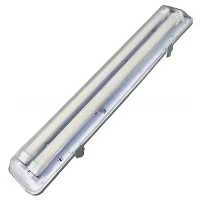
Higher standards for the anti-aging and anti-attenuation performance of lamps are set by the heavy dust and corrosive gas volatility found in machining, chemical and grain processing industries. The T8 double-tube three-proof batten light with minimal luminous decay is specifically designed for dusty and corrosive industrial settings. Long-term dust erosion and chemical gas corrosion can be withstood by the PC anti-aging lampshade and ABS anti-corrosion shell.
Single and double tube flexible switching, which may modify luminous flux in accordance with the lighting brightness needs of various workshop stations, is supported by the double-tube design. It achieves long-term steady lighting output in high-dust and high-corrosion workplace conditions while guaranteeing high-brightness uniform illumination and preventing luminous decay brought on by environmental degradation.
High-Frequency Continuous Lighting Selection for 24-Hour Warehouses
Large storage facilities and unattended logistics warehouses need 24-hour illumination, and the lamp body operates at a high load all year long, which is most likely to cause component ageing and luminous decay. Three-proof lights with ultra-long service life and ultra-low long-term attenuation must be chosen for such situations.
With just 18% luminous loss after 30,000 hours of continuous use, the premium low luminous decay three-proof batten light has a bulb service life of almost eight years. It may significantly lower the long-term operating and maintenance costs of warehouse lighting, remove the need for frequent replacement due to luminous decay, maintain steady brightness for an extended period of time, and adapt to 24-hour continuous high-load operation.
Economic Benefit Analysis of Low Luminous Decay Three-Proof Lights
Long-Term Cost Saving Advantage
Low luminous decay industrial three-proof batten lights have a little higher unit procurement cost than regular inferior goods, but their overall cost performance over the course of their complete life cycle is much greater. Due to significant luminous degradation and bulb ageing, ordinary three-proof lights need regular maintenance and expensive replacement every two to three years. High-quality goods with low luminous decay may continue to operate steadily for over eight years; in the early and middle phases, replacing the whole lamp is not necessary, and in the latter stages, just replacing individual light sources essential.
In addition, compared to conventional fluorescent three-proof lights, the high-efficiency light source design lowers power consumption by 60% to 75%. Long-term steady cost reductions for industrial and warehouse lighting operations may be achieved by businesses thanks to the twin benefits of energy conservation and minimal maintenance.
Production Efficiency and Safety Value Improvement
In addition to preventing production mistakes and safety risks brought on by dim and uneven light, stable low luminous decay lighting can consistently maintain uniform and high-brightness lighting in workshops and warehouses. It can also significantly increase worker productivity and the precision of products management. In addition to reducing long-term operators' eye fatigue and increasing overall production efficiency, flicker-free constant current drive design complies with international industrial health regulations.
Additionally, electrical safety issues brought on by lamp ageing and luminous decay are eliminated by CE-certified entire lamp safety performance, integrated short-circuit and leakage prevention, and flame-retardant material design, guaranteeing long-term safe and stable operation of industrial locations.
Conclusion & Purchasing Suggestions
The primary metric used to assess the long-term usefulness of three-proof batten lights for warehouses and workshops is luminous degradation. Due to subpar materials, irrational structural design, and poor heat dissipation and protection performance, the majority of common industrial lighting products on the market have significant luminous attenuation issues. These issues result in high maintenance costs, low production efficiency, and possible safety risks for industrial businesses.
Businesses should consider low luminous decay performance, material anti-aging ability, heat dissipation efficiency, and industrial protection grade as the primary selection criteria when buying industrial three-proof batten lights, in addition to initial pricing and brightness. With its ultra-low attenuation parameters, industrial-grade ABS+PC anti-aging structure, IP65 full protection, and independent heat dissipation system, the premium T8 double-tube low luminous decay three-proof batten light is ideal for long-term high-load, harsh environment operation requirements of warehouses and workshops.
Selecting high-quality, three-proof batten lights with low luminous decay is the most economical long-term investment for logistics warehouses, processing workshops, cold storage, and other industrial settings that need continuous illumination for extended periods of time. It may result in reduced energy use and consumption, stable, zero-maintenance operation, increased safety and efficiency, and increased economic value for industrial businesses.

How To Cooperate With Us?
Because we have our own facilities, we are pleased to have complete control over the production process and the quality of our goods. We are committed to giving our clients the finest prices since we are manufacturers rather than just brokers. We encourage clients to look at our samples first since we are certain that the cost and quality of our items are transparent. Our dedication to excellence and client happiness motivates us to consistently provide superior products.
Our address
3rd Floor, 5th Building, Hebei Industrial Park, Hualian Community, Longhua District, Shenzhen, China