Why Must the "Anti-UV T8 LED Yellow Tube Light" Be Used in Semiconductor Yellow Light Rooms? Are You Really Choosing the Right One?
In semiconductor, PCB, LCD panel, and other microelectronics manufacturing workshops, there is a special area called the "yellow light room" (photolithography area). Every light used here can directly affect product yield. Why can't ordinary LED tubes enter the yellow light room? What makes anti-UV T8 LED yellow tube lights so special? This article explains from the product itself and helps you understand the LED technology principles and key selection criteria.
1. Core Pain Point: Ordinary LED Tubes Can "Damage" Photoresist
Semiconductor photoresist is highly sensitive to light with wavelengths below 500nm, especially ultraviolet (<400nm) and blue-violet light (400-500nm). Although ordinary white LED tubes do not produce UV from mercury vapor, their blue light component can still cause premature photoresist reaction, leading to pattern defects and increased scrap rates. Traditional fluorescent yellow tubes can filter some UV, but they have problems such as mercury contamination, flicker, and rapid lumen depreciation.
Solution: Professional anti-UV T8 LED yellow tube lights block harmful wavelengths below 500nm at the source.

2. Product Technology Breakdown: How Does It Achieve "True Anti-UV"?
Taking Benwei's Anti-UV T8 LED Yellow Tube as an example, its core technology works on three levels:
2.1 Special LED Chip + Phosphor Formulation (Source Control)
Ordinary white LEDs use a "blue chip + yellow phosphor", producing a significant blue light peak. This product uses a specific-wavelength LED chip combined with a custom yellow phosphor to concentrate the emission spectrum in the pure yellow region of 570-590nm. Looking at the spectral graph, radiation below 500nm is almost zero – this is the foundation of "true anti-UV".
LED Knowledge Point: The color of LED light is determined by the chip material and phosphor. To obtain pure yellow light, you cannot simply use a yellow filter to block blue light (which would lose >70% efficacy). Instead, you must start from chip excitation and phosphor conversion. Benwei uses this efficient approach.
2.2 Dual Filtration Structure: Yellow PC Cover + Anti-UV Coating
The tube uses a V2 flame‑retardant yellow PC diffuser cover, which itself absorbs residual blue-violet light. Some models also add an anti-UV nano-coating on the inner wall to further block any accidentally generated UV. This "internal generation + external barrier" design keeps UV leakage below 0.1%.
2.3 Isolated Driver and Heat Dissipation Design (Long‑Term Stability)
LED tubes are most vulnerable to driver failure and lumen depreciation. This product features:
- Built-in isolated power supply with surge, short‑circuit, and over‑temperature protection; compatible with 100-240V wide voltage.
- High‑strength aluminum heat sink to keep LED junction temperature within a safe range, ensuring stable spectrum and a 50,000‑hour lifespan.
LED Knowledge Point: High temperature can cause LED chip wavelength red‑shift, reduced efficacy, and accelerated phosphor aging. For yellow tubes, wavelength drift may enter the dangerous zone (e.g., below 560nm), so heat dissipation is not optional.
3. Comparison with Traditional Solutions: Why Is LED Yellow Tube the Upgrade Choice?
| Parameter | Traditional Fluorescent Yellow Tube | Ordinary LED Yellow Strip Light | Benwei T8 LED Yellow Tube |
|---|---|---|---|
| Anti‑UV performance | Filters some UV, blue light remains | No professional filtering, high blue leakage | Completely blocks wavelengths below 500nm |
| Efficacy | ~50 lm/W | 80 lm/W (fast depreciation) | 100-120 lm/W |
| Lifespan | 8,000-10,000 hours | 15,000 hours (poor heat dissipation) | 50,000 hours |
| Startup characteristics | Flicker, warm‑up delay | Instant on but may flicker | Flicker‑free, instant on |
| Safety | Contains mercury, glass easily broken | PVC housing ages quickly | Aluminum + PC, flame‑retardant, shatter‑resistant |
| Cleanroom compatibility | Glass shard contamination risk | Not dust‑proof, not anti‑static | Sealed design, suitable for cleanrooms |
4. Three Most Frequently Asked Questions
Q1: Can this tube directly replace my old fluorescent yellow tube?
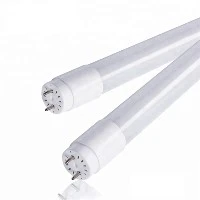
Yes. Standard T8 size (2ft/4ft/5ft), G13 base. No rewiring needed – simply remove or bypass the ballast (Benwei offers both ballast‑compatible and ballast‑bypass versions).
Q2: Is it truly 100% UV‑free?
Not "absolute zero", but it filters more than 99% of the 400-500nm band, and the entire spectrum is above 520nm – well above the safe threshold for photoresist (typically >450nm is sufficient). Professional users can verify with a spectrometer.
Q3: Can it also be used in food or museum applications?
Absolutely. Anywhere that needs to prevent grease oxidation, artwork fading, or photochemical decomposition of reagents – this yellow anti‑UV tube is an ideal choice.

5. Golden Rules for Selection: Look for Three Indicators
- Spectral graph – Ask the supplier for a third‑party test report showing the spectral distribution. Confirm there is no peak below 500nm.
- Efficacy – A good LED yellow tube should have efficacy ≥100 lm/W (lower values indicate poor phosphor efficiency or inadequate heat dissipation).
- Warranty – At least 5 years warranty – a sign that the manufacturer has confidence in product life.
A high-quality, UV-blocking T8 LED yellow tube light serves as more than just an illumination tool-it acts as a guardian of manufacturing yield. If you are currently selecting lighting solutions for a yellow-light zone retrofit, we hope this article helps you avoid the pitfall of choosing products that are merely "yellow" but fail to provide adequate UV protection.