Introduction: Beam Angle Is the Core of Professional Sports Lighting Design
Common Lighting Defects of Traditional Sports Venues
Most community sports courts, school training venues, and commercial recreational football and tennis courts still adopt outdated lighting configurations, including traditional metal halide lamps, halogen lamps, and mismatched narrow or medium beam angle LED flood lights. These conventional lighting solutions have long-term inherent flaws in actual operation. Narrow beam angles ranging from 15° to 60° feature highly concentrated light projection, which is only suitable for ultra-high pole lighting of professional top-level stadiums above 45 meters. For conventional venues with a lamp pole height of 10 to 30 meters, narrow-beam lights produce limited coverage, requiring 30% to 50% more lamps to eliminate dark zones, which greatly increases project procurement and installation costs. Medium beam angles of 60° to 90° have limited coverage capacity for large-area venues, unable to fully cover the boundary areas of standard football fields and tennis courts, forming obvious illuminance gaps and uneven light gradients.
In addition to unreasonable beam matching, traditional light sources suffer from low luminous efficiency, severe light decay, poor heat dissipation, and weak weather resistance. Long-term outdoor operation leads to rapid brightness attenuation, frequent lamp burnout, and rust and water ingress failures. Frequent replacement and daily maintenance consume a lot of manpower and material resources, increasing the long-term operating burden of sports venues. Moreover, traditional lighting has serious stroboscopic and glare problems, which interfere with athletes' judgment of fast-moving ball trajectories, reduce sports comfort, and fail to meet international standard requirements for formal training and amateur competitions.
Industry Standards for Modern Football & Tennis Court Lighting
According to the international sports lighting standard DIN EN-12193, sports venue lighting is divided into three professional grades: Class I for daily recreational sports, Class II for high-intensity training and spectator events, and Class III for professional-level competitions. Standardized football courts require an average illuminance of 200–300 lux for daily recreation and 500–800 lux for formal training, while tennis courts, which require higher visual precision, need 200–300 lux for casual play and 400–600 lux for club-level training. Beyond basic illuminance data, the core professional assessment indicators include illuminance uniformity (≥0.7 for qualified venues), unified glare rating (UGR < 19), and stable lumen maintenance rate.
Beam angle is the key parameter that determines whether these indicators can be stably achieved. A reasonable beam angle can realize full-coverage uniform light distribution, eliminate local hotspots and edge dark areas, effectively suppress glare, and maximize light utilization efficiency. For most non-professional competitive sports venues occupying the mainstream market, the 110° ultra-wide beam angle is perfectly matched with conventional venue sizes, lamp pole heights, and layout modes, becoming the optimal beam angle choice to balance lighting effect, project cost, and long-term stability.
In-Depth Analysis: 110° Beam Angle Optical Advantages for Sports Courts
Professional Optical Principle of 110° Wide Beam Angle Design
This series of 110° LED flood lights adopts high-transmittance PMMA optical lenses and independent secondary refraction optical optimization technology, abandoning the single direct light emission mode of ordinary flood lights. Through computer simulation of sports venue light propagation paths, the 110° symmetrical wide-angle light distribution curve is precisely calibrated, realizing flat and uniform light diffusion. Different from the central over-bright and edge dimming phenomenon of traditional lamps, the 110° beam angle design ensures that the light irradiates the court surface in a regular and consistent manner, with smooth light transition and no obvious brightness difference between the center and the edge of the venue.
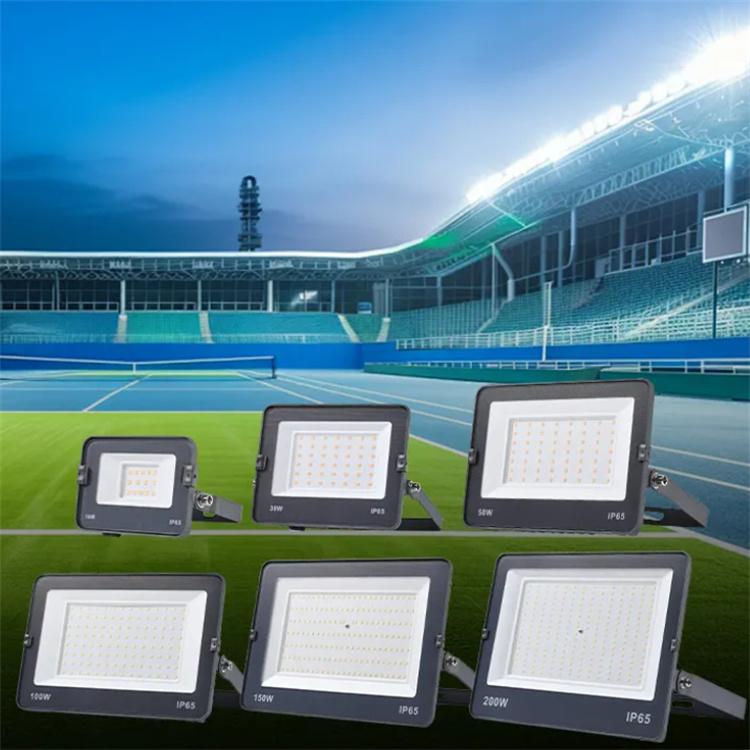
Matched with high-quality SMD LED chips with a luminous efficiency of 100LM/W, the lamp converts electric energy into high-purity visible light with minimal light loss. The full power range of 30W–200W supports flexible matching of different venue scales: low-power 30W–50W models are suitable for small private tennis courts and mini football fields, while high-power 100W–200W models perfectly meet the lighting needs of standard community and school large sports fields, realizing precise power and beam angle matching.
Football and tennis are typical fast-moving sports, and athletes need to continuously capture high-speed ball trajectories. Slight glare and uneven light will directly affect reaction speed and sports experience. The 110° wide beam angle diffuses concentrated light energy through optical lens refraction, avoiding the strong light stimulation caused by excessive local brightness. The product's UGR value is controlled below 18, far lower than the industry safety standard, effectively eliminating visual fatigue during long-term exercise and viewing. Meanwhile, the uniform light distribution completely covers every corner of the court, ensuring no blind spots for sports vision and meeting the lighting accuracy requirements of fast-paced ball games.
Beam Angle Comparison: Why 110° Is Better Than Narrow & Medium Angles
Narrow beam angle flood lights are designed for long-distance high-intensity projection, which is only applicable to professional super-large stadiums with ultra-high lamp poles. When applied to conventional football and tennis courts, narrow-beam lights have extremely limited single-lamp coverage. To reach the standard illuminance of the venue, the number of lamps needs to be increased by 40%–60%, which significantly raises the total cost of project procurement, wiring, and installation. In addition, the high-brightness concentrated light forms strong contrast with dark areas, resulting in serious glare, which disturbs athletes' dynamic vision judgment and cannot meet the basic lighting requirements of daily training and amateur competitions. Narrow-beam lighting also causes serious light spillage, resulting in huge energy waste.
Medium beam angle is the most common traditional sports lighting configuration, with a balance between projection distance and coverage, but it has obvious inherent deficiencies in large-area venue coverage. For standard 10.97m×23.77m double tennis courts and 68m×105m football fields, medium-beam lamps cannot fully cover the venue edges and boundary areas, forming persistent dark zones. In actual engineering construction, additional supplementary lights are required to remedy the illuminance gap, which increases construction difficulty and later power consumption. Moreover, the light attenuation transition of medium beam angles is not smooth enough, resulting in low overall venue uniformity, which is difficult to meet high-standard sports lighting evaluation indicators.
The 110° wide beam angle fills the market gap between narrow-beam long-distance projection and medium-beam insufficient coverage, and is the exclusive optimal solution for conventional sports venues with 10–30m lamp poles. First, it has ultra-large single-lamp coverage, which can reduce the number of lamps by 30% compared with medium-beam schemes, greatly saving project procurement and construction costs. Second, the ultra-uniform light distribution improves the overall venue illuminance uniformity to more than 0.8, exceeding the international qualified standard, ensuring consistent brightness from the court center to the boundary. Third, the wide-angle diffusion design suppresses light spillage to the greatest extent, improves light utilization efficiency, and realizes energy-saving lighting without sacrificing lighting effect. Fourth, the 110° beam angle is compatible with all installation angles, and the 180° adjustable bracket can flexibly adapt to different venue layout needs, with strong engineering adaptability.
Product Core Performance: Guarantee Long-Term Stable Sports Lighting
Lifespan & Low Light Decay Professional Technology
This 110° LED flood light is built with industrial-grade durability, with a rated service life of up to 50,000 hours, which is 8–10 times that of traditional halogen lamps and 3–5 times that of ordinary LED flood lights. Calculated by 8 hours of daily outdoor lighting operation, the continuous service cycle of the lamp can reach more than 17 years, realizing long-term zero frequent replacement. For sports venues that require long-term stable operation, it completely solves the industry pain point of frequent lamp burnout and repeated replacement, greatly reducing later maintenance labor costs and material loss.
Light decay is the core factor that determines the long-term lighting stability of sports venues. Ordinary flood lights will have a brightness attenuation of more than 40% after 20,000 hours of operation, resulting in dim venue lighting and failed compliance. This product adopts a constant current drive system and high-temperature resistant LED chip packaging technology, with a scientific heat dissipation structure to avoid chip aging and light attenuation caused by high-temperature baking. After 30,000 hours of continuous operation, the lumen maintenance rate is still higher than 85%, and the brightness attenuation is extremely slow. It can maintain professional standard illuminance and uniformity for a long time, ensuring that the venue lighting effect does not decline in the whole life cycle.
Industrial-Grade Protection & All-Weather Adaptability
Outdoor sports venues are exposed to wind, rain, snow, and dust all year round, and the protection grade of lamps directly determines operational stability. This 110° sports flood light adopts an integral fully sealed structural design, reaching IP66 industrial high protection grade. It can completely block all dust intrusion, and resist heavy rain flushing, water splashing, and water mist erosion. Unlike ordinary IP65 lamps that can only prevent conventional rainwater, IP66 grade can adapt to extreme rainstorm weather and open-air fully exposed installation without additional rain cover protection, suitable for all outdoor sports court scenarios.
The built-in 6KV high surge protection device of the power supply can effectively resist instantaneous high-voltage impact caused by thunderstorm lightning, avoid lamp burnout and circuit failure in thunderstorm weather, and ensure stable operation in lightning-prone areas. The product has ultra-wide temperature adaptability, which can work stably in the extreme temperature range of -50°C to +55°C. It will not freeze and fail in cold northern winters, nor will it age and burn out in high-temperature summer exposure. In addition, the lamp body is sprayed with anti-corrosion and anti-rust powder coating, which can resist acid rain and coastal salt fog erosion, and is suitable for various complex climatic environments.
Efficient Heat Dissipation & Structural Durability
The lamp body adopts integral die-cast aluminum molding process, with dense vertical rib heat dissipation structure and ultra-large heat dissipation contact area. The independent internal air convection channel can quickly export the heat generated by LED chips in real time, effectively control the internal temperature of the lamp cavity, avoid component aging and light decay acceleration caused by heat accumulation, and maximize the service life of the lamp. Equipped with 304 stainless steel adjustable bracket and anti-loose screws, it has high mechanical strength and rust resistance, supporting 180° free angle adjustment, which is convenient for flexible positioning and installation of different venue poles and walls. The high-transmittance tempered glass panel is impact-resistant and anti-aging, not easy to yellow after long-term sun exposure, and permanently maintains stable light transmittance and lighting effect.
Scenario Matching & Purchasing Value Analysis
Accurate Matching for Football & Tennis Court Scenarios
Conventional community and school football fields have large area and regular shape, requiring wide-range uniform lighting. The 110° ultra-wide beam angle can cover a large area of the venue with a single lamp. Through reasonable pole layout, it can quickly realize full-venue no-dead-angle lighting, effectively solving the edge dark zone problem that plagues medium and narrow beam lamps. The high luminous efficiency and uniform light distribution meet the illuminance and uniformity standards for daily training and amateur competitions, and the all-weather protection performance ensures stable operation in wind, rain, snow and other weather, meeting the all-weather use needs of sports venues.
Tennis sports have high requirements for lighting precision and anti-glare performance, and tiny shadow and brightness differences will affect the judgment of ball trajectory. The 110° beam angle uniform light distribution completely eliminates local shadows and glare, and the high CRI>80 restores the true color of the court and the ball, providing ultra-clear visual conditions for athletes. For small and medium-sized tennis courts, the wide-beam design can reduce the number of lamps, avoid excessive lamp arrangement causing light overlap and energy waste, and achieve a perfect balance between lighting quality and economic cost.
Core Purchasing Advantages for Buyers
Compared with traditional metal halide lamps and halogen lamps, this 110° wide-beam LED flood light reduces power consumption by 75%–85%. Long-term operation can save a huge amount of venue electricity costs every year. The high light utilization efficiency brought by 110° beam angle avoids invalid light waste, further optimizing energy consumption. Meanwhile, the 50,000-hour ultra-long lifespan and low failure rate greatly reduce later maintenance costs, replacement costs, and labor costs, with far higher return on investment than traditional lighting solutions.
The product supports 30W–200W full power customization and 3000K/4000K/6000K multi-color temperature matching, which can meet the differentiated lighting needs of venue training, competition, and daily viewing. The compact integrated design supports single-person quick installation without complex auxiliary accessories, greatly improving engineering construction efficiency. The adjustable angle bracket is compatible with all conventional lamp poles and wall-mounted installation methods, with strong scene adaptability, suitable for new venue construction and old venue lighting renovation projects.
Industrial-grade IP66 protection, 6KV lightning protection, low light decay optical design, and efficient heat dissipation structure ensure that the lamp has no failure, no sudden dimming, and no burnout in long-term outdoor operation. The stroboscopic-free light source meets professional sports lighting health standards, protecting the visual health of athletes and spectators. For venue operators and engineering contractors, this product is a high-quality, low-risk, high-return lighting solution that avoids project quality problems and later maintenance troubles caused by inferior lamps.
Conclusion
Beam angle is the decisive factor in determining the lighting quality of football and tennis courts, and the 110° ultra-wide beam angle is the most scientific and applicable beam angle choice for mainstream recreational and semi-professional sports venues. Compared with narrow and medium beam angle lamps, this 110° LED flood light has unparalleled advantages in venue coverage, illuminance uniformity, glare control, and energy utilization efficiency. Equipped with 50,000-hour ultra-long service life, low light decay optical technology, IP66 all-weather industrial protection, and efficient heat dissipation structure, it solves multiple pain points of traditional sports lighting such as uneven lighting, high energy consumption, short lifespan, and frequent failure.
This product not only meets international professional sports lighting standards in technical parameters, but also has outstanding economic benefits, which can greatly reduce the construction and operation costs of sports venues. It is the preferred professional lighting solution for community courts, school venues, commercial sports parks, and old venue renovation projects. For global engineering buyers and venue operators, choosing 110° wide-beam LED flood lights is not only a choice of high-quality lighting equipment, but also a long-term cost-saving, stable, and high-return venue operation strategy.

How To Cooperate With Us?
Because we have our own facilities, we are pleased to have complete control over the production process and the quality of our goods. We are committed to giving our clients the finest prices since we are manufacturers rather than just brokers. We encourage clients to look at our samples first since we are certain that the cost and quality of our items are transparent. Our dedication to excellence and client happiness motivates us to consistently provide superior products.
Our address
3rd Floor, 5th Building, Hebei Industrial Park, Hualian Community, Longhua District, Shenzhen, China