Introduction: The Hidden Crisis of LED Lighting Lifespan
Common Misunderstandings in LED Lamp Procurement
In commercial and industrial lighting procurement, most buyers focus excessively on surface parameters such as luminous efficiency, color temperature, and IP protection grade, while ignoring the most critical underlying indicator-heat dissipation capability. Many low-cost LED linear lights on the market adopt simplified shell structures, thin and unoptimized heat dissipation grooves, and low-thermal-conductivity materials. Although these products have the same nominal brightness and wattage as high-quality lamps in the initial use stage, their performance declines sharply after 1-2 years of continuous operation. A large number of engineering feedback shows that more than 80% of early failures of LED linear lights, including dimming, flicker, color shift, and circuit burnout, are not caused by poor quality of LED chips or drivers, but by long-term heat accumulation and ineffective heat dissipation.
Most manufacturers mark a nominal lifespan of 50,000 hours for LED lamps, but inferior products often fail to reach 20,000 hours of stable operation. The core reason lies in the unreasonable thermal design, which makes the LED junction temperature far exceed the safe operating range for a long time. This gap between nominal parameters and actual service effect leads to frequent lamp replacement, increased labor and material costs, and interrupted lighting system operation for commercial and industrial projects, bringing huge hidden losses to users.
Core Logic: Why Heat Determines LED Lifespan
LED lighting is a photoelectric conversion process with inherent thermal loss. Only 20%-30% of electric energy is converted into visible light, while the remaining 70%-80% is converted into heat energy and gathered inside the lamp body. According to the Arrhenius equation and IES LM-80 industry test standards, LED chip aging and light decay are positively correlated with junction temperature. The LED junction temperature (Tj) is the core temperature index that determines lamp performance and lifespan. When the junction temperature exceeds the standard 25°C ambient operating temperature and rises by 10°C, the LED lumen depreciation rate doubles, and the overall service life is reduced by nearly 50%. Meanwhile, high temperature will accelerate the aging of internal electronic components, especially electrolytic capacitors in the driver, causing capacity attenuation, leakage, and burnout, leading to overall lamp failure.
In addition, long-term high-temperature operation will cause thermal expansion and contraction of lamp body materials, aging and hardening of sealing silica gel, deformation of lampshades, and loosening of internal wiring. These continuous subtle aging problems will eventually lead to reduced dust and water resistance, light leakage, dark zones, and safety hazards such as short circuits. Therefore, high-efficiency heat dissipation is not an optional auxiliary function of LED lamps, but a necessary core guarantee for long-term stable operation and maximum service life.
Technical Principle: Thermal Dissipation Path and Failure Mechanism of LED Linear Lights
Complete Thermal Conduction Path of Linear Lights
The heat dissipation system of LED linear lights follows a complete three-stage thermal conduction logic: chip heat generation → PCB board thermal conduction → lamp body heat dissipation to the external environment. Each link determines the final thermal management effect. First, the high-density SMD LED chips generate concentrated heat during continuous operation, which needs to be quickly conducted to the aluminum substrate PCB. Second, the high-thermal-conductivity PCB board uniformly transfers the heat to the overall lamp body shell. Finally, the integrated heat dissipation structure of the lamp body contacts the air to complete convection heat dissipation, realizing continuous heat output.
Any bottleneck in the three links will cause heat accumulation. Traditional low-cost linear lights usually use ordinary single-layer PCB boards with low thermal conductivity and thin aluminum shells without heat dissipation grooves, resulting in a large amount of heat gathered near the chips and drivers that cannot be discharged in time. The local high-temperature state continues to impact the LED chips and electronic components, triggering a series of performance degradation problems.
Thermal Failure Mechanism of Inferior LED Linear Lights
Inferior LED linear lights with defective thermal design have three typical failure modes in long-term operation. First, accelerated light decay and brightness attenuation. Long-term high junction temperature will damage the chip luminous wafer, reduce luminous efficiency, and cause the lamp to become dimmer year by year. Most inferior products will have more than 30% light loss after 10,000 hours of use, completely failing to meet daily lighting requirements. Second, driver rapid aging and failure. The internal electrolytic capacitor of the driver is extremely sensitive to temperature. High temperature will accelerate electrolyte volatilization, reduce capacitor life, and cause unstable current output, resulting in lamp flicker, stroboscopic light, and sudden burnout.
Third, overall structural aging and reduced protection performance. Long-term internal high temperature will accelerate the aging of sealing rubber strips, make the PC lampshade yellow and brittle, reduce the IP dustproof and waterproof capability, and easily cause dust and water vapor to invade the interior, triggering short circuits and component corrosion. These failure modes form a vicious cycle: heat accumulation leads to performance degradation, and structural aging further weakens heat dissipation capacity, eventually leading to complete lamp scrapping in advance.
AKKO STAR Exclusive Thermal Design: Core Advantages of Long-Lifespan Operation
High-Thermal-Conductivity Integrated Aluminum Heat Dissipation Shell
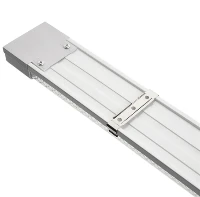
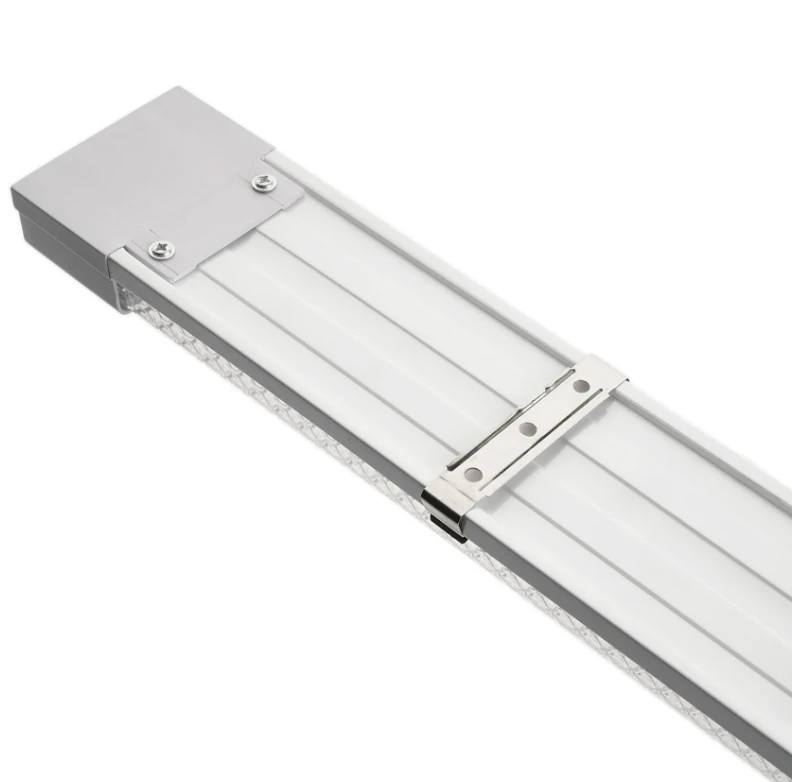
Different from the thin and smooth simple shell of traditional linear lights, AKKO STAR LED linear triproof light adopts high-strength extruded aluminum alloy integrated molding technology, with customized dense deep-groove heat dissipation structure on the back of the lamp body. This structural design greatly increases the heat dissipation contact area between the lamp body and the air, realizing three-dimensional omnidirectional convection heat dissipation. The aluminum alloy material has ultra-high thermal conductivity, which can quickly conduct the heat generated by LED chips and drivers from the PCB board to the entire lamp shell, avoiding local heat accumulation and effectively controlling the LED junction temperature within the safe range all the time.
The integrated molding process eliminates the thermal resistance problem caused by splicing gaps of split shells of ordinary lamps. Every structural part of the lamp body forms an integrated thermal conduction network, ensuring no heat retention dead corners. Even under long-term continuous full-power operation and high ambient temperature of 45°C, the internal temperature of the lamp body can be stably controlled, completely solving the core pain point of easy overheating of industrial and commercial lighting lamps.
Optimized Double-Row Chip Layout and Uniform Thermal Distribution
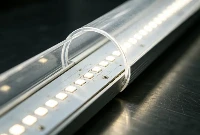
AKKO STAR linear light adopts exclusive double-row high-density 2835 SMD LED chip layout. Different from the uneven heat distribution of single-row chip design of ordinary lamps, the double-row chip layout carries out scientific dot matrix arrangement according to the thermal conduction law, realizing uniform heat distribution on the PCB board. It avoids the local overheating problem caused by excessive concentrated heat of single-row high-brightness chips. The uniform thermal distribution design not only reduces the peak temperature of a single chip, but also balances the overall temperature of the lamp body, making the heat dissipation system operate more stably and efficiently.
Meanwhile, the product is equipped with a high-quality thermal conductive adhesive layer between the LED PCB board and the aluminum lamp body. The high-performance thermal conductive material fills the tiny gaps between the PCB board and the shell, eliminates air thermal resistance, further improves thermal conduction efficiency, and ensures that heat can be exported in real time without delay during long-term operation.
High-Temperature Resistant Driver and Anti-Aging Electronic Configuration
As the core heat-generating component besides the LED chip, the driver's high-temperature resistance and thermal stability directly determine the lamp's overall lifespan. AKKO STAR linear light is equipped with an isolated constant-current IC driver, which adopts high-temperature resistant electrolytic capacitors that can withstand 105°C ultra-high temperature operation, far exceeding the 85°C temperature resistance limit of ordinary drivers. It effectively avoids capacitor swelling, leakage and failure caused by high-temperature heat accumulation.
The driver has built-in multiple protection circuits including overvoltage, overcurrent, short circuit and overheating protection. When the local temperature of the lamp body rises abnormally or the grid voltage fluctuates violently, the driver will automatically adjust the current and power, reduce heat generation, and protect the LED chip and internal circuits from high-temperature damage. The wide voltage design of AC85-265V adapts to unstable industrial power grids, avoids frequent voltage surges causing repeated temperature fluctuations of components, and further optimizes the long-term thermal stability of the lamp.
Data Verification: Heat Dissipation Performance Converts to Actual Lifespan Advantages
Professional Light Decay Contrast Test Data
Based on IES LM-80 standard aging test and 25°C standard ambient temperature environment, AKKO STAR LED linear light shows extremely excellent low light decay performance relying on superior thermal design. After 10,000 hours of continuous lighting, the lumen attenuation is only 8%; after 30,000 hours of operation, the light loss is stably controlled within 18%. In contrast, ordinary linear lights with inferior heat dissipation structures have a light decay rate of more than 30% after 10,000 hours of use, and most of them drop below the L70 lighting standard (70% of initial brightness) after 20,000 hours, resulting in scrapping failure.
With the support of high-efficiency heat dissipation system, the rated ultra-long service life of AKKO STAR linear light reaches 50,000 hours. Calculated by 8-hour daily industrial and commercial use, the lamp can maintain stable and high-brightness operation for more than 17 years, with no frequent replacement and maintenance required in the whole life cycle. The excellent low light decay performance completely solves the problem of gradual dimming of traditional lamps, ensuring consistent and uniform lighting effect for a long time.
Long-Term Operation Stability Comparison
In extreme environment simulation tests, AKKO STAR linear light can maintain stable heat dissipation and normal operation in the temperature range of -20°C to +45°C. In high-temperature closed workshops, humid underground parking lots and other harsh heat-concentrated spaces, the lamp body will not accumulate heat abnormally, no flicker, color shift or abnormal dimming occurs. Ordinary linear lights will have obvious brightness attenuation and frequent flicker after 3-6 months of operation in high-temperature environments, and the failure rate exceeds 40% within two years.
In terms of structural aging resistance, the stable thermal environment of AKKO STAR lamps avoids accelerated aging of sealing silica gel and PC lampshade. The shell will not deform or oxidize due to long-term high temperature, and the IP44 dustproof and waterproof protection performance remains stable for a long time. It greatly reduces the failure rate caused by thermal aging and extends the overall service cycle of the lighting system.
Commercial Value: How Excellent Heat Dissipation Reduces Full-Cycle Procurement Costs
Reduce Replacement and Maintenance Costs
For industrial parks, large warehouses, supermarkets, underground garages and other large-area lighting scenarios, frequent lamp replacement and manual maintenance will generate huge invisible costs. Inferior lamps with poor heat dissipation need batch replacement every 2-3 years, which not only increases the procurement cost of lamps, but also consumes a lot of labor costs and time costs for construction and maintenance, and even affects the normal operation of factory production and commercial venues. AKKO STAR linear light relies on top-level thermal design to achieve 17-year long-term stable operation, almost zero maintenance in the whole life cycle, which can save users more than 70% of long-term lighting maintenance costs.
Improve Energy Utilization Efficiency
Heat accumulation caused by poor heat dissipation will lead to reduced LED photoelectric conversion efficiency and increased invalid power consumption. The more serious the heat accumulation, the lower the luminous efficiency, resulting in more power consumption for the same brightness. AKKO STAR's high-efficiency heat dissipation system always maintains the LED chip in the optimal working temperature state, ensuring the luminous efficiency is stably maintained at 100-110lm/W. Compared with aging and power-consuming inferior lamps, it can save 75% of electric energy consumption for users, forming long-term energy-saving benefits while ensuring stable lighting effects.
Avoid Project Operation Risks
Unstable lighting caused by thermal aging failure of lamps will bring potential risks to industrial production, office work and commercial sales. Dim and flickering lights affect staff vision and work efficiency, and even cause production safety hazards in industrial processing scenarios. At the same time, frequent lamp failure will affect the overall image of commercial venues. AKKO STAR's professional thermal management design ensures zero failure and stable output of the lighting system for a long time, effectively avoiding various operational risks caused by lamp performance attenuation and failure.
Conclusion: Thermal Design Is The Core Foundation of High-Quality LED Lighting
This deep dive fully verifies that heat dissipation performance is the core determinant of LED linear light lifespan, stability and long-term use value. All performance advantages of LED lamps, including ultra-long service life, ultra-low light decay, high brightness stability and long-term structural reliability, are based on scientific and efficient thermal management design. Most inferior LED products on the market cut costs in heat dissipation materials and structural design, resulting in serious performance attenuation and short service life, which brings high comprehensive use costs to users.
AKKO STAR LED linear triproof light relies on integrated aluminum heat dissipation structure, optimized uniform thermal distribution layout and high-temperature resistant core configuration to build a full-link professional thermal management system. It fundamentally solves the industry pain points of heat accumulation, accelerated aging and rapid light decay of traditional lamps, and realizes 50,000 hours ultra-long lifespan, ultra-low light decay and all-scenario stable operation. For engineering contractors, enterprise purchasers and space operators, choosing AKKO STAR linear light is not only choosing a high-brightness and energy-saving lighting product, but also choosing a low-cost, zero-maintenance and high-reliability long-term lighting solution, which maximizes the return on investment of lighting engineering projects.

How To Cooperate With Us?
Because we have our own facilities, we are pleased to have complete control over the production process and the quality of our goods. We are committed to giving our clients the finest prices since we are manufacturers rather than just brokers. We encourage clients to look at our samples first since we are certain that the cost and quality of our items are transparent. Our dedication to excellence and client happiness motivates us to consistently provide superior products.
Our address
3rd Floor, 5th Building, Hebei Industrial Park, Hualian Community, Longhua District, Shenzhen, China