Wildfire Smoke and Daylight Spectrum: How Fresh vs. Aged Smoke Changes Light Over Time (And How to Compensate)
On a day when there is a wildfire, you go outside. It's an orange sky. Even at noon, the light appears to be a sunset. That's where most folks stop. But that orange light is expensive if you run solar panels, take pictures for a living, or cultivate plants indoors.
Smoke's alteration of daylight is not the only issue. The issue is that daylight is constantly altered by smoke. The impact of fresh smoke differs from that of day-old smoke. Furthermore, that is not discussed in the majority of papers.
Three things are accomplished by this guide:
demonstrates the effects of fresh smoke on the light spectrum using actual numbers.
explains why the amount of blue light absorbed by smoke varies over time.
provides you with a step-by-step lighting plan so you can make up for
Let's begin with what you can actually see.
1. First, How Does Daylight Get Affected by New Wildfire Smoke?
1.1 The Direct Impact: Orange/Red Light Remains, Blue Light Is Blocked
Sunlight has a balanced mixture of all visible wavelengths at midday under a clear sky. That equilibrium drastically shifts toward orange and red when there is a lot of smoke.
Why? Because short wavelengths (blue and violet) are scattered and absorbed by smoke particles far more frequently than long wavelengths (orange and red). The removal of blue light causes the sky to appear orange, not because smoke is orange.
It feels like late afternoon when you step outside on a hazy day. Colours are subdued. Whites have an amber appearance. That is the direct result.
1.2 Actual Data: Fresh Smoke Spectrometer Measurements (3440K, SPD Shift)
Let's put some figures on it.
A portable spectrometer was used to detect daylight at noon during the September 2020 wildfires in Portland, Oregon. The typical midday temperature is between 5500K and 6500K. It fell to 3440K when there was a lot of smoke.
Violet, blue, and even some green wavelengths clearly indicated a decline in the spectral power distribution (SPD). The light moved in the direction of 580 nm, a bright amber hue.
The number 3440K is not necessary for you to remember. Just keep in mind that a significant portion of the blue and green are eliminated by fresh smoke. What remains is amber, heated, and low in plant energy.
1.3 Rayleigh scattering: An explanation of why grey smoke produces amber light
Grey, carbon-based particles make up smoke itself. So why can amber light come from grey smoke?
Rayleigh scattering. Longer wavelengths (red) scatter less than shorter wavelengths (blue). Blue light is dispersed in all directions when sunlight travels through a dense layer of smoke particles. A portion of it never makes it to your solar panels or eyeballs. The majority of the light that passes through is orange and red.
The smoke functions as a massive blue-blocking filter suspended across the sky, to put it one way. It's not an orange filter. Blue is just eliminated.
However, only the colour change may be explained by Rayleigh scattering. The amount of blue light absorption is not explained by it. We must examine the chemistry of smoke in order to do that.
2. The Unanswered Question: Why Does Smoke Absorb So Much Blue Light?
2.1 Introducing the Dominant Absorber, "Dark Brown Carbon" (d-BrC)
Particles of smoke differ from one another. Some are soot, or black carbon. Organic carbon makes up some of them. And the primary cause of smoke's high absorption of blue light is a particular kind of organic carbon known as dark brown carbon (d-BrC).
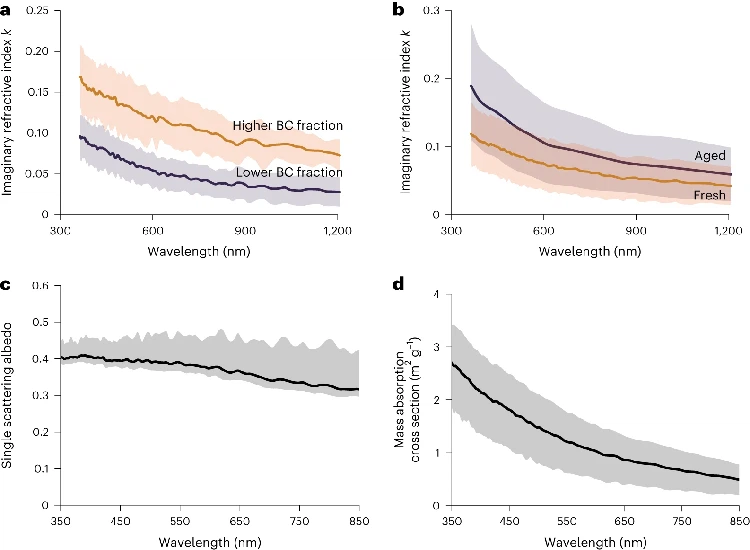
In contrast to ordinary brown carbon, d-BrC is resistant to photobleaching and insoluble in water. It continues to absorb light while remaining in the atmosphere. According to a 2023 study published in Nature Geoscience, d-BrC is the predominant shortwave absorber in smoke plumes from wildfires in the western United States.
2.2 Measured: 3/4 of Blue Light Absorption Is Contributed by d-BrC
Hard numbers from the same study:
Three-quarters of the short visible light absorption (blue to green) is attributed to d-BrC.
It is responsible for 50% of the absorption of long visible light (red).
Black carbon is not the primary cause of the blue light loss you observe on a smoky day. It originates from d-BrC. These particles are extremely viscous, small, and spherical. In the scientific literature, they are frequently referred to as "tar balls."
2.3 Tar Balls: The Amber Sky's Microscopic Particles
d-BrC appears as round, glassy particles when viewed under an electron microscope. Their diameter ranges from 140 to 200 nanometres. They don't merely smoulder; they form during high-temperature flames.
Why should you give a damn? due of tar balls' stubbornness. They take a while to bleach out. They continue to absorb blue light for days while remaining in the atmosphere. For this reason, a smoky sky might remain orange for a considerable amount of time. But not indefinitely.
3. Smoke Changes Over Time: What Most Articles Don't Tell You
3.1 The Process of Ageing: Light-Scattering (White) to Light-Absorbing (Brown)
The colour of fresh smoke is brown. It warms the atmosphere by absorbing shortwave radiation. However, smoke reacts with oxidants such as OH and NO3 radicals as it matures. The chemical makeup shifts. Particles start to disperse more and absorb less.
Smoke that is older turns white. The air is not warmed as much by it. Light is dispersed in every direction. For the light that reaches the earth, this is important.
3.2 Measured: Light Absorption Reduction of Up to 46%
In comparison to fresh smoke, aged smoke can lower light absorption by up to 46%, according to a 2017 study by researchers at Washington University in St. Louis (published in Environmental Science & Technology Letters).
That is a huge decline. After a few days, the same smoke plume that made your noon sky orange will allow more blue light to pass through.
3.3 Visual Timeline: The Evolution of the Daylight Spectrum (0h → 24h → 72h+)
Based on field measurements and laboratory ageing research, the following timetable is approximate:
0–12 hours (new smoke): CCT between 3400K and 3800K. Green and blue wavelengths are strongly muted. The sky appears to be orange to brown. The sun is frequently unseen.
Early ageing (12–24 hours): CCT rises to 4000K–4500K. A little blue light comes back. The sky turns yellowish instead of orange.
24–72 hours (transitional): CCT between 4500K and 5000K. Blue light is still becoming better. The sky appears fuzzy white with a hint of yellow.
CCT approaches 5000K–5500K after 72 hours (aged smoke). Although the spectrum is closer to normal, scattering may still result in a decrease in total intensity.
Weather, fire type, and smoke density all affect this timetable. However, the direction is always the same: aged smoke is more diffused and white, whereas fresh smoke is more orange.

4. The Significance of This Timeline for Your Everyday Life
4.1 For Growers and Indoor Plants: PPFD Recovery and Drop Curve
For compact development and stomatal control, plants require blue light. Blue light might decrease by 60–70% in the presence of fresh smoke. PPFD, or photosynthetic photon flux density, frequently decreases by 30–50%.
For commercial growers, this entails decreased yields, stretching, and slower growth. The good news is that PPFD recovers as smoke aged. However, it takes time for everything to return to normal. During the first 48 hours, you must make daily adjustments to your supplemental illumination.
4.2 A White Balance Nightmare That Changes Every Day for Photographers
The auto white balance on your camera is predicated on the light source being near D65, or daylight. The camera overcorrects at 3440K when there is new smoke. Images appear excessively chilly, sometimes even purple.
Even worse, the colour temperature varies daily. By 2 p.m., a custom white balance that was set at 10 a.m. might be incorrect. Use a grey card if you are shooting outside during a smoke incident. Every few hours, check your white balance. Alternatively, change to manual Kelvin and make adjustments as the smoke matures.
4.3 For Owners of Solar Panels: Daily Variations in Output Loss
Direct normal irradiance (DNI) is greatly reduced by fresh smoke. Diffuse light from your panels still generates some power, although overall output may decrease by 20–40%.
Diffuse light intensifies as smoke matures and becomes more scattering. However, until the plume disappears, total irradiance stays below average. Keep an eye on your everyday output. It won't be very helpful to clean your panels vigorously during the smoke occurrence. Hold off till the smoke clears.
4.4 For Everyone Else: The Impact of Ageing Smoke on Sleep, Mood, and Visual Comfort
Low blue light and low colour temperature can make you feel drowsy and less awake. That isn't creativity. Circadian rhythms are regulated by blue light. Your body may see dusk if you spend the entire day in 3400K light.
Use 5000K illumination during the day to make up for working indoors. Your eyes will appreciate it as well. Reading in amber light causes your eyes to strain more quickly.
5. How to Make Up for It: A Time-Based Lighting Plan
5.1 Overall Idea: Reintroduce What's Missing in Accordance with Age
The sky appears warm, so don't only add warm light. That exacerbates the issue. Reintroduce the blue and green wavelengths that smoke eliminated.
Compensation should be in line with the smoke stage. The most vigorous rectification is required for fresh smoke. Older smoke requires less.
5.2 Stage 1: Fresh Smoke (0–24 hours): Blue Supplement + 5000K–6500K High CRI
CCT: between 5000K and 6500K
CRI: > 90
Blue supplement: If you cultivate plants, add an extra 450 nm.
Why? Blue light is reduced by more than 50% by fresh smoke. To restore colour rendering and give plants adequate blue, you need high CCT and high CRI.
5.3 Stage 2: Transitional Smoke (24-72 hours): Full Spectrum CCT: 4000K to 5000K
Type: LED with full spectrum
The spectrum is beginning to improve. Heavy blue supplements are no longer necessary. Usually, a decent full-spectrum light in the 4000K–5000K area will do.
5.4 Stage 3: Aged Smoke (72h+): 3500K–4500K, Evenness CCT: 3500K–4500K
Priority: Even coverage rather than maximum intensity
The spectrum is almost typical at this point. The light is still more dispersed than normal, though. Make sure your workspace is evenly lit by your artificial lighting.
5.5 What Not to Do: Using "Warm White" (2700K) alone will make the situation worse.
The most frequent error is this one. In an attempt to "match" an orange sky, people go for warm white lights. That makes the issue twice as serious. The blue colour of warm white bulbs (2700K) is already low. Your blue light level decreases even more when you combine them with a smoky day.
Make use of lights with high CCT and high CRI. Don't try to match the sky. Make up for it.
6. Not All Atmospheric Haze Is the Same: Smoke vs. Others
| Condition | CCT Change | CRI Change | Time Evolution | Main Component |
|---|---|---|---|---|
| Wildfire smoke (fresh) | Drops to 3400-4500K | Drops significantly | Changes over days (aging) | d-BrC, black carbon |
| Urban haze | Moderate drop to 4500-5500K | Slight drop | Slow, less dramatic | Nitrates, sulfates |
| Volcanic ash | Can drop below 3000K | Severe drop | Weeks to months | Silica, rock dust |
| Thin cloud | Slight increase (cooler) | Slight change | Hours | Water droplets |
| Clear sky | ~5500-6500K | ~95+ | Stable | N/A |
Smoke is unique because it ages chemically. Haze and clouds do not.
7. How to Keep an Eye on Light Quality When Smoke Occurs
7.1 Visual Cues: What to See in the Sky at Every Phase
Fresh: Orange to brown sky, invisible sun
Transitional: golden sky, hardly visible sun
Aged: White sky, hazy yet noticeable sun
Visual clues are difficult to interpret. Just use them to make a fast guess.
7.2 Low-Tech Resources: CCT Estimation Apps for Smartphones
CCT may be estimated from your phone's camera using apps like Colorimeter or LightSpectrum Pro. Although they are not lab-grade, they are sufficient to determine whether you are at 3500K or 5000K.
7.3 Expert Instruments: Portable Spectrometers
Investing in a handheld spectrometer is worthwhile if you manage a commercial grow or a photo studio. You can obtain CCT, CRI, and the complete SPD with a single measurement. You'll be able to determine the precise stage of the smoke.
FAQ
Q: Does the colour and temperature of smoke from wildfires alter over time?
A: Indeed. CCT can be lowered to about 3400K with fresh smoke. Over the course of two to four days, CCT progressively returns near 5000K–5500K as smoke matures.
Q: How long does it take for smoke to mature and alter how much light it absorbs?
A: Within 12 to 24 hours, significant effects begin. Depending on sunlight, humidity, and oxidant levels, the complete change from brown to white smoke takes two to five days.
Q: What distinguishes "black carbon" from "brown carbon"?
A: All visible wavelengths are severely absorbed by black carbon, or soot. Blue and green are largely absorbed by brown carbon. Compared to ordinary BrC, dark brown carbon (d-BrC) absorbs considerably more powerfully and is resistant to bleaching.
Q: Can smoke lower the output of my solar panels? At each step, by how much?
A: Indeed, fresh smoke can reduce production by 20–40%. 10–20% of transitional smoke. smoking by 5–10% or less.
Q: On a smoky day, what colour temperature should I set my grow lights to?
A: Use 5000K–6500K for fresh smoke. Aged smoke: 3500K–4500K; transitional smoke: 4000K–5000K. Avoid falling below 3500K.
Contact
Kevin Rao
Email:bwzm12@benweilighting.com
Tel/Whatsapp:+8619972563753