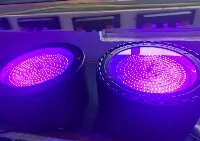
365nm curing lamps deliver excellent curing performance across numerous applications, especially in scenarios requiring deep-layer curing or processing heat-sensitive materials. However, to achieve optimal results, it is essential to understand their working principles and the key factors influencing the curing process.

What is a 365nm UV Curing Lamp?
Let's take a brief look at 365nm curing lamps. The term "365nm" refers to the wavelength of ultraviolet (UV) light, measured in nanometers (nm). UV light is an invisible segment of the electromagnetic spectrum with shorter wavelengths than visible light. In the field of UV curing, different wavelengths serve distinct purposes. The 365nm band is extremely common and particularly suitable for activating specific types of photoinitiators, thereby enabling rapid hardening of liquid resins or adhesives.
Such curing lamps typically adopt LED technology. Compared with traditional mercury lamps, LED lamps offer advantages like longer service life, lower energy consumption, instant on/off capability, and minimal heat generation. These benefits have made 365nm LED curing lamps increasingly popular in both industrial and daily applications.
Core Working Principle: How Does 365nm UV Curing Work?
You may wonder how light exposure turns a liquid into a solid. This process relies on an elegant chemical reaction.
Photoinitiators are the key.Almost all UV-curable resins or adhesives contain special chemical substances called photoinitiators, which can be visualized as "switches".
Activation by 365nm wavelength.When UV light at 365nm irradiates these photoinitiators, the photoinitiators absorb light energy and then decompose to generate free radicals or cations.
Initiation of chain reactions.These free radicals or cations act like "matches"-they rapidly react with monomer and oligomer molecules in the resin, triggering a fast chain polymerization reaction.
Material curing.As the polymerization reaction proceeds, the originally fluid liquid material gradually cross-links into a rigid solid. This process is extremely fast, usually completed within seconds or even less.
The 365nm wavelength is critical because the optimal absorption wavelength of many commonly used photoinitiators falls within this range. This means they can be activated most efficiently under 365nm light, achieving high-performance curing.

Unique Advantages of 365nm Curing Lamps
What specific curing advantages make 365nm curing lamps stand out?
Stronger deep-layer curing capabilityCompared with shorter-wavelength UV light (e.g., 254nm), 365nm light features superior penetration power. It can better penetrate colored or thick adhesive layers, enabling uniform curing from the surface to the interior and avoiding the problem of "surface drying while the interior remains uncured".
Good compatibility with various photoinitiatorsMany commercially available UV adhesives and resins are formulated with photoinitiators matched to the 365nm wavelength, making 365nm curing lamps highly versatile.
Low heat generationLED curing lamps themselves produce far less heat than traditional mercury lamps, and the 365nm wavelength generates relatively low heat during curing. This is particularly important for processing heat-sensitive materials (e.g., certain electronic components and medical devices), as it reduces the risk of thermal stress damage.
Low curing shrinkage rateIn some applications, 365nm curing enables better control over curing shrinkage, which is highly beneficial for applications requiring high precision and dimensional stability.
Key Factors Influencing Curing Performance
Having a 365nm lamp alone is not sufficient to achieve optimal curing results. Several key factors must also be considered:

Comparison Between 365nm and Other Wavelengths
You may wonder if there are curing lamps with other wavelengths besides 365nm. The answer is yes! The most common alternatives are 395nm and 405nm. What are the differences between them, and how should you choose?

If your adhesive is heat-sensitive, requires very precise and deep curing, and explicitly recommends 365nm, then 365nm is an excellent choice.If your application demands higher penetration or extremely fast curing speed, and your adhesive is compatible with 395nm, then 395nm may be a better option.405nm is primarily used in applications such as 3D printing that require ultra-deep curing or specialized materials.When making a selection, the most important step is to check the technical specifications of your UV adhesive or resin to understand their recommended curing wavelength and energy requirements.
Wide-Ranging Applications of 365nm Curing Lamps
Thanks to their unique advantages, 365nm curing lamps are widely used across various industries:
Electronics Industry: Bonding of smartphone camera modules, touchscreen lamination, FPC flex circuit reinforcement, micro-speaker assembly, coil fixation, etc. They minimize thermal stress on precision electronic components.
Medical Devices: Catheter bonding, needle assembly, endoscopic device manufacturing, sensor encapsulation, etc. These applications require high biocompatibility and curing stability.
Optical Industry: Optical lens bonding, fiber optic connector curing, optical component encapsulation. The cured bond must be highly transparent and bubble-free.
Crafts & Jewelry: UV resin curing, amber/wax repair, jewelry surface coating. Fast curing speeds up production efficiency.
Nail Art: Curing of UV gel nail polish. Most nail lamps use 365nm or a dual-wavelength combination of 365nm + 405nm.
Scientific Research & Laboratories: R&D and testing of various UV adhesives, materials science research.
Printing & Coatings: Curing of certain UV inks and coatings.As you can see, 365nm curing lamps play a vital role, from high-precision electronics manufacturing to everyday nail art
.
How to Choose the Right 365nm Curing Lamp?
With a wide range of products on the market, how do you select the best 365nm curing lamp for your needs?
Determine Power and Intensity
Power (W): This refers to the electrical power of the lamp, but optical power density (mW/cm² or W/cm²) is more critical. Select based on your adhesive's curing requirements-some adhesives may require several hundred mW/cm², while others need several W/cm².
Light Spot Size: The size of your curing area will dictate the required spot size.
Heat Dissipation PerformanceLED lamps generate heat during operation. A good heat dissipation design (e.g., cooling fans, heat sinks) ensures the stability and longevity of the LED beads.
Light UniformityEnsure uniform light intensity distribution across the spot to avoid poor curing in some areas.
Control MethodsSome lamps come with timers, intensity adjustment, or even external signal control, which improve operational convenience and precision.
Brand and QualityChoose well-known brands or manufacturers with a good reputation. For example, if you are looking for a professional LED bead manufacturer, consider Shenzhen Hengcai Electronics, which has extensive experience in this field. High-quality products not only guarantee curing performance but also have a longer service life.
SafetyEnsure the product complies with relevant safety standards and includes necessary protective measures (e.g., UV-protective goggles).
BudgetSelect the product with the best performance-to-price ratio within your budget.
Safety and Maintenance Tips for 365nm Curing Lamps
For your safety and the longevity of the curing lamp, please note the following:
Wear Protective Goggles: UV light is harmful to the eyes. Even 365nm UVA can cause damage with prolonged exposure. Always wear professional UV-protective goggles.
Avoid Skin Exposure: Although UVA's immediate skin damage is less severe than UVB or UVC, long-term or high-intensity exposure can cause skin aging or more serious issues.
Maintain Ventilation: Some UV adhesives may release trace amounts of irritant gases during curing. Good ventilation helps protect your health.
Clean Regularly: Periodically clean the lamp surface, especially the light output window, to prevent dust and adhesive residue from affecting light output.
Store Properly: When not in use, store the curing lamp in a dry, dust-free environment and avoid dropping or impact.
Curing Issues? Common Problems and Solutions
If you encounter poor curing results with your 365nm curing lamp, you can troubleshoot from the following aspects:

Q1: Is a 365nm curing lamp harmful to the eyes?
A1: Yes, ultraviolet light is harmful to the eyes. The 365nm wavelength falls into the UVA band. While it is not as strongly germicidal or destructive as UVC, prolonged or high-intensity direct exposure can still damage the retina and even trigger conditions such as cataracts. Therefore, always wear professional UV-protective goggles when operating the lamp.
Q2: The instruction manual for my UV adhesive states a wavelength range of 365nm-405nm. Which lamp should I use?
A2: This indicates that your adhesive can be cured within the wavelength range of 365nm to 405nm. Generally speaking:
365nm delivers superior deep-layer curing performance.
395nm or 405nm may offer faster curing speeds.
You can select the appropriate wavelength based on your specific application requirements and test results. If working with heat-sensitive materials or requiring precision curing, 365nm is likely the better choice.
Q3: Can a 365nm curing lamp cure all types of UV adhesive?
A3: No, it cannot. Although 365nm has broad applicability, UV adhesive curing relies on specific photoinitiators, which exhibit varying sensitivity to different wavelengths. You must use a UV adhesive or resin explicitly formulated to match the 365nm wavelength. Always check the technical specifications of the adhesive before purchase.
Q4: Why has the curing performance of my 365nm lamp deteriorated after prolonged use?
A4: This issue may stem from the following factors:
LED chip aging, which causes a decline in light intensity.
Surface contamination (dust or adhesive residue buildup on the lamp) that blocks light output.
Poor heat dissipation, which impairs LED chip performance.
We recommend first inspecting and cleaning the lamp surface. If the problem persists, the LED chips or the entire lamp unit may need replacement.
Q5: Are 365nm curing lamps the same as nail lamps?
A5: They are not identical, but share significant similarities. Many nail lamps do utilize 365nm wavelengths (or dual wavelengths of 365nm + 405nm), as nail adhesives are typically engineered to cure under these spectra. However, industrial-grade 365nm curing lamps feature:
Higher power output
More focused light spots
Enhanced heat dissipation systems
Professional-grade designs


http://www.benweilight.com/professional-lighting/uv-lighting/uv-light-black-light-for-halloween.html
www.benweilight.com/professional-lighting/uv-lighting/outdoor-arena-stadium-lighting-flood-lights.html
www.benweilight.com/industrial-lighting/led-flood-light/uv-led-flood-light.html