420W LED Tennis Court Light: Redefining Illumination Standards for Competitive and Recreational Tennis

Tennis is a sport that demands precision, speed, and split-second decision-making-qualities that are directly influenced by the quality of court illumination. Whether for professional tournaments, college matches, or community recreational play, tennis courts require lighting that meets strict standards for brightness, uniformity, glare control, and color accuracy. For decades, facilities relied on traditional lighting solutions like metal halide (MH) or high-pressure sodium (HPS) fixtures, but these often fell short: they produced uneven light, took minutes to warm up, consumed excessive energy, and required frequent maintenance. The introduction of the 420W LED Tennis Court Light has transformed the industry, offering a purpose-built solution that meets and exceeds the rigorous demands of tennis lighting. This high-performance fixture delivers the exact brightness, uniformity, and color quality needed for both casual play and competitive matches, while slashing energy costs and reducing maintenance burdens. This article explores the technology behind 420W LED Tennis Court Lights, their key features, compliance with global lighting standards, benefits over traditional systems, installation considerations, and real-world applications-highlighting why they have become the gold standard for tennis facilities worldwide.
To understand the significance of the 420W LED Tennis Court Light, it is first essential to grasp the unique lighting requirements of tennis courts. Unlike other sports venues, tennis involves fast-moving objects (tennis balls traveling at speeds up to 150 mph in professional play) and wide player movement across a large court (78 feet long by 27 feet wide for singles, 36 feet wide for doubles). This means the lighting must be bright enough to track the ball clearly, uniform enough to eliminate dark spots or glare that could obscure a player's vision, and consistent enough to avoid distracting fluctuations. Global governing bodies like the International Tennis Federation (ITF) have established strict standards to ensure fair play and safety: for recreational courts, the minimum average illuminance (light level) is 200 lux; for competitive matches, it ranges from 500 lux (regional tournaments) to 1000 lux (professional events like ATP/WTA matches). Additionally, the uniformity ratio (minimum illuminance to average illuminance) must be at least 0.7 for recreational play and 0.8 for competitive play, ensuring no area of the court is significantly darker than others. Glare is another critical factor-ITF standards require glare ratings of less than 30 (on a scale of 0–100, where lower is better) to prevent eye strain and ensure players can see the ball clearly against the sky or court surface.
The 420W LED Tennis Court Light is engineered specifically to meet these demanding standards, with a power output and light distribution tailored to the size and layout of tennis courts. At its core, the fixture uses high-power LED chips-typically COB (Chip on Board) or high-density SMD (Surface Mount Device) chips-that deliver intense, focused light with a luminous efficacy of 130–150 lumens per watt. This translates to a total light output of 54,600–63,000 lumens per fixture-enough to cover a significant portion of a tennis court when mounted at the correct height and angle. Unlike traditional MH lights, which emit light in a broad, unfocused pattern (wasting up to 30% of light on surrounding areas), 420W LED Tennis Court Lights use custom-designed optical lenses or reflectors to direct light precisely onto the court surface. These optics are available in narrow beam angles (25–45 degrees) for long-range coverage (e.g., illuminating the baseline from a pole at the side of the court) or medium beam angles (50–70 degrees) for closer coverage (e.g., the net area), ensuring uniform light distribution across the entire playing surface.

Another key technical feature of the 420W LED Tennis Court Light is its color quality, which is critical for both player performance and spectator experience. The fixtures typically offer a color temperature of 5000K–6500K, which mimics natural daylight-ideal for tennis, as it allows players to distinguish the yellow tennis ball against the green or blue court surface with minimal eye strain. Additionally, 420W LED models have a high Color Rendering Index (CRI) of 90+, meaning they reproduce colors accurately. This is not only important for players (who need to see subtle variations in court markings or ball spin) but also for televised matches, where accurate color reproduction ensures viewers at home can follow the action clearly. Unlike HPS lights, which produce a yellowish glow with a CRI of less than 70, LED fixtures eliminate color distortion, making the court look vibrant and the ball easy to track.
Flicker control is another critical technical advantage of 420W LED Tennis Court Lights. Traditional MH lights often suffer from flicker-rapid fluctuations in light intensity-that are imperceptible to the naked eye but can cause eye fatigue during long matches and create a "strobe effect" in slow-motion replays of televised games. 420W LED fixtures operate at a high frequency (1000Hz+), making them flicker-free (meeting the IEEE 1789 standard for flicker mitigation). This ensures smooth, consistent light that reduces eye strain for players and delivers clear, distortion-free footage for broadcasters-a must for competitive tournaments.
The benefits of 420W LED Tennis Court Lights over traditional lighting systems are numerous, making them a superior choice for facilities of all sizes. One of the most significant advantages is energy efficiency. A 420W LED fixture produces the same or higher light output as a 1000W MH light-meaning it uses 58% less energy. For a facility with 8 courts (each requiring 4 fixtures), this translates to substantial savings: a 1000W MH system would consume 32,000W per hour, while a 420W LED system consumes just 13,440W per hour. If the courts are used for 10 hours per day, 6 days a week, the LED system saves 11,136 kWh per month-approximately \(1,670 at an average industrial electricity rate of \)0.15/kWh. Over a year, this amounts to $20,040 in energy savings-enough to offset the initial cost of the LED fixtures within 2–3 years.

Long lifespan is another major benefit of 420W LED Tennis Court Lights. High-quality models have a rated lifespan of 50,000–60,000 hours-5–6 times longer than MH lights (which typically last 8,000–10,000 hours). At 10 hours of daily use, an LED fixture can last 13–16 years before needing replacement, compared to just 2–3 years for an MH fixture. This not only reduces the hassle of frequent bulb changes (which require specialized crews to access the high mounting poles, often 15–20 feet tall) but also minimizes maintenance costs. For a facility with 32 fixtures (8 courts × 4 fixtures), replacing MH bulbs every 2 years would cost approximately \(12,800 (at \)200 per bulb, including labor), while LED fixtures would require no replacements for over a decade-saving tens of thousands of dollars in maintenance expenses.
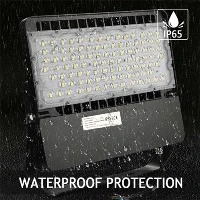
420W LED Tennis Court Lights also offer superior durability and weather resistance, which is critical for outdoor tennis facilities. Unlike MH lights, which have fragile glass bulbs and filaments that can break due to vibration or extreme weather, LED fixtures have no moving parts and are housed in rugged, corrosion-resistant enclosures made of aluminum or stainless steel. Most models have an IP65 or higher ingress protection rating, meaning they are fully protected against dust and low-pressure water jets-making them suitable for use in rain, snow, or high-humidity environments. Additionally, LED fixtures operate well in extreme temperatures, from -30°C to 50°C (-22°F to 122°F), whereas MH lights can struggle to start in cold weather and may experience reduced lifespan in hot climates.
The instant-on capability of 420W LED Tennis Court Lights is another advantage for facilities. Traditional MH lights take 5–10 minutes to warm up to full brightness and require a cool-down period if turned off accidentally-causing delays in matches or practice sessions. LED fixtures turn on instantly to full brightness, allowing facilities to start play immediately and adjust lighting quickly if needed (e.g., turning on additional fixtures for evening play). This flexibility is particularly valuable for community centers or schools that host back-to-back practice sessions or matches.
For competitive tennis facilities, compliance with ITF and local lighting standards is non-negotiable-and 420W LED Tennis Court Lights are designed to meet or exceed these requirements. As mentioned earlier, the fixtures deliver an average illuminance of 500–1000 lux (depending on the number of fixtures and mounting layout), which meets the standards for regional and professional tournaments. The uniform light distribution, achieved through custom optics, ensures a uniformity ratio of 0.8 or higher-exceeding the ITF's minimum requirement of 0.7 for competitive play. Additionally, the low glare design (achieved through anti-glare lenses and precise mounting angles) keeps glare ratings below 30, ensuring players can focus on the ball without squinting or losing visibility. Many 420W LED models also undergo third-party testing to verify compliance with ITF standards, giving facility managers confidence that their lighting meets the highest industry benchmarks.
When designing a lighting system for a tennis court using 420W LED fixtures, several key factors must be considered to ensure optimal performance. First, the number of fixtures required depends on the court type (singles vs. doubles) and the desired illuminance level. For a singles court requiring 500 lux (regional tournament standard), 4–6 fixtures are typically sufficient, mounted on poles at the corners or sides of the court. For a doubles court or higher illuminance (1000 lux for professional play), 6–8 fixtures may be needed, with additional fixtures mounted along the length of the court to ensure uniform coverage. The height of the mounting poles is also critical: poles should be 15–20 feet tall to avoid glare and ensure the light is directed evenly across the court. Mounting the fixtures too low can cause glare, while mounting them too high may result in light waste or uneven distribution.
Second, the beam angle of the fixtures must be selected based on their position relative to the court. Fixtures mounted on corner poles (far from the center of the court) require narrow beam angles (25–35 degrees) to focus light on the distant baseline and sideline areas. Fixtures mounted on side poles (closer to the net) require medium beam angles (50–60 degrees) to cover the net and mid-court areas. Using the correct beam angles ensures that light is directed exactly where it is needed, minimizing waste and maximizing uniformity.
Third, the lighting layout should be designed to avoid shadows and dark spots. This often involves using a "cross-lighting" configuration, where fixtures are mounted on opposite sides of the court and directed toward the center. This configuration ensures that light is distributed evenly, with no areas of the court left in shadow. For televised matches, additional considerations include avoiding light spillage into the camera lenses and ensuring consistent light levels across the entire court to prevent color distortion in footage.
Installing 420W LED Tennis Court Lights requires careful planning and execution to ensure safety and performance. The first step is to conduct a site survey to assess the existing infrastructure (e.g., existing poles, electrical wiring) and determine the optimal fixture placement. If new poles are needed, they should be installed in concrete foundations to ensure stability-especially in areas with high winds. The electrical wiring must be rated for outdoor use and properly insulated to prevent water damage. It is also important to ensure that the electrical system can handle the load of the LED fixtures: while 420W fixtures use less energy than MH lights, multiple fixtures may still require a dedicated circuit.
After installation, the system should be tested to verify compliance with illuminance and uniformity standards. This involves using a light meter to measure light levels at various points across the court (e.g., baseline, service line, net) and calculating the uniformity ratio. If adjustments are needed (e.g., a dark spot in the mid-court), the beam angle of the fixtures can be fine-tuned or additional fixtures can be added. Many 420W LED fixtures also offer dimming capabilities, allowing facility managers to adjust the light level based on the time of day or type of play (e.g., dimming to 50% for practice sessions to save energy).
Real-world applications of 420W LED Tennis Court Lights demonstrate their transformative impact on facilities. For example, the Oakwood Tennis Club, a community facility in a suburban area, recently upgraded its 6 outdoor courts from 1000W MH lights to 420W LED fixtures. Prior to the upgrade, the club struggled with high electricity bills (\(12,000 annually) and frequent bulb replacements (\)3,000 per year). After the upgrade, the club's energy costs dropped by 60% (to $4,800 annually), and maintenance costs were eliminated for the next 10+ years. Additionally, players reported improved visibility and reduced eye strain, leading to a 25% increase in membership sign-ups. The club also noted that the instant-on capability of the LED fixtures made it easier to host evening tournaments, as they no longer had to wait for the lights to warm up.
Another example is the University of Western Athletics, which upgraded its 4 indoor tennis courts to 420W LED lights for its NCAA Division I tennis program. The university required lighting that met ITF standards for competitive play and could support televised matches. The 420W LED fixtures delivered an average illuminance of 800 lux with a uniformity ratio of 0.85 and a glare rating of 25-exceeding ITF requirements. The upgrade also reduced the university's energy consumption for tennis court lighting by 55%, aligning with its sustainability goals. Broadcasters noted that the high CRI of the LED fixtures improved the quality of televised matches, with viewers able to see the ball more clearly and distinguish between court markings and the ball.
When selecting a 420W LED Tennis Court Light, facility managers should consider several key factors to ensure they choose a high-quality product. First, check the lumen output and efficacy: look for a fixture that produces 54,600–63,000 lumens with an efficacy of 130+ lumens per watt to ensure energy efficiency. Second, verify compliance with ITF standards: choose a fixture that has been tested and certified to meet illuminance, uniformity, and glare requirements for the desired level of play (recreational vs. competitive). Third, check the lifespan and warranty: a rated lifespan of 50,000+ hours and a warranty of 5–10 years indicate a reliable product. Fourth, consider the weather resistance rating: look for an IP65 or higher rating for outdoor courts. Fifth, evaluate the control options: choose a fixture with dimming capabilities if you want to adjust light levels for different uses, and consider smart controls (e.g., remote monitoring via a smartphone app) for easier management.
The future of 420W LED Tennis Court Lights is bright, with ongoing innovations that promise to further improve performance and functionality. One of the most exciting developments is the integration of smart lighting systems, which allow facility managers to control and monitor the fixtures remotely. For example, smart LED fixtures can be programmed to turn on/off automatically based on scheduling (e.g., turning on at 5 PM for evening play) or motion sensors (e.g., turning on when a player enters the court). They can also send alerts to facility managers if a fixture is malfunctioning, allowing for proactive maintenance. Additionally, advancements in LED chip technology are leading to even higher efficacy and brightness, with some models now reaching 160+ lumens per watt-further reducing energy consumption.
Another innovation is the use of adaptive lighting, which adjusts the light level in real time based on natural light conditions. For example, on a cloudy day, the fixtures can increase brightness to maintain the desired illuminance level, while on a sunny evening, they can dim to save energy. This not only optimizes energy use but also ensures consistent lighting conditions for players. Additionally, researchers are exploring the use of tunable color temperatures, which would allow facilities to adjust the color of the light based on the time of day (e.g., warmer 4000K light for evening play to reduce eye strain) or player preferences.
In conclusion, 420W LED Tennis Court Lights have redefined the standards for tennis court illumination, offering a powerful, efficient, and reliable solution that meets the unique needs of the sport. Their ability to deliver uniform, bright, flicker-free light with high color accuracy ensures optimal performance for players and a superior viewing experience for spectators. The energy savings, long lifespan, and low maintenance requirements make them a cost-effective choice for facilities of all sizes, from community centers to professional stadiums. As technology continues to advance, 420W LED Tennis Court Lights will only become more capable, solidifying their position as the future of tennis court lighting. Whether for a casual game with friends or a high-stakes tournament, these fixtures ensure that the focus remains on the sport-where it belongs.
https://www.benweilight.com/industrial-lighting/led-flood-light/420w-led-tennis-court-light.html
Together, we make it better.
Shenzhen Benwei Lighting Technology Co.,Ltd
Mobile/Whatsapp :(+86)18673599565
Email:bwzm15@benweilighting.com
Skype: benweilight88
Web: www.benweilight.com
Add:F Building,Yuanfen Industrial Zone,Longhua,Bao'an District,Shenzhen, China