A Comprehensive Guide: Shunted vs. Non-Shunted Lamp Holders
By Kevin Rao November 18,2025
|
What is a Lamp Holder (Tombstone)? Shunted Lamp Holders Non-Shunted Lamp Holders Comparison Table: Shunted vs. Non-Shunted When to Choose Shunted vs. Non-Shunted Summary |
The lighting market features various types of lamp holders (commonly known as "tombstones"), and a fundamental decision buyers face is whether to use shunted or non-shunted versions. Selecting the correct type for linear lamps is critical to prevent electrical hazards, ensure system safety, and maintain product certifications. Using the wrong type can lead to short circuits, damage to components, voided UL listings, reduced lamp lifespan, or even fire risks.
This guide details the differences between shunted and non-shunted lamp holders and provides clear guidance on their proper applications.
What is a Lamp Holder (Tombstone)?
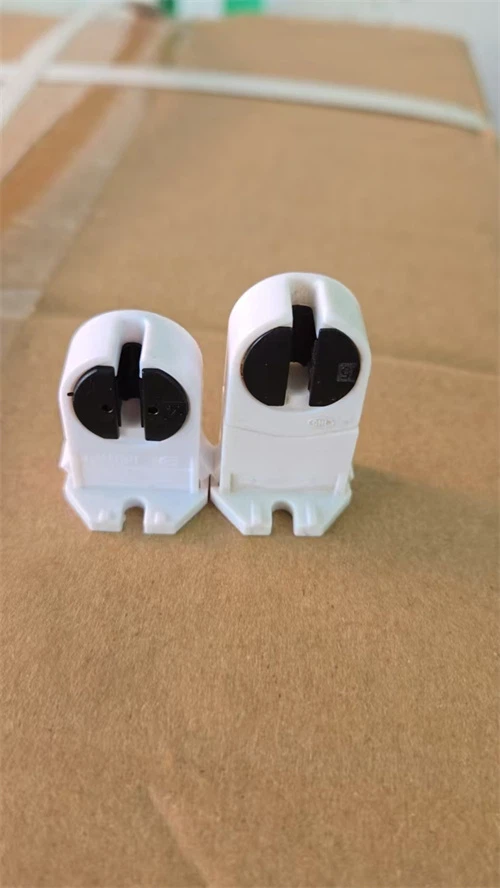
A lamp holder is the physical and electrical interface that secures a linear tube light (like fluorescent or LED tubes) and connects it to the power source. It ensures safe and reliable electrical transmission to the lamp.
Key Differences: Shunted vs. Non-Shunted
The core distinction lies in their internal electrical configuration, which dictates how current flows to the lamp's pins.
Shunted Lamp Holders
Internal Structure: Shunted lamp holders have a built-in conductive bridge (the shunt) that internally connects the two metal contacts. This creates a single electrical pathway.
Current Flow: Power is supplied to one side of the holder. The internal shunt allows current to pass across both contacts simultaneously, providing a complete circuit to the lamp's pins on that single end. This is why some LED tubes, for example, can light up with power connected to only one end of the fixture, while the other end acts merely as a physical support.
Key Feature: Their wiring is simpler because the internal connection eliminates the need for separate wires to each contact on the same end.

Non-Shunted Lamp Holders
Internal Structure: Non-shunted lamp holders feature two completely separate, electrically isolated contacts. There is no internal bridge.
Current Flow: Power must be delivered independently to each contact via separate wires. The current typically enters through one pin at one end of the tube, travels through the lamp's internal circuit, and exits through a pin at the opposite end, forming a continuous loop.
Key Feature: They provide independent electrical paths, offering greater flexibility for specific wiring configurations, such as series circuits or systems with dimmers.
Visual Identification and Testing
While physical differences can sometimes be seen, the most reliable method to confirm the type is to use a multimeter set to continuity mode. If the meter beeps when touching the two contacts, the holder is shunted. No beep indicates a non-shunted holder.
Comparison Table: Shunted vs. Non-Shunted
| Feature / Aspect | Shunted | Non-Shunted |
|---|---|---|
| Internal Wiring | Terminals are internally connected | Terminals are electrically isolated |
| Current Flow | Single, unified path | Separate, independent paths |
| Primary Use Case | Instant-start fluorescent ballasts; Type A LED tubes | Series circuits; Ballast-bypass LED tubes (Type B) |
| LED Compatibility | Works only with Type A (plug-and-play) LEDs | Required for Type B (direct-wire) LEDs |
| Ballast Dependency | Requires a ballast for operation | No ballast required (in ballast-bypass setups) |
| Wiring Complexity | Simpler | More complex, requires careful wiring |
| Common Applications | Older commercial fluorescent fixtures | Modern LED retrofits and updated installations |
When to Choose Shunted vs. Non-Shunted
The choice primarily depends on the ballast and the type of lamp being used.
Choose SHUNTED Lamp Holders when:
You are using fluorescent tubes with an instant-start ballast.
You are installing Type A (Plug-and-Play) LED tubes, which are designed to work with the existing fluorescent ballast. The shunted holder provides the correct electrical pathway for these ballast-dependent systems.
Choose NON-SHUNTED Lamp Holders when:
You are performing an LED retrofit with Type B (Ballast Bypass) LED tubes. These tubes require direct line voltage to each end of the tube, which is only possible with isolated contacts.
The fixture uses a programmed-start or rapid-start ballast (common in older fluorescent systems).
The wiring configuration is a series circuit.
The application involves dimmable lighting systems that require separate current control.

Summary
In summary, the decision is straightforward:
Shunted: Used for ballast-dependent systems (instant-start fluorescents and Type A LEDs).
Non-Shunted: Used for ballast-bypass or direct-wire systems (Type B LEDs) and other applications requiring independent electrical paths.
If you are ever uncertain, always consult the lamp manufacturer's specifications or seek advice from a qualified lighting specialist to ensure a safe and compliant installation.
Tel/Whatsapp:+8619972563753
Email:bwzm12@benweilighting.com
Skype:bwzm32
Web:https://www.benweilight.com/