Advantages and disadvantages of glass led fluorescent tube
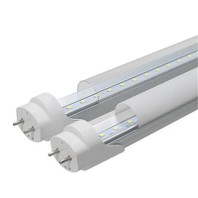
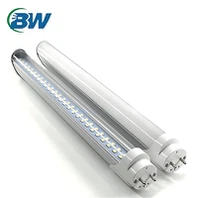
At present, most of the LED T-tube lamps on the market use semi-plastic and semi-aluminum shell materials, which are mainly composed of aluminum alloy and PC cover. Recently, in order to further reduce costs, some manufacturers use glass materials to make LED T-tube lamp shells. The cost is only 50% of the cost of traditional semi-plastic and semi-aluminum LED T8 tube lights.
The cost of glass tube LED fluorescent lamps meets the desire of many consumers to be "cheaper", but from the perspective of industry experts, in addition to fragility, glass tube has a fatal weakness that can only be used for Retail market with low quality requirements.
The fatal disadvantage of glass tube LED fluorescent lamps is thermal management. Industry experts said that heat dissipation is a big problem facing glass tubes. He commented: “Take the 1.2m T8 tube as an example, the PC+aluminum design can really reach 18W, 120PCS 2835 LED. The lumen can be very high, and the stability is also very good. If you use a glass tube, as on the market now Yes, because of the fear of poor heat dissipation, it is often made with either insufficient power or very low lumen, or the warranty period is only one year. All of this is because if the glass tube is made of the same specification as aluminum, the lamp life will be obvious affected."
LED semi-plastic and semi-aluminum housing
Compared with the half-aluminum + PC cover, the heat dissipation of the glass LED fluorescent lamp is not satisfactory. Of course, the worst heat dissipation is the glass tube, and some of the all-plastic tubes have heat sinks inside. Inexpensive glass tubes usually do not have internal aluminum heat sinks. In many cases, manufacturers use an LED strip as a light source. At this time, the temperature of the LED is close to the absolute maximum, leading to a reduction in life (50% failure in about 8000 hours) and faster and higher light decay.
Experts believe that if the problem of thermal management cannot be solved, glass tube LED lighting can only be applied to the retail market with low cost and low quality requirements. If it is a professional application, glass tube is not preferable.
Summarize the shortcomings of glass LED fluorescent lamps. 1. Glass heat dissipation is always far worse than aluminum heat dissipation. After testing, when the glass near the lamp panel is very hot, the temperature of the glass at the lamp panel is still normal. 2. It is difficult to assemble. Maybe we didn't find the correct method. However, we need to use fixtures when glueing and fixing. In addition, the thermal paste is not easy to handle. 3. It is fragile, and the lamp will be scrapped as soon as it is touched.