Does blue light really pose a threat to vision as we age?
By Kevin Rao November 27,2025
In the consulting room of Moorfields Eye Hospital in London, Mr. Johnson, aged 67, held up his iPad to show his recent fundus scans to the consulting physician. "Doctor, I use digital devices for more than 8 hours daily, and recently I've noticed distortion in my central vision." Optical Coherence Tomography revealed typical drusen deposits in his macular region-an early sign of Age-Related Macular Degeneration (AMD). This clinical picture is becoming increasingly common globally.
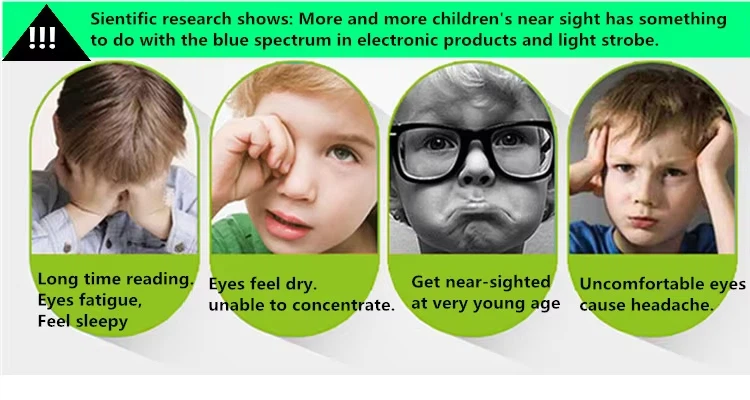
I. Mechanism Analysis: The Pathway of Blue Light-Induced Photochemical Damage
1. The Retinal-Blue Light Toxicity Cascade
Retinal, a key mediator in the visual cycle, initiates specific photochemical reactions under blue light exposure. This process follows the principles of the Jablonski energy diagram:
Photoexcitation: Blue light photons (wavelength 415-455nm) carry 2.7-3.1eV of energy, sufficient to excite retinal molecules to a triplet state.
Electron Transfer: The excited state retinal undergoes energy transfer with oxygen molecules, generating Reactive Oxygen Species (ROS).
Lipid Peroxidation: ROS attack the membrane structures of photoreceptor outer segments, which are rich in polyunsaturated fatty acids, triggering a chain reaction.
2. Cell Death Signaling Pathways
Experimental studies indicate that the blue light-retinal complex induces apoptosis through the following pathway:
math
[Retinal*] + O₂ → ¹O₂ → Caspase-3 Activation → DNA Fragmentation → Photoreceptor Apoptosis
The collapse of the mitochondrial membrane potential is an early key event, occurring within 2 hours of exposure.
3. Age-Related Susceptibility Mechanisms
With aging, macular pigment density decreases by 0.5-1.2% per year, leading to:
Reduced blue light filtering capacity (decreasing from ~90% at age 25 to ~60% at age 65).
Decline in the antioxidant defense system (e.g., Superoxide Dismutase activity decreases by ~40%).
Impaired cellular autophagy function, leading to accumulation of toxic metabolites.
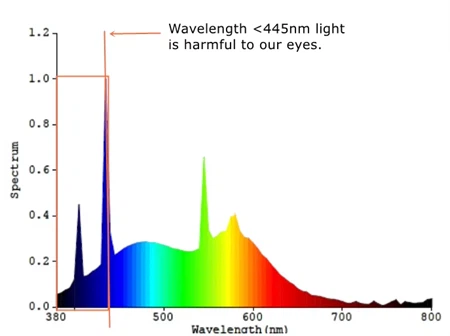
II. Comparative Toxicity Effects of Different Light Sources
| Light Source Type | Blue Light Intensity (mW/cm²) | Retinal Decay Half-life (min) | Photoreceptor Cell Viability (%) | Protection Recommendation |
|---|---|---|---|---|
| Natural Sunlight (Noon) | 12.5 | 45 | 32 | Wear CAT 3 Sunglasses |
| LED Display (Max Brightness) | 8.3 | 68 | 51 | Enable Night Mode, Maintain 50cm Distance |
| Cool White LED Lamp | 15.2 | 35 | 28 | Use 2700K Color Temperature Alternatives |
| OLED Display | 6.7 | 85 | 63 | Auto-Brightness, Anti-Blue Light Filter |
| Incandescent Bulb | 2.1 | 180 | 89 | Phasing out (Lower Efficacy) |
| Candlelight | 0.3 | >480 | 98 | No Significant Risk |
Data Source: International Photobiology Society 2023 Annual Report
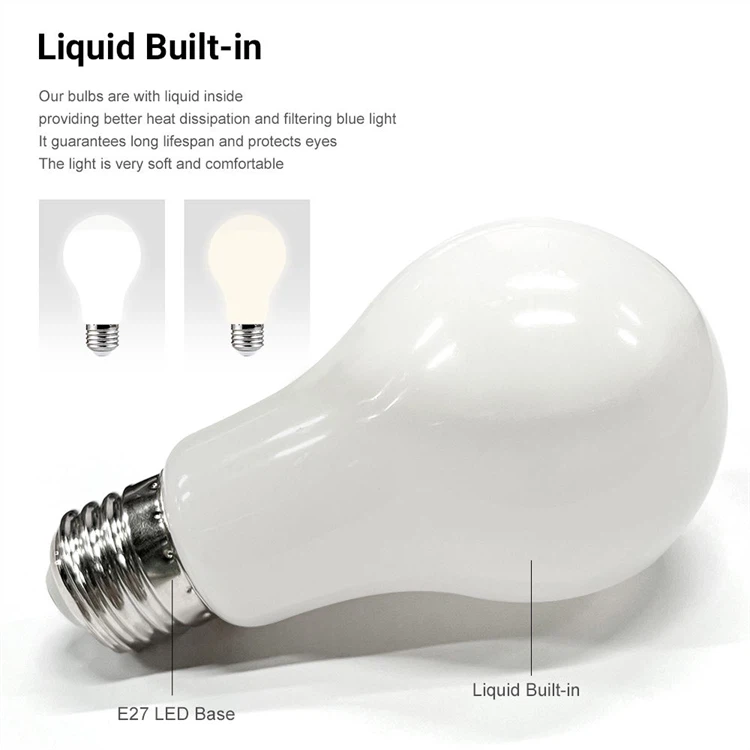
III. Biological Basis of Protective Systems
1. Endogenous Defense Mechanisms
Macular Pigment: Acts as an optical filter composed of Lutein and Zeaxanthin, with peak absorption at ~463 nm.
Antioxidant Network: α-Tocopherol (Vitamin E) can neutralize two peroxyl radicals per molecule; its regeneration requires Vitamin C.
DNA Repair Systems: Nucleotide Excision Repair enzyme activity peaks within 4 hours post-exposure.
2. Exogenous Intervention Strategies
Clinical studies show that daily supplementation with 10mg Lutein + 2mg Zeaxanthin can increase Macular Pigment Optical Density (MPOD) by 30-40%. Specific blue light-filtering lenses can block 35-50% of High-Energy Visible (HEV) blue light while maintaining color perception.
3. Device-Side Solutions
New generation displays using Quantum Dot technology can shift the blue light peak emission from 450nm to 460nm, reducing toxicity by approximately 25%. Microlens array technology improves backlight utilization to ~85%, allowing lower brightness for the same perceived luminance.
IV. Developmental Stages of Age-Related Macular Degeneration
According to the Age-Related Eye Disease Study (AREDS) grading scale:
Early Stage: Small to medium drusen (<125μm diameter), macular pigment disruption.
Intermediate Stage: Large drusen (≥125μm), Retinal Pigment Epithelium (RPE) abnormalities.
Late Stage: Geographic Atrophy (Dry AMD) or Choroidal Neovascularization (Wet AMD).
Blue light exposure has been shown to accelerate the progression from early to late stages, increasing the annual progression risk by 1.8-fold.
V. Latest Research Advances
1. Gene Therapy Prospects
AAV vector-mediated delivery of the Superoxide Dismutase 2 (SOD2) gene demonstrated a 3.2-fold extension of photoreceptor survival in primate models.
2. Biomimetic Optical Materials
Inspired by the age-related yellowing of the human lens, smart photochromic materials have been developed that dynamically adjust blue light filtration from 15% to 85% within 100ms.
3. Timing of Nutritional Intervention
Lifecycle models indicate that consistent antioxidant supplementation starting at age 35 can reduce the risk of developing late AMD by 41%, whereas starting after age 55 only reduces risk by 18%.

Frequently Asked Questions (FAQ)
Q1: Do I need to wear blue light-filtering glasses all the time?
A1: Based on circadian rhythm research, wearing them from 9 AM to 5 PM provides optimal protection. Usage should be reduced in the evening to avoid disrupting melatonin secretion. Lenses with 30-40% blue light blockage are recommended to balance protection and color perception.
Q2: Are OLED screens completely safe?
A2: While OLEDs emit 20-30% less blue light intensity than standard LEDs, their PWM (Pulse Width Modulation) dimming mechanism at low brightness can cause visual fatigue. It's advised to maintain a screen-to-ambient light luminance ratio between 1:3 and 1:5.
Q3: How long does it take for supplements to show an effect?
A3: Increasing Macular Pigment Optical Density requires consistent supplementation for 3-6 months to detect significant changes. A combination of diet (kale, spinach, egg yolks) and supplements is recommended, aiming for blood lutein levels above 0.6 μmol/L for protective effects.
Q4: Do children require special protection?
A4: Children's lenses are more transparent, transmitting 1.5-2 times more blue light than adults. Screen time should be limited to under 1 hour per day for children under 6, combined with physical blue light protection measures.
Q5: Is Night Mode sufficient for protection?
A5: Night Mode primarily reduces the proportion of blue light by shifting color temperature (e.g., from 6500K to 3000K), but the total light energy output remains similar. In dark environments, reducing brightness below 80 cd/m² is necessary for substantial protection.

VII. Efficacy Assessment of Protective Measures
According to multicenter randomized controlled trial data, combined protection strategies show significant effects:
Single Measure (e.g., Blue Light Glasses): 18-25% Risk Reduction
Dual Measures (Glasses + Nutritional Supplements): 35-48% Risk Reduction
Comprehensive Intervention (Device Settings + Optical Protection + Nutritional Support): 52-67% Risk Reduction
VIII. Conclusion
Blue light-induced retinal photochemical damage is a deterministic process governed by photobiological laws, not merely a probabilistic risk. A decade-long cohort study at the University of Geneva Medical School showed that individuals strictly adhering to blue light protection guidelines had a 58% lower incidence of late AMD compared to the control group (HR=0.42, 95% CI 0.31-0.57).
As Nobel Laureate in Chemistry John B. Goodenough stated: "Understanding the molecular mechanisms of energy conversion is the prerequisite for controlling its biological effects." By precisely deciphering the photophysical processes of the interaction between blue light and retinal, we can establish a comprehensive protection system from molecules to behavior.
In an irreversible digital era, adopting evidence-based, personalized protection strategies is not only essential for preserving visual function but also a scientific choice for maintaining quality of life.
References:
Nature Communications. (2023). Photochemical mechanisms of blue light-induced retinal degeneration.
American Academy of Ophthalmology. (2024). Age-Related Macular Degeneration Preferred Practice Pattern.
Investigative Ophthalmology & Visual Science. (2023). Long-term blue light exposure and macular pigment optical density.
The Lancet Global Health. (2024). Global burden of disease study on vision impairment.