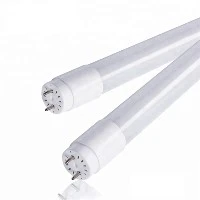
Comprehensive Performance Comparison: T8 LED Tubes vs. Traditional T8 Fluorescent Tubes
1. Energy Efficiency Comparison: Why Do LED Tubes Save Over 60% Energy?
The difference in energy efficiency is particularly significant. Traditional T8 fluorescent tubes typically achieve only 50‑70 lm/W, while high‑quality T8 LED tubes can steadily achieve over 90 lm/W luminous efficacy, with some premium products exceeding 120 lm/W.
Fundamental difference in energy‑saving principles: Traditional T8 fluorescent tubes use a ballast to excite mercury vapor to produce ultraviolet light, which is then converted into visible light by phosphor powder. About 60% of the electrical energy is lost as heat during this process. In contrast, LED tubes use semiconductor light‑emitting technology that directly converts electrical energy into light, achieving high electro‑optical conversion efficiency and eliminating the need for a ballast, further reducing energy loss. Research from the University of Michigan shows that LED lighting can achieve up to 44% efficiency improvement compared to T8 fluorescent tubes.
This means that at the same brightness, the power consumption of a T8 LED tube is only about 50%‑67% of that of a fluorescent tube. For example, an 18‑20W T8 LED tube can replace a traditional 36‑40W T8 fluorescent tube to meet the same lighting requirements, delivering significant long‑term electricity savings for users.
| Comparison Dimension | T8 LED Tube | T8 Fluorescent Tube |
|---|---|---|
| Lamp power | 14‑24W | 36‑40W (including ballast losses) |
| Luminous efficacy (lm/W) | 90‑150+ | 50‑70 |
| Actual power consumption | LED only | Tube + ballast dual losses |
| Line loss | ≤0.4W | 0.5W |
| Power factor (PF) | ≥0.9 (can exceed 0.97) | 0.4‑0.7 |
| Energy consumption for same brightness | About 50%‑67% of fluorescent | Baseline |
Data source: Comprehensive test data

2. Lifespan Comparison: From "Replace Every Few Years" to "No Replacement for a Decade"
In terms of lifespan, T8 LED tubes show an absolute advantage. Traditional T8 fluorescent tubes have an average lifespan of about 8,000‑12,000 hours, and are significantly affected by frequent switching and voltage fluctuations, showing brightness depreciation and blackening of the tube walls after just 1‑2 years. Frequent switching (e.g., in restrooms, storage rooms) significantly shortens the life of fluorescent tubes.
In contrast, T8 LED tubes use semiconductor light‑emitting principles, have no filament structure, contain no mercury, and have a service life exceeding 50,000 hours, with some high‑quality products reaching 80,000 hours. Based on 8 hours of daily use, this translates to a lifespan of up to 27 years, greatly reducing replacement frequency and maintenance costs. In practice, LED tubes maintain 80% of rated life in high‑temperature environments (e.g., 50°C workshops), while fluorescent tubes under the same conditions see their lifespan shortened to about 3,000 hours.
| Comparison Dimension | T8 LED Tube | T8 Fluorescent Tube |
|---|---|---|
| Average lifespan | 30,000‑80,000+ hours | 8,000‑12,000 hours |
| Lifespan multiple | 3‑10 times that of fluorescent | Baseline |
| Effect of frequent switching | No effect | Significantly shortens life |
| High‑temperature (50°C) performance | Maintains 80% of rated life | Lifespan drops to ~3,000 hours |
| Years of use at 8h/day | 10‑27 years | ~3‑4 years |
| Maintenance cost | Almost none | Frequent replacement, high cost |
Data source: Comprehensive manufacturer data and test reports
3. Light Quality Comparison: Color Fidelity and Visual Comfort
In terms of light quality, T8 LED tubes also excel. They reach rated brightness instantly upon startup, requiring no warm‑up time as fluorescent tubes do. T8 LED tubes typically have a Color Rendering Index (CRI/Ra) above 80, with some products reaching 90 or higher, producing light that is closer to natural light, accurately rendering true colors, and reducing visual fatigue. In low‑temperature environments, LED tube performance is unaffected, while fluorescent tubes start slowly and lose brightness.
The flicker problem common to fluorescent tubes (about 50‑100Hz, hard to see but harmful to eyes) is completely solved with LED tubes. High‑quality LED tubes have a flicker depth of ≤3.2%, achieving a "flicker‑free" rating, making them less likely to cause eye strain during long hours of office work or reading. LED tubes also emit almost no UV or IR radiation, reducing the risk of fading for sensitive materials such as artwork and fabrics.
| Comparison Dimension | T8 LED Tube | T8 Fluorescent Tube |
|---|---|---|
| Startup speed | Instantaneous rated brightness | Requires warm‑up time |
| Low‑temperature startup | No performance loss | Slow start, brightness drop |
| Color Rendering Index (CRI/Ra) | 80‑95+ | 60‑80 |
| Flicker | Flicker‑free (flicker depth ≤3.2%) | Flicker present (approx. 50‑100Hz) |
| UV/IR radiation | Almost none | Present |
| Color temperature tunability | 3000K‑6500K multiple options + tunable | Mostly fixed color temperature |
| Unified Glare Rating (UGR) | ≤16 (with anti‑glare design) | 19‑22 |
Data source: Comprehensive industry standards and product parameters
4. Environmental Protection and Safety Comparison: From "Mercury Pollution" to "Green Lighting"
Traditional T8 fluorescent tubes contain mercury vapor. If a tube breaks, mercury is released into the environment, contaminating soil and water and endangering human health. Moreover, discarded fluorescent tubes must be treated as hazardous waste, increasing environmental costs and safety risks.
T8 LED tubes contain no mercury or other harmful substances. They are safe and environmentally friendly after disposal, aligning with green and sustainable development trends. At the same time, LED tubes generate less heat due to their semiconductor light‑emitting principle, reducing safety hazards caused by high temperatures. They also feature high vibration resistance and impact resistance, making them less likely to break.
| Comparison Dimension | T8 LED Tube | T8 Fluorescent Tube |
|---|---|---|
| Mercury content | Mercury‑free | Contains mercury |
| UV/IR radiation | None | Present |
| Heat generation | Low | High |
| Vibration resistance | High, impact‑resistant | Fragile |
| Environmental friendliness | Green, recyclable | Requires special disposal |
| Operational safety | Safe, low temperature, low voltage | Unsafe, high temperature, high voltage |
5. Installation and Compatibility Comparison: From "Complex Rewiring" to "Plug‑and‑Play"
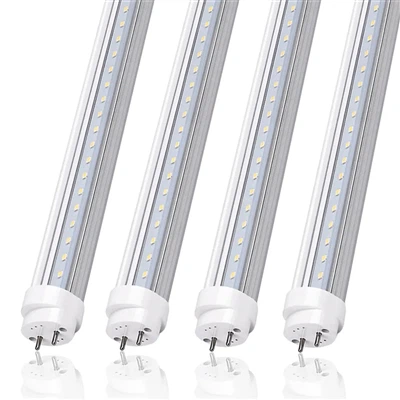
In terms of installation, T8 LED tubes offer flexible compatibility options. Traditional fluorescent tubes require a ballast, and the ballast itself is a common point of failure, increasing maintenance needs and replacement costs.
Modern T8 LED tubes typically offer three installation modes:
- Type A (plug‑and‑play): Directly replaces fluorescent tubes, compatible with existing ballasts.
- Type B (direct wire): Bypasses the ballast and connects directly to the mains, eliminating the ballast as a failure point.
- Type A+B (hybrid): Compatible with both modes, offering the greatest adaptability.
LED tubes have a wide operating voltage range (AC85‑265V) and are unaffected by voltage fluctuations, while fluorescent tubes require relatively stable voltage. Regarding power factor, LED tubes typically have PF ≥0.9 (meeting China's Level 1 energy efficiency standard), providing higher electrical energy utilization, reducing interference with the power grid, and lowering total energy costs.
| Comparison Dimension | T8 LED Tube | T8 Fluorescent Tube |
|---|---|---|
| Ballast requirement | Optional (Type A/B/A+B) | Mandatory |
| Voltage range | AC85‑265V wide range | 220V single voltage |
| Starting device | Not required | Requires starter / electronic ballast |
| Installation difficulty | Easy, direct replacement | Complex, requires ballast matching |
| Failure points | Tube only | Tube + ballast dual failure possibilities |
| Power loss | Low | High (approx. 3‑4W ballast loss) |
6. Selection Recommendations and Overall Conclusion
Key specifications for choosing T8 LED tubes:
| Application Scenario | Recommended Power | Recommended CCT | Recommended CRI | Installation Advice |
|---|---|---|---|---|
| Office / Classroom | 18W | 4000‑5000K | ≥80 | Anti‑glare design, low UGR |
| Factory / Warehouse | 18‑22W | 5000‑6500K | ≥80 | High luminous flux, wide voltage tolerance |
| Retail / Store | 18W | 3000‑4000K | ≥90 | High CRI, true color rendering |
| Home / Residential | 9‑18W | 3000‑4000K | ≥80 | Flicker‑free, soft and comfortable |
| Parking garage | 16‑22W | 5000‑6500K | ≥80 | Suitable for low temperatures, withstands frequent switching |
Overall advantages summary:
T8 LED tubes comprehensively outperform traditional T8 fluorescent tubes in core performance aspects such as energy saving, lifespan, light quality, environmental friendliness, and installation convenience. They are an ideal choice for modern lighting upgrades.
- Significant energy savings: At the same brightness, power consumption is about 50%‑67% of fluorescent tubes, saving 65‑90 kWh per tube per year (based on 8 hours/day).
- Ultra‑long lifespan: 3‑10 times longer than fluorescent tubes, greatly reducing replacement frequency and maintenance costs.
- Excellent light quality: High CRI (Ra≥80), flicker‑free, instant start, true color rendering.
- Environmentally safe: Mercury‑free, no UV radiation, meeting green development requirements.
- Flexible installation: Supports Type A/B/A+B installation modes, directly replacing existing fixtures.
Although the upfront cost of T8 LED tubes is generally higher than that of traditional fluorescent tubes, considering their advantages in energy saving, long life, and low maintenance, the total cost of ownership over the long term is significantly lower. In today's pursuit of low‑carbon, environmentally friendly, and smart lighting, T8 LED tubes are undoubtedly the smartest choice for modern lighting upgrades.