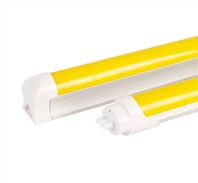
LED tubes are becoming an essential component of contemporary illumination systems due to the global trend towards energy-efficient lighting. However, the ease of retrofitting and design compatibility with current fluorescent lights are key factors in their broad use. For LED tubes to operate safely and effectively in legacy systems, mechanical, electrical, and thermal considerations must be carefully taken into account, in contrast to standard fluorescent tubes. With a focus on housing design advances that bridge the gap between old and new technology, this paper examines the technical problems and solutions for retrofitting LED tubes into older fixtures.
Recognising the Difficulties of Retrofitting
Fluorescent Infrastructure's Legacy
Fluorescent T8 or T12 lights are still used in more than 70% of commercial buildings globally. Up to 50–60% more energy can be saved by retrofitting them with LED tubes, although there are particular challenges with historical systems:
Mechanical mismatches include variations in end-cap design, tube diameter, or length.
Electrical incompatibility: LED drivers could not work with fluorescent ballasts.
Thermal constraints: LED lifespan may be shortened by enclosed fixtures made for fluorescent tubes that retain heat.
Important Retrofitting Strategies
Direct Wire Ballast-Bypass: Take off the ballast and connect the LEDs straight to the line voltage.
Use pre-existing ballasts (such as instant-start or programmed-start) if they are ballast-compatible.
Dual-mode tubes that function with or without ballasts are known as hybrid systems.
To guarantee performance and safety, each strategy calls for certain housing modifications.
Compatibility of Mechanical Designs
Standardisation of Dimensions
For LED tubes to fit into existing sockets and reflectors, their physical dimensions must match those of their fluorescent counterparts:
The most popular ones are T8 (1-inch diameter) and T5 (5/8-inch diameter).
Tolerances for length are crucial: To prevent misalignment, a 4-foot LED tube has to be 48 ± 0.5 inches in length.
Innovations in End-Cap Design
Bi-pin (G13) or single-pin (FA8) bases are used in fluorescent lighting. LED housings include:
Rotatable end caps: These enable tubes to lock into either non-shunted (parallel) or shunted (series-wired) gravestones.
Universal bases: Both G13 and G5 bases are compatible with patented designs such as Philips' "UltraFit."
In older fixtures, spring-loaded pins can be used to compensate for tombstone wear (Figure 1).
Mechanisms of Mounting
Retention clips: To fasten LED tubes in high-vibration situations, swap out the fluorescent rotating locks.
In fixtures that are difficult to reach, magnetic mounts allow for tool-free installation.
Ballast-Bypass Retrofitting for Safety and Electrical Compatibility
LED housings must be integrated into direct-wire installations:
Built-in drivers: Usually found in the tube's end segments, these small, UL-listed drivers take the role of ballasts.
Designs that are polarity-agnostic: Avoid mistakes in reverse wiring.
Metal-oxide varistors (MOVs) provide surge protection by preventing voltage spikes.
Systems Dependent on Ballast
Housings for LED tubes that are compatible with ballast must withstand:
High voltage spikes: During ignition, electronic ballasts have the capacity to produce 600–1,000V.
Variations in frequency: instant-start ballasts oscillate between 20 and 60 kHz.
Arc-resistant polymers such as polyphthalamide (PPA) and double-insulated housings are examples of solutions.
Certifications for Safety
UL Type A/B/C: Type C (external driver), Type B (ballast-bypass), and Type A (ballast-dependent).
IP Ratings: IP65 for moist areas and IP20 for dry ones.
Controlling Heat in Restricted Areas
Capturing Heat in Closed Fixtures
LED junction temperatures (Tj) can rise beyond 85°C due to the frequent absence of ventilation in fluorescent lamps. Overheating shortens lifetime by 50% and lowers lumen output by 10% to 15%.
Solutions for Housing Design
Vented end caps: Provide passive ventilation while maintaining IP ratings.
Thermally conductive polymers: Compared to ordinary plastics, Polyamide 66 (PA66) with 40% mineral fillers disperse heat three times more quickly.
Modular heat sinks: In hot conditions, detachable aluminium fins attach to housings (Figure 2).
Case Study: Retrofitting Troffers with Drop Ceilings
LED tubes were used to retrofit 1,000 enclosed troffers at a hospital in the United States. The remedy:
Material: Aluminium housing that has been extruded and has longitudinal grooves (surface area +25%).
As a result, Tj reached L70 > 60,000 hours and stabilised at 75°C.
Adherence to Regulations and Codes
Energy Code and NEC Requirements
Grounding is required for retrofit kits in suspended fixtures under NEC 410.130.
California's Title 24 requires commercial retrofits to have a high CRI (>90) and be dimmable.
DLC Accreditation
Priorities for the DesignLights Consortium (DLC) include:
Maintenance of lumens: ≥ 95% after 25,000 hours.
To prevent grid interference, keep THD below 20%.
For housings with integrated drivers to satisfy DLC's ambient temperature requirement of 25°C, thermal testing is required.
Developments in IoT Integration and Smart Tubes for Universal Retrofit Design
Case Studies: Implementing Retrofitting
Case 1: Redesigning Warehouse Lighting
5,000 T8 fluorescent bulbs were swapped out with ballast-bypass LEDs at a logistics centre:
Problem: A combination of electrical and magnetic ballasts was present in the fixtures.
Dual-mode drivers with universal G13 end caps (auto-sensing line voltage) are the solution.
Result: 62% energy savings; 1.8-year return on investment.
Case 2: Preservation of Historic Structures
A theatre from the 1920s updated its chandeliers without changing the original sockets:
Housing: Aluminium tubes with a slim profile and frosted glass covers in the manner of Edison.
Result: 70% less energy was used while maintaining aesthetics.
Upcoming Patterns and Difficulties
New Guidelines
Standardises LED tube interfaces for plug-and-play substitutes (Zhaga Book 25).
LightingEurope's ReVolt: Encourages circular economy reversible retrofit kits.
Technical Difficulties
Harmonic distortion: Building power quality may be affected by poorly built drivers.
Advanced PWM drivers that work with older phase-cut dimmers are necessary to prevent flicker in dimmed systems.
AI-Powered Personalisation
By optimising housing shape for certain fittings, generative design technologies like as Autodesk Fusion 360 minimise the need for trial-and-error prototyping.
The keystones of the LED lighting revolution are retrofitting and design compatibility. Manufacturers may guarantee smooth switches from fluorescent to LED systems by tackling mechanical, electrical, and thermal issues with creative housing design. Future LED tubes will probably place a higher priority on modularity, universal fit, and circular design principles as smart technologies and sustainability revolutionise the industry. This will turn retrofitting from a technical necessity into a competitive advantage.