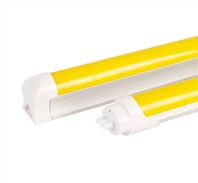
Did you know that having lights that can be dimmed offers more advantages than just a seamless transition from bright to dim? Making your lights even more energy-efficient is one of the biggest benefits of including this feature in your lighting system! Compared to previous light fixtures, LED lights currently use 10 times less power. Since you use less energy when it's only 50% bright, the efficiency rate increases even more if you include a dimmer! It's a great feature to have because you don't always need really bright lighting.
In addition, your fitting's longevity exceeds its specified life expectancy because your lights aren't constantly 100% bright. As a result, not only are your power costs going down, but your maintenance expenses are also going down!
The concern now is, can you use any dimmers with your LED lights if you wish to utilize a dimmer? Is a specific dimmer required for LED lights?
Can I use any dimmer with my LED lights?
Regretfully, not every kind of dimmer can work with your LEDs. Therefore, before connecting your lights, find out what kind of wall dimmer you have in your house if it has been there for a long time. Your dimmer may be a state-of-the-art dimmer designed for incandescent and halogen light bulbs. Only LED-ready or trailing-edge dimmers are compatible with LED bulbs.
What is the difference between a leading-edge dimmer and a trailing-edge dimmer?
Although there are many other kinds of dimmers, leading-edge and trailing-edge dimmers are the two that are much more common. What distinguishes them?
Compared to trailing-edge dimmers, leading-edge dimmers are more well-known. They have been in use for a longer time and are used to dim conventional incandescent and halogen light bulbs. LED lights are less likely to function with this dimmer since it spans a wider wattage range (between 200W and 1000W), yet it is still feasible provided the tolerance is satisfied.
On the other hand, dimmers that are trailing-edge or LED ready are made primarily to work with LED lights. It is the cause of their shared traits, such as digital makeup and wattage range. These dimmers are perfect for low-power LEDs since they require a substantially lower wattage. Once more, if the wattage tolerance is fulfilled, you can use a trailing-edge dimmer with an incandescent light.
Simply verify the compatibility of your bulbs to make things easy for you. The majority of manufacturers make sure their bulbs work with a variety of dimmer switches. On their websites, you may easily view the findings.
What do you need to consider before setting up your dimming system?
One of the most fulfilling things in the world is turning down the lights as you unwind after a demanding workday! Here are some things you should think about to make sure your setup won't have any glitches.
Check if your light bulbs are dimmable
The first item on the list is to make sure the light bulb you intend to purchase is dimmable. A dimmable bulb will function properly even if your circuit is not dimmable, but a non-dimmable bulb will not work with a dimmable circuit; instead, you will have a flickering light that is not dimmable. You can find out this information on the supplier's website or on the bulb's packaging.
Examine your present dimmer
As previously stated, leading-edge dimmers work best with incandescent and halogen bulbs, while trailing-edge dimmers work best with LED lights. You may determine your dimmer switch's compatibility by looking at its kind and minimum/maximum load range.
Know how many bulbs your dimmer can hold
To discover how many bulbs are suitable for your dimmer, divide the minimum and maximum load by ten. Then add the wattages of your LED bulbs to know how many may be connected up with the dimmer. Do take note that the total wattage of the LED bulbs must surpass the estimated minimum wattage of the dimmer.
Get a professional's help
Seek expert assistance if you're truly struggling to comprehend the proper lighting configuration for your dimmer system. Asking them directly is preferable to speculating. It will assist you in avoiding squandering your money on incompatible parts. Speak with your provider; they are better able to determine which goods will work best together. They can also suggest the most effective dimming system configuration for you!
Are all LED lights suitable for dimming?
Unfortunately, not every LED light can be dimmed. Dimmable and non-dimmable LED bulbs have distinct parts. Therefore, it is impossible to get a non-dimmable LED bulb to function in a dimmable circuit just by plugging it in. It will only result in severely damaged electrics and countless frustrations.
However, if you reverse it, this is not true. It's OK to use a dimmable lightbulb with a non-dimmable circuit. Your lights won't just go off, and your electricity won't be damaged.
Why are my LED lights not dimming properly or flickering?
There are three most likely reasons why your LED lights are not dimming properly, however there could be others.
Under loading the dimmer
It's possible that you just switched out your old halogen lamps for LEDs without checking your dimmer. If so, the minimum load requirements for your dimmer will be higher since halogen lamps have a higher wattage count. Because of their intrinsically low wattage count, you might not be able to exceed the required maximum even with several LED lights. The best course of action in this situation is to swap out your dimmer for one that works with your LEDs.
Overloading the dimmer
One of the most frequent causes of flickering lights is this. Because LED bulbs have a relatively low wattage, some individuals think that the number of LED bulbs they are using would not exceed the dimmer's maximum load. However, they fail to perform the necessary calculations. Overloading is detrimental to your entire lighting system, therefore it's imperative that you remember to complete your calculations accurately.
Incompatible bulb and dimmer
Although certain types of lights have recommended dimmers, LEDs are especially susceptible to compatibility issues. It is possible that you will encounter dimmer brands that are incompatible with your LED lights. To find out if your dimmer is suitable, look at the technical characteristics of the lightbulb. If not, you will be completely disappointed and will have wasted your money.