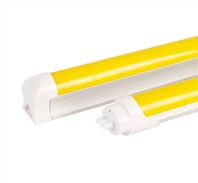
LED batten lights are becoming increasingly popular due to their energy efficiency, durability and long lifetimes. They are commonly used in commercial settings such as offices, warehouses and industrial buildings. But a question that often arises is whether LED batten lights require a starter like traditional fluorescent batten lights?
The answer is no. LED batten lights do not require a starter as they work on a different principle compared to fluorescent lights.
In fluorescent lights, the starter is required to provide a high voltage to start the flow of current through the tube. Once the tube is lit, the starter automatically switches off. However, LED batten lights work on a direct current (DC) and do not require high voltage to start. This means that they can operate without a starter.
In addition to not requiring a starter, LED batten lights have a host of other advantages over fluorescent batten lights. Firstly, they are more energy-efficient. LED lights use 80% less energy compared to fluorescent lights, which can save a considerable amount on energy bills over time. Secondly, they are much more durable and can last up to 10 times longer than fluorescent lights. This means that there is less need for maintenance and replacement, which again saves time and money.
Another significant advantage of LED batten lights is that they produce less heat compared to fluorescent lights. This means that they are not only safer to use but also help reduce air conditioning costs in warm climates.
In terms of installation, LED batten lights are much easier to install compared to fluorescent lights. As they do not require a starter, the wiring is much simpler, and the entire installation process can be completed quickly.
One disadvantage of LED batten lights is that they are initially more expensive compared to fluorescent lights. However, the long-term cost savings and other benefits more than make up for the initial cost.
In conclusion, LED batten lights do not require a starter like fluorescent batten lights. This is because LED lights work on a lower voltage and direct current, making them more energy-efficient, durable, and safer. While they are initially more expensive, the cost savings and other benefits make them a popular choice for commercial lighting applications.