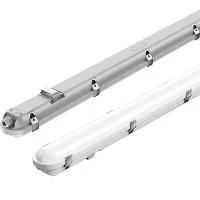
What kind of fixtures do you want to use or have in mind while creating your lighting design? In addition to being reasonably priced, energy-efficient, long-lasting, and environmentally friendly, LED T8 tube lights are increasingly being preferred by consumers due to their exceptional brightness, which no other light type can match!
Unsurprisingly, there are a lot of misunderstandings regarding LED lights because they are always in the news. Among the most prevalent are LED lights that are too pricey, too blue, or not bright enough. Some people are reluctant to switch to a higher-quality ship for these reasons. They get so perplexed and doubtful about it that they are unable to go to a better choice. Here's all you need to know if you're among those who are also curious about whether LED lights become hot.

Do LED lights really not produce heat?
We must first comprehend how LEDs produce light in order to completely appreciate the question's breadth. Diodes, which only allow one direction of electrical current to flow, are used to make LEDs. Thus, the diodes are responsible for both the heat and the light. A diode won't have any waste, which means there won't be any heat, if it can completely convert all of the power that flows through. That isn't physically feasible, though, as the LED light's components have shortcomings. LED tubes do grow heated because of these inefficiencies, which cause the diodes to emit heat.
Before you assume that LEDs are no different from other artificial lights, know that they are far more stylish than incandescent bulbs. As previously said, LED lights have a greater conversion rate than other types, making them more energy-efficient. An LED light that has been on for hours will still allow you to unscrew it, while an incandescent bulb can burn you if you touch it in the same situation! Why is that?
LED lights can turn more power into light with far less heat than halogen and incandescent bulbs. Additionally, LEDs disperse heat into the air rather than building it up, which keeps the bulbs consistently pretty cold.
How warm can LED lights become?
Now that we've established that LED lights do produce some heat let's set how warm they can get. With this, you'll have an idea of what's still normal and when you need to check with your electrician and replace your lights.
A fully lit LED bulb has a heatsink of about 60 °C – 100 °C (140°F-212°F) depending on the construction and model of the bulb, airflow, and room temperature. Usually, the better airflow management, the cooler the bulbs will be. Also, the larger the heat sink, the more efficient your lights can diffuse heat. So, when buying LED bulbs, it's best to look into these features, so you'll know that your lights will indeed last for a long time. With a good airflow management system and a large capacity heat sink, your light will cope well and not overheat even if the room temperature is on the warmer side.

Could you burn your fingers if you touch a lit LED bulb?
If you touch the bulb itself, it won't burn your fingers even if it's lit because the heat is already dissipated from that area. What you need to be wary about is the heat sink! Since it's the basin that collects heat, it's bound to be hot. Anything above 55 °C is already scorching when touched. So, if you happen to test it out and don't pull away fast, it will really burn your finger. Don't let curiosity get the better of you by trying to touch the hot parts of an LED bulb. There's no guarantee that the heat index of a particular LED bulb will be the same as the others, so that you might encounter something hotter!
How hot are other non-LED bulbs?
Although you are aware that LEDs generate a minor amount of heat, what about the other types? What is the difference between them, and how hot can they get?
Incandescent Bulbs
These lamps are born the earliest that's why it's the least energy-efficient and produces so much heat. The actual glowing filament can reach as high as 2500 °C, while the glass surrounding it can go as hot as 200-260 °C (heat from the filament). The reason behind its crazy high temperature is because the tungsten filament will not glow unless it reaches a specific temperature. Also, the primary product of the conversion of this bulb is heat, and light is only secondary. So, more energy goes to heat, and only the residue goes to the light.
Halogen Bulbs
These fittings are a slightly upgraded version of incandescent bulbs but still have the same light production principle. Although they have a better lifespan and brightness, these lamps tend to produce more heat because of the addition of halogen! The filament can go as high as 2500-2700 °C while the glass around it is around 260 °C. Still, if an incandescent bulb covert 5% of electricity to light, halogens can convert up to 10% – 20%.
Compact Fluorescent Bulbs (CFL)
CFLs still generate a lot of heat even though they don't operate on the same light conversion concept as the previous two. They stimulate the electrons to produce energy in the form of photons (light particles) using this kind of fitting. It generates a significant quantity of heat due to the electrons' motion. While only 25% to 30% of energy is converted to light, CFL bulbs may achieve temperatures of up to 80°C. Since incandescent and halogen bulbs produce light by producing a significant quantity of heat, we may conclude that they are the hottest. Therefore, you may anticipate feeling heated even in the evening if you have any of the two at home. It is thus preferable to get an LED light bulb in its place!

Why LEDs Are Still the Best Option for Lighting
LEDs are the best option for both residential and commercial environments because to their unparalleled versatility, which goes beyond their low heat output and energy economy. This is especially important for LED lighting experts who work with clients around the world. In printing industries, where eye protection and accurate colour rendering are essential, LED lights with high CRI (90+) and UGR < 19 provide steady illumination that minimises worker fatigue while maintaining print accuracy. Dimmable LED track lights are useful in retail settings because they draw attention to products without producing excessive heat that could harm them or make customers uncomfortable.
In terms of sustainability, LEDs meet global environmental regulations, which is a crucial selling feature in international trade. LEDs are 100% recyclable and environmentally benign, in contrast to CFLs, which contain mercury, a toxic element that needs specific disposal. For companies that source internationally, their lengthy lifespan (50,000+ hours) also means fewer replacements, which reduces waste and logistics expenses. LEDs' decreased energy consumption compared to incandescents reduces electricity bills by 75% for clients who prioritise cost-effectiveness, providing a quick return on investment that is particularly alluring for large-scale projects like office buildings or stadiums.
Gaining the trust of clients requires dispelling misconceptions about LED performance. Modern LEDs have tunable colour temperatures (2700K–6500K), from warm amber to bright daylight, making them appropriate for any lighting design, although early models were criticised for having chilly blue tones. The worry about not having enough light is also baseless: While remaining efficient, high-lumen LEDs (up to 2000 lumens per bulb) outshine conventional lamps. When combined with information on durability and heat dissipation, highlighting these aspects in technical communications aids clients in making well-informed choices.
LEDs are the most dependable, versatile, and future-proof lighting option available in a market where consumers are influenced by factors like quality, sustainability, and cost effectiveness. LEDs provide on all fronts, whether developing a smart home system or outfitting a commercial facility, demonstrating that they are a long-term investment for international partners in lighting rather than only a fad.