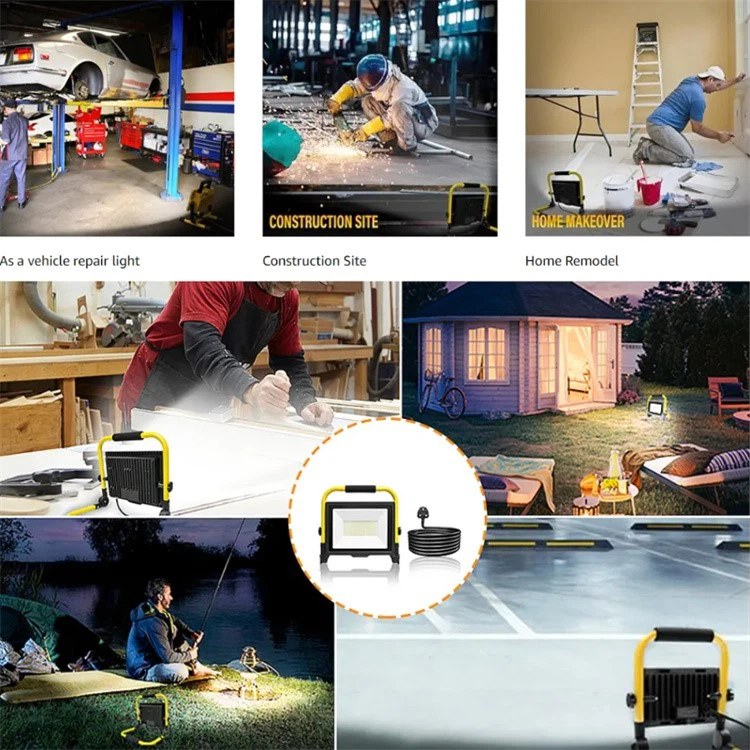
LED portable floodlights have become a game-changer in a time when portable lighting is essential for disaster planning, emergency response, outdoor events, and construction. These gadgets offer powerful light, mobility, and energy efficiency, but their safety features are frequently disregarded. In order to guarantee dependability and avoid risks, enquiries such as "Do LED portable floodlights have overheat protection?" or "Can they alert users about low battery levels?" are essential.
The safety features included in contemporary LED portable floodlights are examined in this 1,500-word guide, with an emphasis on low-battery alarms, overheat prevention, and other measures. We'll go over the functions of these characteristics, their significance, and what to look for when buying or using these lights.
The Significance of Safety Features in Portable Floodlights
LED floodlights are frequently utilised in difficult settings.
places for construction when combustible materials are present.
large-scale outdoor gatherings.
emergency situations, such as natural catastrophes or power shortages.
In these situations, safety lapses may result in:
risks of fire due to overheating.
injuries brought on by unexpected power outages during crucial times.
damage to equipment caused by water exposure or electrical shocks.
These dangers are reduced by safety mechanisms, which guarantee dependable operation while safeguarding people and property.
Overheat Protection: Its Function and Importance
Why Does It Overheat?
Heat is produced by LED floodlights because of:
Significant current is being drawn by high-power LEDs.
extended usage of the brightest setting.
inadequate ventilation in confined areas.
ambient heat, such as that experienced throughout the summer.
In the absence of precautions, overheating can:
intrinsic circuitry damage.
shorten the life of LEDs.
Light any surrounding flammable objects.
Mechanisms for Protecting Against Overheating
These solutions are included into contemporary LED floodlights:
Sensors of Heat
Track the temperature inside in real time.
If a threshold is reached, such as 60°C/140°F, the light will automatically dim or turn off.
Sinks for Heat
LED heat is dispersed using copper or aluminium fins.
Avoid confined "hot spots."
Automatic Dimming of Lights
reduces heat production by gradually dimming the light while preserving some functionality.
Fans for Cooling
Heat dissipation is improved by active airflow systems, which are typical in industrial-grade versions.
For instance, the DEWALT DCL050 floodlight has a thermal cutoff switch that turns the light off if the temperature rises over acceptable bounds and only turns it back on once it has cooled.
Low-Battery Warnings: Avoiding Unexpected Power Outages
Unexpected Battery Drain's Dangers
In dire circumstances, a dead battery can:
Put a stop to building at night.
Emergency personnel should be left in the dark.
Interrupt outdoor activities.
Low-Battery Alert Types
Visual Alerts
LED indicators that flash, such as those that pulse red when the battery is down to 20%.
Runtime remaining is displayed on display panels (common in expensive models like Milwaukee M18).
Alarms that sound
The beeps get louder as the battery runs down.
Intelligent Alerts
Alerts are sent to smartphones or tablets via Bluetooth or WiFi-enabled lights (e.g., Ryobi Link ecosystem).
Slow Dimming
Certain lights automatically lower their brightness in order to prolong their residual runtime.
Example: Based on use patterns, the Goal Zero Yeti 1500X predicts remaining runtime and links with an app to provide push alerts when the battery is low.
Extra Security Features in LED Security Lighting
A. Protection Against Short Circuits and Overload
Issue: Circuits may sustain damage from power surges or defective wiring.
Solution: When there is an electrical malfunction, built-in fuses or resettable circuit breakers turn off electricity.
B. Design that is Dustproof and Waterproof
IP Ratings: Search for IP67 (submersion-proof) or IP65 (dust-tight and water-resistant) ratings.
For instance, the Lumens LS1 floodlight (IP67) is resistant to dusty construction sites and intense rain.
C. Protection Against Surges
protects against erratic power networks or generator-induced voltage spikes.
D. Resistance to Impact
Polycarbonate lenses or rubberised housing offer protection from vibrations and drops.
Certifications and Industry Standards
Reputable producers follow safety certificates like:
UL Certification: Guarantees adherence to electrical safety regulations in the United States.
CE Marking: Denotes adherence to EU environmental and health regulations.
RoHS Compliance: Limits dangerous materials like mercury and lead.
Always check product labels or manufacturer websites for certifications.
Case Study: Protected Systems vs. Safety Failures: An Unsafe Model (Hypothetical)
Absence of overheat protection After two hours of nonstop usage, it overheats and might catch fire.
No warnings of low battery: passes away suddenly while working a night shift in construction.
Milwaukee M18 RedLithium is the protected model.
Overheat protection: To keep temperatures safe, thermal sensors control brightness.
Battery warnings: The Fuel Gauge LED shows how much charge is left.
Impact resistance: Able to withstand fall of more than six feet.
How to Examine Safety Features Prior to Purchase
Examine the product specifications: Search for phrases such as "low-battery warning" or "thermal cutoff."
Read Reviews: People frequently comment on how well safety systems work in the real world.
Request Demos: Stores could show off heat control or alarm systems.
Harmonising Performance and Safety
To increase brightness, some people turn off safety measures (such turning off auto-shutoffs), which is a risky compromise. Safety should always come before immediate convenience.
Upcoming Developments in Safety Technology
AI-Powered Predictive Alerts: Programs that use usage data to predict battery life or overheating hazards.
Self-Cooling Materials: Heat sinks with graphene enhancements for quicker dissipation.
Improved Smart Integration: Lights that send out group app notifications to team members in case of an emergency.
FAQs Regarding the Safety of LED Floodlights
Can my LED floodlight be left to charge overnight?
A: In the event that it has overcharge protection, yes. Once the battery is full, current is stopped by modern chargers.
Is it true that all LED floodlights are waterproof?
A: Look at the IP rating instead. Don't use unrated models outside.
How frequently should safety features be inspected?
A: Every month, especially after rough usage, test thermal reactions and alarms.
The Non-Negotiable Quality of Safety
The dependability of LED portable floodlights depends on their safety features. Low-battery alarms and overheat protection are now required for preventing mishaps, guaranteeing efficiency, and prolonging the life of equipment. When selecting a floodlight, give preference to models that have:
strong thermal control (auto-shutoffs, heat sinks, etc.).
Clearly visible, auditory, or app-based battery warnings.
certifications from other parties (UL, CE, RoHS).
By purchasing lights with these features, customers may rest easy knowing that their teams and projects are shielded from avoidable dangers.
This thorough guide empowers consumers to make educated selections by highlighting the significance of safety in LED portable floodlights. Never skimp on safety, whether you're lighting a backyard party or a dangerous work site.