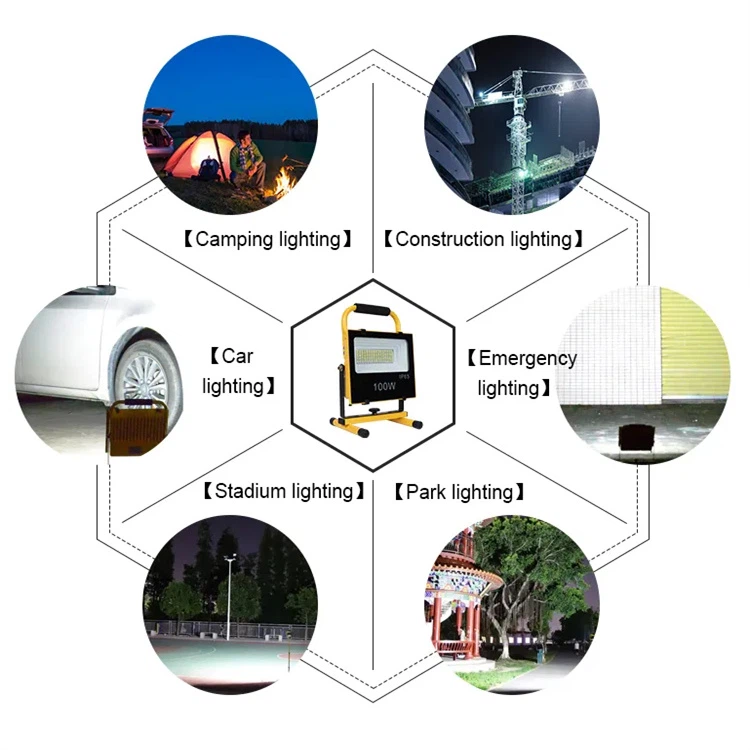
LED portable floodlights, which provide strong illumination in a small, energy-efficient container, have completely changed outdoor and industrial lighting. Battery runtime, or how long the light lasts on a single charge, and recharging time, or how quickly the battery can be recharged, are important factors for consumers and sellers. The usefulness of the light for uses such as building sites, emergency response, outdoor activities, or camping is determined by these criteria. The mechanics, factors, and best practices for maximising battery performance in LED portable floodlights are covered in detail in this tutorial.
The Importance of Battery Runtime and Recharge Time
Portable floodlights are intended for situations in which there is little or no access to a reliable electrical grid. The flexibility of the light to function independently is crucial, whether you're using it to illuminate a construction site at night, put up a stage for an outdoor performance, or respond to a power loss.
The amount of time that tasks may be finished uninterrupted is determined by runtime.
Workflow efficiency is impacted by recharge time, particularly in circumstances where time is of the essence.
Inadequate battery optimisation can result in lost time, higher expenses, and safety hazards.
Users may choose the best model for their requirements and preserve the light's effectiveness over time by being aware of these considerations.
Elements That Affect Battery Runtime
Battery runtime varies on a number of factors and is not a set statistic.
Capacity of Batteries
This shows the amount of energy that the battery can store and is measured in milliampere-hours (mAh) or watt-hours (Wh). The best batteries for short-term usage (e.g., 5–10 hours on medium brightness) are smaller ones, such those with 10,000–20,000 mAh. Larger batteries, such as those with 30,000–50,000+ mAh, are better suited for 15–20 hours of all-night use.
Settings for Brightness
The majority of LED floodlights include programmable brightness settings, such as 30%, 70%, and 100%. Only 3–8 hours of runtime are possible with high brightness settings (20,000–30,000+ lumens), which rapidly deplete the battery. Runtime is much increased at lower settings (5,000–15,000 lumens), frequently exceeding 8–20+ hours.
The temperature of the surroundings
Common in portable lighting, lithium-ion batteries don't work well in extremely hot or cold temperatures. Heat (over 40°C/104°F) speeds up long-term deterioration, while cold temperatures (below 0°C/32°F) can decrease battery performance by up to 30%.
Extra Features
Runtime is shortened by features like built-in fans, motion sensors, and USB connections that use more power.
Common Situations for Battery Runtime
Here are some examples from the actual world to show how these factors interact:
Construction Site Lighting: Perfect for brief shifts needing powerful illumination, a 30,000-lumen floodlight with a 40,000 mAh battery lasts around five hours when operating at full brightness.
Camping or emergency backup: During blackouts, a 10,000-lumen light with a 20,000 mAh battery can run for more than eighteen hours at low brightness (30%), offering dependable all-night illumination.
Hybrid Power Mode: When connected to a generator or outlet, many models enable limitless runtime by allowing simultaneous charging and operation via AC power.
Expectations for Recharging Time
The battery size, charger type, and power source all affect how long it takes to recharge:
AC Wall Charger: A 20,000–50,000 mAh battery requires 4–8 hours to charge normally. USB-C Power Delivery (PD) fast-charging devices may be fully charged in two to three hours.
automobile Charger (12V DC): Depending on the power output of the automobile plug, this usually takes 6 to 10 hours.
Solar Panels: Depending on the panel's power and exposure to sunshine, solar charging can take anywhere from six to twelve hours or longer. For instance, a 20,000 mAh battery may be recharged by a 100W solar panel in around 8 hours of direct sunshine.
Swappable Batteries: High-end versions include detachable batteries that enable you to quickly swap out depleted units for fully charged spares.
Evaluating Well-Known LED Floodlight Types
Three widely used models are broken down below to help put performance numbers in context:
LuxPro LFX-200: With a 30,000 mAh battery, this 20,000-lumen model can operate for up to 12 hours at 50% brightness. It has a tripod mount for stability, an IP65 rating for weather protection, and an AC recharge time of five hours.
DEWALT DCL060: With a 20,000 mAh battery that lasts for eight hours at full brightness, this 3,500-lumen light is made for tough use. It has USB ports for charging devices and offers rapid charging (3 hours via AC).
With a 40,000 mAh battery and 20 hours of uptime at 30% brightness, the Goal Zero Yeti is a solar-compatible powerhouse. With a 100W panel, solar charging takes around 10 hours, and it has a 120V AC outlet for hybrid usage.
Strategies to Increase Battery Efficiency and Life
To maximise your LED floodlight's performance:
Make Strategic Use of Dimming Modes: Use low/medium settings for general lighting and save maximum brightness for important work.
Steer clear of extreme temperatures by using insulated cases in cold weather and keeping the light in a climate-controlled space.
Select Fast-Charging Models: USB-C PD chargers drastically cut down on downtime.
Preserve Battery Health: Replace lithium-ion batteries after around 500 cycles and recharge them before they completely empty, ideally at 20–30% capacity.
Leverage Hybrid Power: To extend battery life, use AC power when it is available.
Upcoming Developments in Battery Technology
Runtime and charging speeds will be enhanced via innovations:
Solid-state batteries have the potential to double duration due to their quicker charging and increased energy density.
Solar Integration: Continuous charging during the day may be made possible by integrated solar panels.
AI Power Management: Depending on ambient light levels or motion detection, smart systems may adjust brightness.
Commonly Asked Questions
Is it possible to recharge my floodlight using a portable power station?
Yes, but make sure that the power station's output matches the voltage that the light needs, such as 12V DC or USB-C.
Why does the runtime of my light get shorter over time?
As lithium-ion batteries are used, they deteriorate. You should anticipate a 20–30% decrease in capacity after two to three years.
Are gas-powered floodlights inferior than LED floodlights?
Indeed! LEDs are less expensive to run over time, quieter, and emit no emissions.
The main components that make an LED portable floodlight usable are its battery runtime and recharge time. Users may guarantee dependable performance in difficult conditions by giving preference to models with large-capacity batteries, fast-charging capabilities, and customisable brightness. Future floodlights will probably be significantly more efficient as battery technology develops, making them essential equipment for both professional and recreational users.
To confirm actual performance, always refer to user reviews and manufacturer specs. An LED portable floodlight may be a long-lasting investment for any lighting demand if it is used strategically and maintained properly.