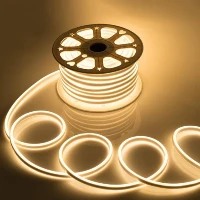
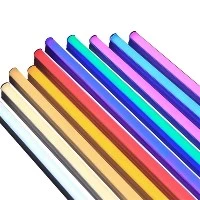
Do You Really Understand LED Lighting? Choose the right LED, save money, and protect your eyes
1. Colour Temperature: Would You Like to Feel "Alert" or "Relaxed"? – Don't Be Fooled By the Numbers
1.1 3000K vs 6000K More then just yellow vs white
The low colour temperature (2700‑3000K) produces a warm light that stimulates the production of melatonin – ideal for bedrooms, dining rooms and hospital wards. High colour temperature (5000‑6500K) is cool and helps keep you alert – great for offices, kitchens and operating rooms. Mixing them creates visual chaos and can lead to unexplained irritation.
1.2 Use one colour temperature in the same space
Unless you have a smart tunable-white system, you'll have a "two-face" living room if you mix 3000K downlights with 6000K LED strips. A good rule of thumb is to keep the colour temperature difference within 1000K for the whole room.
One sentence: Bedrooms → 2700-3000K, living rooms → 4000K, kitchens/studies → 5000-6000K.

2. Color Rendering Index (CRI): Your Eyes Can Tell Ra80 from Ra95 in One Second
2.1 Low Ra makes reds look grey and skin look pale
Under a standard LED (Ra80), a red apple looks like plastic, and a face looks tired and dull. High‑CRI (Ra≥90) or even full‑spectrum (Ra≥97) restores true colours – especially important for museums, clothing stores, and hospitals.
2.2 Don't look only at Ra – check R9 (saturated red) as well
Many lamps claim Ra90 but have an R9 of only 20. Poor red rendering ruins the whole experience. A quality full‑spectrum LED requires R9≥90.
Real‑world experience comparison for different CRI levels
| CRI level | Typical Ra | R9 value | Red appearance | Skin tone appearance | Best for |
|---|---|---|---|---|---|
| Standard LED | 80‑85 | 5‑20 | Dull, orangeish | Pale / waxy | Garages, corridors |
| High‑CRI LED | 90‑93 | 50‑70 | Fairly vivid | Natural | Offices, schools |
| Full‑spectrum LED | 95‑98 | ≥90 | Bright & true | Rosy & healthy | Hospitals, museums, high‑end homes |
| Sunlight | 100 | 100 | Perfect | Perfect |
Bottom line: For general home use, choose Ra≥90. For colour‑critical applications, go straight to full spectrum (Ra≥97 + R9≥90).
3. Efficacy & Lifetime: Saving Energy and Durability Can Go Together
3.1 Higher efficacy means less energy, but don't chase the highest number blindly
Mainstream LEDs deliver 120‑150 lm/W; high‑efficacy ones can reach 180+ lm/W. But ultra‑high efficacy often comes at the cost of CRI (Ra may drop below 80). A balanced choice: 130‑150 lm/W + Ra≥90 for home use.
3.2 Lifetime depends on heat dissipation and driver quality
The LED chip itself can last over 50,000 hours, but poor heat sinking causes faster lumen depreciation and driver failure. When choosing a luminaire, touch the heat sink – aluminium is better than plastic, and deeper fins mean better cooling.
Practical tip: Reputable brands often specify "L70 ≥ 50,000h" – meaning brightness will not fall below 70% of its initial value after 50,000 hours of use.

4. Anti-Glare & Flicker: The Silent Killers
4.1 The lower the UGR value, the more comfortable your eyes
UGR (Unified Glare Rating) is a measure of discomfort glare. Offices can get away with UGR <= 19 but hospitals/classrooms should be aiming for <=16 and the best products are <=10. The simplest test: if you look directly at the light and you want to squint or look away, the UGR is too high.
4.2 Flicker can cause headache and eye strain
Point your phone camera to a lit LED. Bad flicker is when you see stripes rolling on the screen. Quality LED drivers are designed with "flicker-free constant-current" with flicker depth <1%.
One sentence summary: Ask two questions when you buy a light, "What's the UGR?" and "Do you have a flicker report?" and you will filter out 80% of bad products.
Want to get the right high‑CRI, long‑life, flicker‑free LEDs for your project?
We offer free spectral testing, IES reports, and selection consulting. Feel free to reach out!