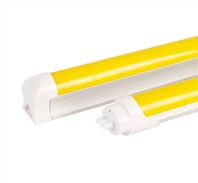
There is more to emergency lights than a straightforward escape sign over a door. It is an advanced technology designed to supply vital lighting in the event that the primary power source fails. Emergency lighting plays a vital role in providing illumination. People would have a far harder time evacuating during catastrophes without it.
The approach takes into account a number of variables, including typical occupancy and building architecture. Because of this, emergency lighting is a crucial part of a building's safety infrastructure and needs to be carefully planned and implemented.
Emergency Lighting System Types
There are various kinds of emergency lighting, each designed to meet particular requirements and situations:
Lighting for Escape Routes: This kind of lighting is essential for safely directing people to the closest exit. To guarantee a clear route to safety, lights are positioned thoughtfully along doorways, stairwells, and hallways.
Standby lighting is intended to keep things running normally in the event of a power outage. Work and other crucial tasks may continue with the least amount of interruption thanks to standby lighting.
Open Area Lighting: In large locations like assembly halls and lobbies, open area lighting helps reduce confusion and anxiety by illuminating wider spaces. It guarantees that people can go through these areas securely.
Lighting for High-Risk Task Areas: This is utilized in locations where hazardous work is done. To improve visibility and lower the chance of accidents, more lighting is installed.
Every kind of emergency lighting is essential for protecting building inhabitants. When combined, they create a system that handles several emergency situational elements. This emphasizes how crucial a carefully considered design is.
Increased Efficiency and Safety
The fundamental safety requirements are set by building codes, however exceeding them can significantly improve occupant safety. A carefully thought-out emergency lighting design guarantees that people are aware of exits and are accurately led through hazardous situations.
To guarantee safety, you need to take into account a number of things, such as:
visibility in places with smoke.
light's psychological affects on people who are panicking.
the particular requirements of the disabled and elderly.
By taking these factors into account, emergency lighting can be designed to create a secure atmosphere in case of an emergency.
Benefits of Energy Efficiency
Modern emergency lighting systems provide notable energy saving gains.
These systems use a lot less power than conventional lighting solutions since they use contemporary technology like LED lighting. LEDs are renowned for using less energy. They lower energy waste and increase your electricity bill savings.
They also have longer lifespans, which reduces the need for maintenance and replacements. This effectiveness is consistent with the decrease of environmental impact and green construction standards.
Increased Dependability
Redundancy and state-of-the-art technologies are frequently incorporated into systems built to beyond standard regulations in order to guarantee reliable operation in challenging circumstances. This includes characteristics like automatic switchover systems, two power sources, and sturdy construction that can handle environmental conditions. When lighting systems are most needed in an emergency, reliability is crucial.
These systems can provide exceptional reliability by employing cutting-edge technology and design techniques, guaranteeing that they operate at their best when needed most. Building managers and residents can rest easy knowing that the building is dependable. This is a result of the lighting system's readiness for unforeseen circumstances.
Advanced Techniques for Design
By using sophisticated design techniques, you can achieve better lighting results. Depending on your demands, this one is emergency lighting.
Photometric Scheduling
Careful photometric planning is the first step in the science of emergency lighting. This entails figuring out how much light is precisely required in different parts of a building. These computations aid in guaranteeing both safety and adherence to rules.
Sophisticated software tools can model various situations, taking into consideration elements like building layout, inhabitant mobility, and any obstructions. Designers can construct systems that offer the best visibility and safety by strategically placing and intensifying lights.
This design minimizes glare and energy use while guaranteeing that lighting is efficient in directing occupants.
Temperature of Color and Distribution of Light
For efficient emergency lighting, selecting the right color temperature and making sure that the light is distributed evenly are essential. Clarity and visibility are maintained with the help of a constant color temperature, which is particularly crucial in high-stress scenarios.
Uniform light dispersion avoids glare or dark areas. This lessens confusion and discomfort. Choosing lighting fixtures and combinations carefully aids designers in creating the ideal setting. They can guarantee that the emergency lighting is efficient while also making a room comfortable and useful.
Integration of Systems
The integration of contemporary emergency lighting systems with other building systems, like security and fire alarms, is growing.
Through this connection, automated emergency responses are made possible, such as the activation of particular lighting sequences or the provision of visual cues to direct inhabitants to safety. Building managers can guarantee a coordinated response that improves efficiency and safety by smoothly integrating these systems. Centralized monitoring and control are made possible by this method. Use basic maintenance to make sure systems are operating as intended.
Management of Power and Batteries
An essential part of emergency lighting systems' design is making sure they have dependable power sources. To make sure they are prepared for usage when needed, batteries need to be inspected and maintained on a regular basis. In order to ensure uninterrupted operation in the event of a power outage, systems should also be built with backup power sources, such as generators or supplementary battery banks.
These redundancies give building occupants a dependable safety net by guaranteeing that the lighting system continues to function even in the face of difficult circumstances.
Contemporary Emergency Lighting Technologies
Over the past 50 years, emergency lighting in the UK has undergone tremendous change. There have been significant changes in efficiency, safety regulations, and technology.
LED Technology
With its many benefits, LED technology has completely changed the emergency lighting industry. LEDs are a great option for emergency lighting applications because of their low energy consumption, long lifespans, and durability.
They come in a variety of shapes and sizes to accommodate a range of architectural and practical needs, and they offer brilliant, steady illumination. Because of their versatility, LEDs enable designers to produce unique solutions that satisfy particular requirements while preserving dependability and energy efficiency.
Intelligent Technology and Remote Surveillance
Emergency lighting systems can now be monitored and controlled with new capabilities thanks to smart technology.
Because these systems are remotely manageable, their performance and status may be tracked in real time. This guarantees that any flaws or problems can be found and fixed. This preserves the integrity of the system.
It is possible to program smart lighting systems to adjust to shifting circumstances. To increase their efficacy and efficiency, for instance, light levels can be changed according to occupancy or environmental conditions.
System Self-Diagnosis
Self-diagnostic systems offer an automated way to check if emergency lighting is functioning properly. These systems lessen the need for manual inspections by routinely checking for flaws and reporting any failures.
Because of this automation, the system is always operational. You get greater piece of mind and dependability from it. Building managers can optimize maintenance procedures and guarantee that the emergency lighting system is always operating at its best by implementing self-diagnostic features.
Improved Safety Features
Beyond the bare minimum, advanced emergency lighting systems provide improved safety features. Adaptive lighting, motion sensors, and integrated alarms are a few examples of these features. These features improve the system's capacity to safeguard residents, making it an invaluable component of any building's security framework.
Long-Term Advantages and Financial Factors
Advanced emergency lighting systems may need a larger initial expenditure, but over time, they can result in significant cost savings. The longer lifespans of parts like LEDs, fewer maintenance costs, and decreased energy use all contribute to these savings.
Building owners benefit from improved safety and dependability as well as a lower total cost of ownership thanks to advanced technologies.
Any building's unique requirements can be accommodated by customizing contemporary emergency lighting systems. This guarantees both the best possible performance and appearance. Because of this customization, designers are able to think about and solve certain problems.
They have to develop solutions that are both practical and visually beautiful, taking into account architectural limitations and particular safety regulations. Advanced systems offer a flexible and adaptive approach to emergency illumination through customizable designs.


https://www.benweilight.com/emergency-led-panel-light/led-flat-emergency-panel-light-20w.html
Our address
No. 5-3 Niujiao Road, Yanchuan Community, Yanluo Street, Bao'an District, Shenzhen
Phone Number
+86 18659785153
bwzm04@ledbenweilighting.com