Essential Lighting Terminology: A Comprehensive Guide
The lighting industry utilizes a specialized vocabulary that can be challenging for both consumers and professionals. This guide provides clear explanations of fundamental lighting terms, helping you make informed decisions whether you're selecting residential lighting or planning commercial installations.
Electrical Fundamentals
Volts (V)
Voltage represents the electrical potential difference that pushes current through a circuit. Think of it as water pressure in a plumbing system - higher pressure (voltage) enables water (current) to flow more forcefully. In North America, standard household voltage is 120V, while many other countries use 220-240V systems. Understanding your local voltage is crucial when selecting lighting fixtures to ensure compatibility and safety.
Watts (W)
Watts measure electrical power consumption - the rate at which a device uses energy. Historically, consumers associated higher wattage with brighter lighting, but this correlation doesn't apply to modern LED technology. Today, watts primarily indicate operating cost rather than light output. For example, a traditional 60-watt incandescent bulb and a 10-watt LED can produce similar brightness, but the LED consumes approximately 80% less energy.
Light Quality Metrics
Lumens (lm)
Lumens quantify the total visible light emitted by a source - the true measure of brightness. Unlike watts, which measure energy consumption, lumens directly indicate light output. The higher the lumen rating, the brighter the light appears to human eyes. As a reference point, a traditional 60-watt incandescent bulb produces approximately 800 lumens, while a 100-watt bulb generates around 1600 lumens.
Luminous Efficacy (lm/W)
This crucial metric represents efficiency - how effectively a light source converts electrical power into visible light. Calculated as lumens per watt, higher values indicate better efficiency. Modern LEDs typically achieve 80-150 lm/W, while traditional incandescent bulbs manage only 10-17 lm/W. This measurement helps consumers compare the energy efficiency of different lighting technologies.
Color Temperature (CCT)
Measured in Kelvins (K), Correlated Color Temperature describes the visual warmth or coolness of white light. The scale ranges from:
Warm White (2000K-3000K): Creates a cozy, intimate atmosphere similar to sunset or incandescent lighting
Natural White (3500K-4500K): Provides neutral, balanced illumination ideal for workspaces
Cool White (5000K-6500K): Offers crisp, energizing light comparable to daylight
Lower Kelvin values produce warmer (yellower) light, while higher values create cooler (bluer) light.
Color Rendering Index (CRI)
CRI measures a light source's ability to reveal objects' true colors compared to natural sunlight. Rated on a scale of 0-100, higher CRI values indicate better color accuracy. For most applications, seek CRI 80+; for retail, art, or medical environments, CRI 90+ provides superior color discrimination.
Product Specifications
Lamp Fittings/Bases
The fitting (or base) constitutes the physical interface between a lamp and its socket, ensuring electrical connection and mechanical support. Common types include:
Bayonet (B22): Push-and-twist connection common in Commonwealth countries
Edison Screw (E26/E27): Standard screw-base for North America (E26) and Europe (E27)
GU10: Twist-lock bi-pin base for directional lighting
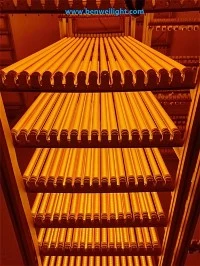
G13: Two-pin base standard for T8/T12 fluorescent tubes
G5: Miniature two-pin base for T5 fluorescent tubes
Always verify fixture compatibility before purchasing replacement lamps.
Lifespan and Maintenance
Rated Life Hours
Manufacturers calculate lamp lifespan differently across technologies:
Incandescent: Determined when 50% of test samples fail (B50 method)
LED: Based on lumen maintenance - typically the point (L70) when output declines to 70% of initial lumens
While LED products may claim 25,000-50,000 hour lifespans, actual longevity depends on operating conditions, particularly thermal management.
Lumen Maintenance
This specification indicates how well a light source maintains its initial brightness over time. Expressed as a percentage of original lumens after a specific duration (e.g., L90 @ 10,000 hours), it helps predict when lighting will require replacement due to insufficient brightness rather than complete failure.
Advanced Technical Concepts
Power Factor (PF)
Power factor measures how effectively electrical power converts to useful work, ranging from 0 to 1. Higher PF values (≥0.9) indicate better efficiency and reduced strain on electrical systems. Commercial installations often benefit from high-power-factor lighting to minimize energy waste.
IP (Ingress Protection) Rating
The IP code classifies environmental protection levels using the format IPXY:
First digit (X): Solid particle protection (0-6)
Second digit (Y): Moisture protection (0-8)
For example, IP65 indicates dust-tight construction with protection against water jets, making it suitable for outdoor or industrial applications.
Beam Angle
Particularly relevant for directional lighting, beam angle determines light spread. Narrow beams (≤30°) create focused accent lighting, while wide beams (≥60°) provide general illumination. Consider both beam angle and application when selecting fixtures for specific tasks.
Implementation Considerations
When planning lighting systems:
Prioritize lumens over watts for brightness assessment
Match color temperature to application requirements
Verify physical and electrical compatibility
Consider long-term performance metrics beyond initial cost
Evaluate environmental conditions for appropriate IP ratings
This terminology foundation enables more effective communication with lighting professionals and ensures informed decision-making for both residential and commercial projects. As lighting technology continues to evolve, understanding these core concepts will help you navigate new developments and optimize your lighting investments.