What does a UV lamp really do?
Unseen by the human sight, ultraviolet radiation is a kind of light energy that is emitted by a UV flashlight. Certain items have the ability to fluoresce, a phenomena that resembles a strong glow, when ultraviolet light strikes them. Many materials, including paints, dyes, minerals, living creatures, and bodily fluids, glow, making it necessary to shine a UV light source on them in order to identify their existence.
A UV flashlight has the same format and structure as a typical white light flashlight, but it produces ultraviolet light instead of white light. Almost all UV torches are equipped with LED technology.
Should I get a UV lamp for my use?
Although UV illumination has many different uses, UV lamps are often the most practical when mobility and usability are crucial. Although UV flashlights often don't produce enough UV light to cause any physical or chemical processes (like curing), they do produce enough UV light to see fluorescence effects.
Here are some uses for UV lamps as examples:
forensic analysis and counterfeit detection
Gemstone and mineral observation
looking for stains from other bodily fluids or pet urine
looking for bugs and reptiles
Which UV flashlight should I use, and why?
Without looking at the specs, it might be difficult to determine which UV flashlights would be suitable for your specific use case given the wide variety of UV flashlights available in terms of kind and quality. See what to watch out for below:
Identify the proper wavelength. In reality, the word "UV light" refers to a broad spectrum of UV wavelengths. UV light's wavelength, which is measured in nanometers, is used to define it along a spectrum, much way visible light is (nm). It is crucial to know the wavelength (measured in nanometers, or nm) of any UV light before searching for it.
Why is wavelength such a crucial factor? In order for a UV light to be effective, fluorescence must be induced. By choosing the incorrect UV wavelength, you run the risk of failing to achieve the desired fluorescence effects. Not all UV wavelengths have the capacity to do so.
Although different materials and objects may have different optimum wavelengths, most fluorescence is brightest at wavelengths about 360 nm. Because of this, it's critical that you get a UV flashlight with a wavelength at or close to 365 nm; otherwise, the UV radiation it produces may not be useful for creating the fluorescent glow you want.
Higher wavelength LEDs are simpler and more affordable to produce because to advances in LED production. Therefore, 405 nm (borderline visible violet light) and 415 nm (visible violet light) LEDs are often utilized as "ultraviolet" LEDs. Be cautious if a vendor or manufacturer doesn't specify the wavelength since they can be employing a violet or purple LED instead of a real UV light source.
395 nm is a typical wavelength choice. When we adopt the definition of 400 nm to describe UV, then technically speaking, they are UV LEDs. However, due to their proximity to the 400 nm cut-off, these LEDs continue to produce a large portion of their energy as violet light. As a consequence, without enough lower-wavelength UV light to trigger fluorescence, many items will be lighted in a dull violet hue.
Does it provide sufficient power? If there isn't enough UV light, even the right wavelength may be worthless. To put it another way, you must guarantee both quantity (a good wavelength) and quality.
However, how can you determine how much UV radiation is being released? Unfortunately, since this is a difficult criterion, few products include it. Due of UV's invisibility, it is not possible to use the lumens meter to express brightness, unlike white flashlights. Although it is possible to measure UV light, most manufacturers do not give much information, thus this may not be very useful when looking for UV torches.
The amount of UV light that a UV flashlight can produce is often determined by two design factors. The first is the power use, which is typically measured in watts. While bigger flashlights may operate at 3W or more, most smaller flashlights will operate at 1W or less. Don't be deceived by the number of LEDs; just because there are more LEDs does not indicate that there are more LEDs, per se. The amount of power used is what counts; one LED operating at 3 watts has more power than three LEDs operating at 0.5 watts each.
Efficiency of LEDs is the second factor. Different LEDs do not convert electrical energy to UV light energy at the same rates, and this may have a significant impact on how much UV light energy is eventually released. Even a high power UV flashlight may not really be providing much usable UV light output if it has a poor efficiency LED. Although it is difficult to assess UV LED efficiency, in general, keep an eye out for less costly UV flashlights since LED chips are often the most expensive part of a flashlight and poor efficiency numbers are frequently the consequence of cheap or overdriven LED chips.
Its power source. Disposable AA or AAA batteries may be used to power a lot of UV flashlights. If, for instance, you just use it for a few minutes at a time to check for pet pee, this is often the most affordable and practical solution. What if you anticipate more intensive or prolonged use? You may want to think about using a rechargeable device.
The most popular battery type is a rechargeable lithium ion battery known as the 18650. A single 18650 battery may store up to 2500 mAh (at 3.6V) or more, which is around 3–4 disposable AA batteries. You may reduce the expense of long-term batteries by using a rechargeable battery pack. Numerous UV torches also include a USB or comparable connector for charging rechargeable batteries.
There are two types of 18650 batteries: protected and unprotected. An integrated circuit in a protected 18650 cell prevents the battery from overheating, exploding, or leaking. A home burning down or a person being hurt might depend on whether or not a battery explodes due to a lack of circuit protection, even if shielded batteries do cost a little more.

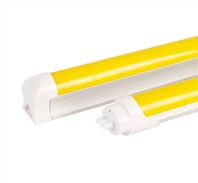
Benwei UV 120cm led tube light Product Specification:
|
Item |
UV led light tube bulb T8 |
|
Input Volt |
AC85-265V |
|
Power |
10W,18W,24W |
|
Length |
60cm/2ft, 120cm/4ft, 150cm/5ft |
|
Bean Angle |
120°, 180° |
|
Lifespan |
50000 hrs |
|
Wavelength |
365nm 395nm 254nm 280nm |
|
Warranty |
3-5 years |