Flood lights are directional fixtures manufactured with a variety of beam spreads and projection distances. Flood lights have a wide beam spread, or beam angle, which measures the spread of light (width of beam) from a reflected light source. A wide beam spread means that light comes from a smaller angle which creates a light that will become more diffused further away. So as light moves away from a reflected light source, it spreads out and becomes less intense. Flood lights most often have beam spreads of more than 45 degrees and up to 120 degrees. Particularly with flood lights, it’s imperative to look at the mounting angles when discussing light patterns.
Flood lights utilize NEMA Beam Spreads (different than IESNA Light Distribution Patterns) and since most flood lights utilize adjustable angle mounting, the mounting angle affects how those NEMA Beam Spreads project light at a surface. WARNING – Technical information incoming! A NEMA light distribution is indicated by two numbers that correspond to the horizontal and vertical light spread of a fixture and indicates the two planes of light where the intensity is at least 10% of the maximum light intensity of the fixture.
The ideal NEMA light distribution for your project is determined by the distances between where the light is mounted and the area being illuminated. A wider beam works best for closer distances and a narrower beam is best for longer distances. Flood Lights, and by association NEMA Bead spreads, are intended to provide focused illuminations in smaller areas, compared to even illumination across larger areas.
NEMA's classification system describes distribution of light within the beam produced by the fixture:
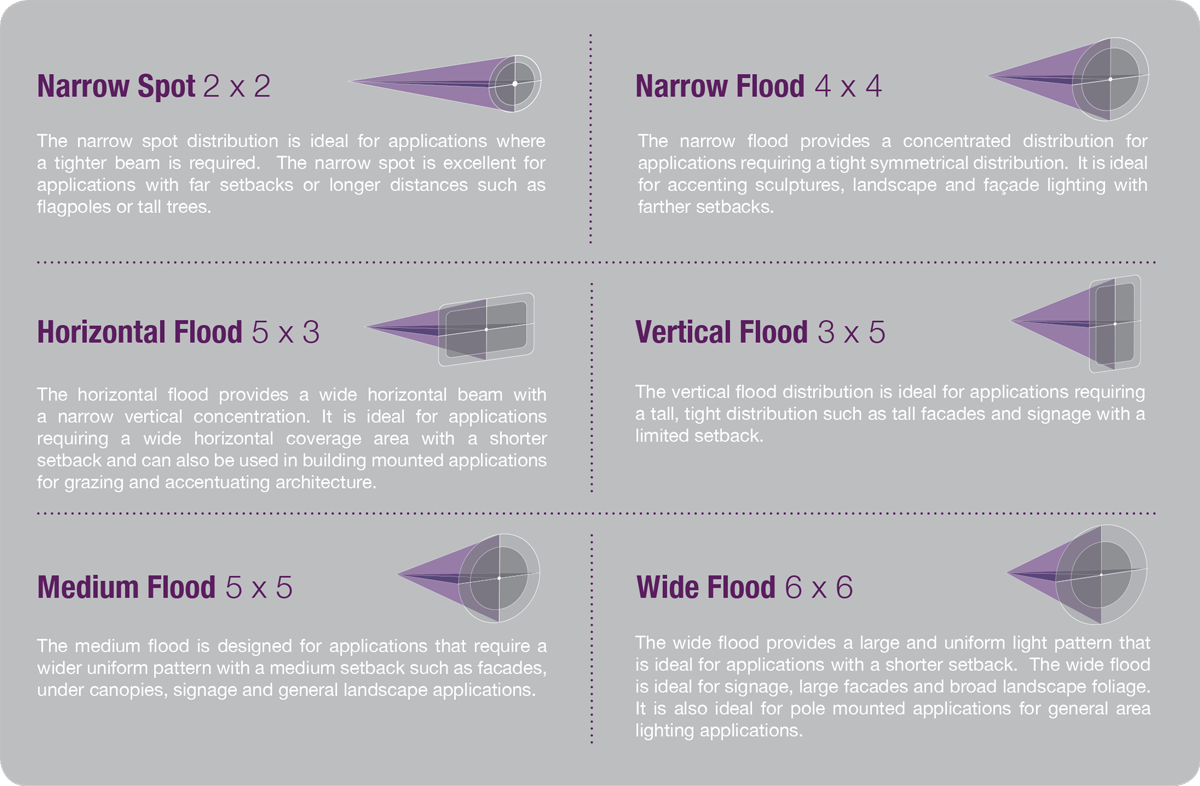
Flood Lights, and by association NEMA Bead spreads, are intended to provide focused illuminations in smaller areas, compared to even illumination across larger areas. Determining the ideal beam angle for your fixture means you must know the distance where the light will be mounted and the area being illuminated. By using the appropriate NEMA classification type, you can get the right type of light distribution for your project.