Introduction
A lot more money is taken with a pen than with a pistol every year. Since personal computers, scanners, and color copiers now have the capacity to perfectly copy paper money, a large portion of fraud is caused via counterfeiting. Governments and companies lose billions of dollars each year due to counterfeit money. Only in the 1997 fiscal year did a total of $136,205,241 in fake US dollars surface globally.
This application shows how a basic fluorescence equipment can be used to confirm a bill's authenticity by looking for the security thread and the bill's background fluorescence. It is possible to examine the aging and repeatability of money manufacture using this fluorescence intensity.
The Canadian dollar is the second-most-falsified currency in the world, followed closely by the US dollar. These currencies are well-liked because they are considered "hard" money, equivalent to gold. Numerous fake banknotes of various denominations are sent to unwary businesses and financial institutions. Only big bills, such the $100 and $50 bills, were counterfeited in the past. However, several companies have recently reported receiving counterfeit $5, $10, and $20 notes, with the $20 note being used the most often.
Ultraviolet (UV) light is used to detect counterfeits, which is one of the most popular methods. The basic premise is that if a bill has fluorescence, it is authentic. The reasoning behind this is that real currency is printed on paper with a high starch content, which makes it appear dull when exposed to UV light. Bond paper that has been bleached and has almost no starch is typically used by counterfeiters. Under UV light, the bleached bond paper fluoresces.
Since around 1976, UV detection of fake money has been in use and has shown to be somewhat successful. Recently, a security thread, a new security precaution, was put in place to stop counterfeiters from passing off a lower value note as a higher denomination one. A security thread is a fine ribbon or thread that passes through a banknote. The new $50 note has micro-printing, images, and printing, continuing the common theme in U.S. money.
When held up to an ultraviolet light, the thread in the new notes illuminates. It will glow pink on the $100 bill and yellow on the $50 bill. Additionally, it may be seen in light that is transmitted but not in light that is reflected.
With a professional color copier, it is difficult to replicate cash due to these security threads. With each denomination beginning with the $100 note having a different thread location, it is impossible to use counterfeiting methods like bleaching ink off a lower denomination and using the paper to "reprint" the bill as a higher denomination.
Conclusion
Simple fluorescence instrumentation can be used to evaluate the authenticity of U.S. currency. Using a fluorescence instrument as shown, the signal from the bill and its inherent security thread can be monitored to ensure currency validity and possibly provide a method for the examination of aging of a bill.
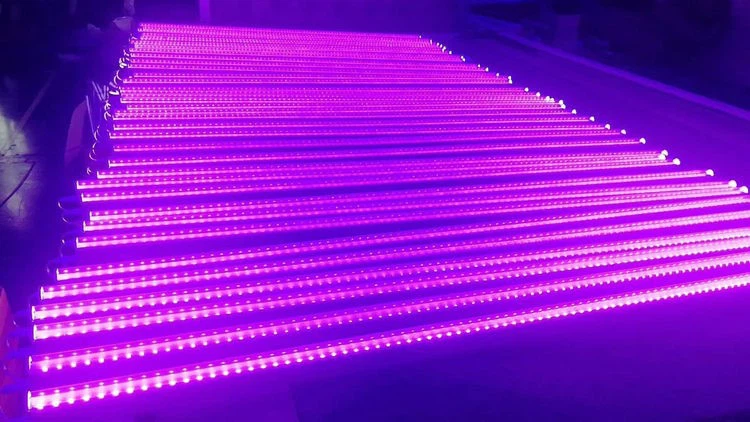
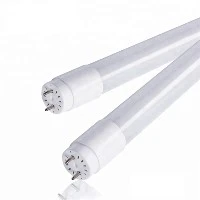
Benwei UV 120cm led tube black light Product Specification:
|
Item |
UV led light tube bulb T8 |
|
Input Volt |
AC85-265V |
|
Power |
10W,18W,24W |
|
Length |
60cm/2ft, 120cm/4ft, 150cm/5ft |
|
Bean Angle |
120°, 180° |
|
Lifespan |
50000 hrs |
|
Wavelength |
365nm 395nm 254nm 280nm |
|
Warranty |
3-5 years |